
Extra content pops up along the way.
Trailheads
Good places to start walking.Chapters
June 7, 2025
The Internet is Serious Business
Double-tap the sides to skip 15 seconds
Trailheads
Places to startArtwork explorations
The other takes the image generator gave us, and the prompts behind each piece.
Chapters
Settings
The Internet is Serious Business
With Kris Tyte & Sean Snodgrass
In this insightful and candid episode of Positive Pedestrian, the hosts welcome Corey Meyer, who shares his experiences on platforms such as Bluesky, Reddit, and X. He discusses his journey through an internet suspension and explores topics ranging from social media stories and the psychology of trolling to the "dead internet" theory. This episode is filled with humor, valuable insights, and philosophical significance, making it a must-listen for anyone questioning the purpose of our online activities.
Share
Detour
Episode description
In this insightful and candid episode of Positive Pedestrian, the hosts welcome Corey Meyer, who shares his experiences on platforms such as Bluesky, Reddit, and X. He discusses his journey through an internet suspension and explores topics ranging from social media stories and the psychology of trolling to the "dead internet" theory. This episode is filled with humor, valuable insights, and philosophical significance, making it a must-listen for anyone questioning the purpose of our online activities.
Chapters
Show notes

Episode Art 12 pieces
Full Transcript
If there's an artisanal thing, or if there's a way that a human can be involved in the refinement or development or creation thereof. Let's do that. Because I do not want to you. I don't want to lose that spark, that human element. You know, if that human element, spark has a value, it will protect itself. Like, none of this requires oversight or anything.
Like at the end of the day, if something is valuable and there is a demand for it, it will stick around. That's how market economy works. The only time that doesn't stick around is what do you have a planned economy which does not work? Right, right. It's just what it comes in that just see what happens. And people are freaking out about like ATMs at the turn of the previous century, putting bankers out of business.
And now there's more bankers than ever. Right. I don't I'm just not buying into all this type of like, oh, this is going to take away job. Super freaking out about the internal combustion engine. People were freaking out about computers, all this stuff. It's just, you know, we've been we've been doing this for centuries. I just I just don't want to buy into it.
And I just want to take a higher level view. Like, we've been here before many times. And there's more humans than there were. Yeah. And they all still the majority of them have gainful employment. Yeah, absolutely. Absolutely. Over the last 5 or 10 years, I think the futurists and technologists mostly have moved more in the direction of like this.
There is kind of this automation takeover, but they're not. That doesn't mean that's what the future is. It's just like how people are trying to predict it. And in this really high speed tech economy, kind of what I've seen is everyone that tries to make predictions gets it wrong. There's a huge information problem and I hate I know, I know, I, you know, technology futurist good guy.
But like if you come out with an article saying humans are going to be replaced by robots in ten years, that's going to get a lot of clicks. One that says, you know, I think we're going to be okay. I don't know how many people are going to click on that article. So I paid to put it that way.
But, you know, maybe they can get us into the end of this. We can officially start. Yeah, the official start. So it's like, 2016. And then I basically been using computers since, like, you know, the early 90s that just kind of like how I grew up. My dad was in it, so. And me all along. You know.
Right. Exactly. Yeah. Yeah. Yeah. Right. Right. Right, right. We just kind of attract each other because, well, when you grow up around technology and usually you have a certain way of thinking, a certain analytical way of thinking, and I think you're just good at singing through the bullshit. Right? That a lot of people just like to talk about.
Well, you have this insistence that you're layers, right? Like we just have a naturally attracted to the right. This is to an end, you know, coin A to point B, so never really thought much about much of it, about how much I was using technology or social media until around 2016. I just remember it was kind of pretty, aggressive online environment, if you can say that about what's going on on the screen.
Right. There's not actually any aggression or danger there. It's just a screen at the end of the day. But it's you can make that argument. I think that was a pretty good time for it. And I remember it. My wife saw something I posted and she didn't like it, and that was my penalty. I said, why do I care about it?
I did all my social media accounts and I was often for eight years. Okay. And it's easy to talk about what you don't do, right? Oh, I don't drink. I don't do this. I don't do that. I don't know if there's much value in that. And what you don't do. Right. There was even like big like atheist organizations, right.
People who don't have a religion. Like, how is that something to celebrate? Right. So more about what you do. Do what you don't leave calling about the atheist side endlessly agreeing there, but there's nothing actually there. It's just like, okay, but what are you. Right. So, you know, during that time I, you know, started reading more books. My wife and I didn't have internet service at our house for a year.
Wow. Bravo. This was before Covid, you know, and yeah, we didn't have internet service. We put our, like, TV stashed away in the garage, read books, went outside. Daddy, I started doing, like, mindfulness and meditation. Like, really got into it. And then, you know, something like Covid happened, you know, work from home. So we, you know, we got the internet back.
I mean, had to make a live manual list, right? You know, when you remove yourself from that long, you could find really simple ways to kind of keep yourself from doing the stuff you don't want to be doing. At the end of the day, it's a tool, right? Any tool can be used for good or bad. Sure, in between time ways.
So, you know, there's comes down to their sites. You go to their sites you don't go to. You can regulate that on your own. Or there's like internet plugins. Yes, they can kind of do that for you. There's like distraction freed YouTube log in where it doesn't show you suggestions or play the next video automatically. You know, YouTube's a very useful resource if you want to learn how to fix your car right, you go refund the video on how to fix that part.
You follow it and then you're done. We're home. How to find yes, exactly how to's like all these things can be used for you that way. Many, many times. Yeah, exactly. Yeah. And that's a good way to do it. So I mean, I was really just on this train for eight years and I don't know, you know, 20, 24, you know, there's kind of, you know, even like I kept hearing people talking about it.
I'm like, all right, I gotta see what's going on. I'm, you know, calling me curious. So woohoo! Oh my goodness. So that was probably an absolute intellectual onslaught. It was like I decided, well, and I was listening to like Joe Rogan talking about like how easy it was to get banned for blue Sky. Oh, shit. Okay. So I said, you know what?
I'm going to create a fake account on blue Sky, see how fast I can get banned. And that was kind of like the startup. So competition. Yeah. Yeah. So the username. Good be. You're not even allowed to make one. Oh. So, you know, so passionately. It took me two weeks to get banned from blue Sky. Although I will say I was not hardcore trolling.
I could have got banned a lot sooner, but I was trying to use all factual base arguments. Okay, in the midst of if you even questioned one little thing, you know, one of their favorite people says you're you're racist, use of a racist and a rapist and, you know, a German World War Two party member, just like he's like, there's your quest was to get banned by just using facts.
Yeah. To see if I could do. Okay. So you're right. It gets two after two weeks. I was being gory. I like your constraints. I will only get banned by using truth as a cudgel. Yes, absolutely. So, like, you know, but it was kind of I kind of came up with my own term. There's a lot of micro censorship on there and that like 90% of people, if you disagree with what they say, they'll ban you right away so that you can't see their posts and they can't see yours.
Just dumb. They continue their own echo chamber of competition, right? Right. The filter bubble. They want to keep it clean and pristine and then like 8% will respond by insulting you. Oh, wow. And then if you say hey, instead of insulting me, could you maybe address one of my points? Then they'll probably just banned you, you know, after eight days.
They'd be like 2% will actually try to argue. But then at some point, like to many people see that this thread is going on and join in and just, you know, every single one will report you for being like a troll, even if you're using facts. And then after about two weeks of that, you get enough reports that you get banned so you can get voted off the island really, without doing anything wrong, without doing anything wrong.
So there's the Achilles heel of these federated services, though shorter, decentralized. But there, you know, it ends up they end up being microcosms of, you know, an echo chambers that really dog food the hell out of these ideas and a shoe. Any opposition. Yeah. Yeah. There's absolutely no room for discourse or argument. It's just that just doesn't seem to be what it's for.
Like, I don't know what their mission statement is, but if it's, you know, discourse or, you know, honest, intellectual. If not, I also got back on to probably the worst site in the history of the internet rat. Chris, you would agree with that. Reddit has gotten to the point where if you post on conservative subs, if you have a post on there and then you post to one of the main subs, they'll ban your account immediately for having posts on one of those other ones.
No, and it's like I tried to point this out to some people on Reddit and they were like, there's no way that's not true. And then I would post like a screenshot of where I got banned for posting on that side. And they would say, well, I don't want to talk to idiots anyways. And then they would, then they would ban me from talking to them.
And just like that, there's just no objective truth whatsoever. People just want to see what they want to see. Oh, they don't want it. They don't want to have their arguments challenge whatsoever, their ideas, even so, almost like you're creating your own little safe space for themselves in that chamber, but a place where my values are predicted. There you go.
Yeah, and not only that, but it's like the shorter the post and the more emotion put into it and the less facts about it gets. Upvoted. Like you are an idiot gets up voted way more than like a whole paragraph telling you why you're because it's easily digestible and it's emotionally impactful. Yeah, right. Let me share a quick story that that ties in that perfectly.
I really one of my really good friends, John on he posted one time about guns like and exactly the same thing. You're talking to us. Why I'm bringing the story ties in so nice. I mean, he went through and fact after factor for a fact like these are the statistics. These are the right and I mean he just like kept his opinions out of it, kept everything out of it.
It's like here's the facts guys. So like objectivity. Here are my sources. Yeah. And you know how sometimes, like, we all make this mistake I think ten times if you're on social media, but we all like go off and we like basically write it essay, you know, like that's what he did. But it was like one of the best written things I've seen in a long time on social media was fantastic.
Somebody came behind him and put a post of that Vietnamese, scene where the where the officer has the gun to the other one's head, he's about to pull the trigger, and then everyone like that and thumbs up to like that was the rebuttal to try to this like factual. It's exactly what you're saying. They dragged it into the mud.
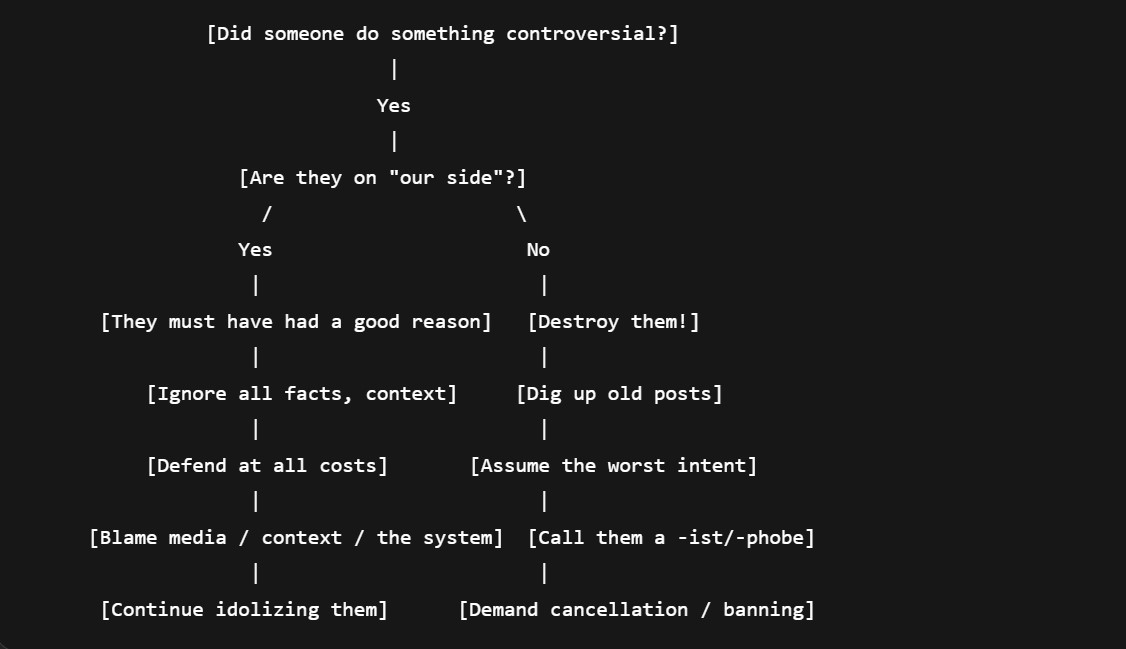
These people just put in this little quips and this nonsense, and it gets upvoted and they get crowded. It's 100% tribe was I didn't solve this horrible was them? Yeah. There's the word I would suck was tongue in cheek, flowchart that basically said, like, someone did something bad. Are they with us? Yes. It's okay. Are they with us?
No. Destroy that. That's just what it is like. The tribalism is that bad? There is absolutely no objectivity whatsoever. If you agree with someone or. Or even like if you think they agree with you on everything. And a lot of times people just think that other people agree with them on everything, but then they'll let go against like the narrative of what they're supposed.
And like, just like what I thought he was with me. This is a chain I cannot like. It's like their computer in their head just exploded. Yeah. Because they can't comprehend that this person that they idolize doesn't agree with them 100% on everything. Yeah. You know, and I can totally picture that flow chart like you do some espionage, you break into one of these corporate media or mainstream media places, then they have that exact flow chart.
Yeah. And it's like, you know, it's in the day one orientation, the folder. Right. So what we're doing on this podcast now is we have this thing called extra content, okay. Where we add content to the each episode for fun. And that's going in the extra content. And so we have to make this, oh, I get a copy of this little chart and so or create it and put it as extra comes in.
This is everything going in there. So yeah that was blue sky in red. I got on X2. And a lot of people, a lot of people went to blue Sky because they thought X was too conservative. Sure, I will say I think X container can form to what you want to see, like I think you get. But the thing is, it highlights the extreme extreme.
So let's say if you're a libertarian person, right? You think okay, the government like a moderate libertarian person, you think the government is too big. It's not going to show you that. It's going to show. Hey, instead of having the TSA, everyone on an airplane should carry a gun. Seriously, that's the type of content that highlights. So like, the crazier the post, the most outlandish the better.
And that's what you see is a representation of this. And so this is my theory on that, is that all of these major platforms, they bring you to the extreme to increase engagement. Yeah. Right. And I mean, I guess we're all probably in agreement on that, that that's the idea. If we can drag you kicking and screaming to the extreme version of your view, you'll become radicalized and more engaged.
Well, I don't know. See, I think it's a chicken and egg thing because it's like if people didn't want to see that, they want to show you. People said, that's terrific. I can't believe someone would say, you know, they should bring a gun on an airplane. I'm not getting on this. But the more you get exposed to that, you start to normalize it in your own mind.
You start to the needle starts to. Yeah. So like if you're a libertarian, as you say, what you're kind of suggesting is that really rapidly you're going to start getting hyper liberal libertarian. The concept to tuning. If you don't question that, though, don't keep a let us head right. If you got into it, if you're, scrolling it, if you're just consuming it, if you're not really like thinking about me gauging it is that we're saying you're pretty.
Okay. So you try to curate your algorithm by engaging with things that are less extreme, then you can move the needle back. Maybe. Yeah, I didn't really try to manipulate my algorithm too much. Like that was probably more time and data than I've been using. The tools that we need if we're going to use these platforms, are these some of the tools that we need, methods of actually tuning our own algorithm.
You just said that big F though, right? Right. Yeah yeah yeah yeah and all. But it is a big if I also got on True social underwhelming honestly because it's kind of like the big accounts, you know, like the owner of the beauty network and maybe like ten other accounts are basically the only content posted. Right? There's like there's not a lot of people posting independent content on there.
So I find that I found this sponsor accounts that bubble up to the For You page. Yeah, yeah, it's mostly followers and major posters, not a lot of independent content, which kind of makes sense because, you know, like one side of the political, back on the spectrum does have a pretty clear leader right now. The other side absolutely does not.
So I think that was kind of, you know, that was kind of indicative. Well, do you feel like it is a closed off, solely owned echo chamber to amplify that side that do I think not? I think
That's a good question. I think right now it's just kind of like a forum for those people to post on it. But who knows what would happen if. And I'm not encouraging people to like, invade it, because honestly, that's like a waste of time. Like if you have that much time and energy, put it towards something. You know, that's actually the only thing I wouldn't.
There's a bot. Well, that comes to another point is how many of these accounts that I interacted with were real people. How many of them were bots? Yes, I know on all the platforms, I was getting DMs constantly from people that I could tell right away were bots. They were all like an attractive female, right? Who? I get a reverse image, search their patron as some like Russian model every single run.
But you know, you'd get like a site from some site that's like acrylic characters, right? So they use like the photo of a Russian model. They try to engage with you, ask you a few questions about yourself, and then they just start talking about, cryptocurrency. Yeah. Like every single time. Probably at least 50 bots that behave in that age dogs app or some third party of they want it.
I'd be like, oh, what about like normal SMS? They'd be like, oh, well, maybe we can get there at some point, but you've got to start out. So you started with that. And yeah, also go to my cryptocurrency trading platform is as I can tell how fast it I'll talk start talking money. I mean I, I don't know I like you know like kind of engaging with scammers.
I'll do a certain point where I could see what they're looking at. You got this side. You have to. Right? I mean this is great at that too. He loves that. He tapped one of my primary for blender came in for the last couple of years delivery. But like, I mean, I'll get light engagement guys, but I don't think I've gotten any kind of engagement with scammers.
You guys have the. It's gone. I did get I did get Chris. It told me, you know, one of his interactions started out with, like, a picture of a wine glass in a lady's hand. I finally got that from a scammer. And and I was like, oh yeah, okay. You as a canteen as well. Oh, she was like, she with the winery in Charlotte.
And I was like, oh, the winery. Yeah. Oh yeah. Okay, I'll be at the winery, I can't wait. I'm ready to put on my nice suit right on there. So, this isn't our podcast is marked explicit, so, like, I can say certain things. Yeah. You're it's so there's a disclaimer, but like, I've tried all different methods with these things.
Like should I talk to them about giving me money as far as their possible. Right. This a meet me at the winery of like, should I bring the toy bag?
Yeah I was the lyrics and everything. Is this a is this a freak off or is this like the normal? Oh, yeah. Yeah. Good. What are we doing this week? And then, I'll say like, what's your name again? And I'll say some name that's really popular. I Google it real quick. A popular name that's popular. Popular Indian name for a male.
Oh, no. Say, who's this again? Is this in an insert? You know, is this insert name here? Yeah. And then you get those weird responses and sometimes it's just gut wrenching, you know, like and and I'll do it like as a live. So like, this is my family. So like I'll be doing this not not with like talking to stuff with the kids, but like, if I'm driving with Sue or something, I'll be, like telling her what I'm doing.
So she, she's feeding me ideas so it becomes this, like, oh, you know, gamified this nonsense. Oh yeah. Yeah. Just different entertainment and educate. Yeah. You know, like like what you did on blue Sky. Yeah. It was a sex acts. That's all there is getting banned in a fortnight with the backs of the goalie backs. So look at the Paradise here okay.
This is hilarious. So me getting like, you know, banned or shut off from a from a Indian scammer by talking about a bag of, you know, porn objects was comparable by the blue sky with facts. Yeah.
Sorry, blue sky. But I'll tell you what, though. I know when all this started, I can pinpoint the exact moment. All right, you ready for this year, 2003? All right. People started noticing. Okay, you know, there's these online forums people are on and people are arguing on them. This is the dumbest thing I've ever seen. And they came out with this.
Mean you guys remember this? The internet is serious business. No, I don't you don't remember that? It was basically like a guy in a suit in front of a computer, and it was like the internet karma that in all caps serious business. The expert basically said, like, why would anyone argue on the internet? Like, this is a stupid form.
We're just duping up. It's not that serious. Why are you being so serious on the internet? I'm gonna say that's some, like old neurons. They have mostly been neural proof that just kind of like, I don't. They didn't fully bring me back. He entered into serious under the vice. I'm gonna find it, though. Didn't answer content. I really think the only thing that changes a dime base right now, the only thing that's changed his adoption.
If we would have been told in 2003 that, like the speaker of the House and like your grandma and mom were going to be on the internet, like engaging with us, we would have been horrified. We would have been like, whoa, whoa, what? No no no no no, that's a huge mistake. We gotta we gotta talk of them.
So if they had said in 1996, there's gonna be heavy engagement and all the societies can be involved in this word of build platforms on top of it, I'll have conducted myself differently. I agree, I agree. And then and then it kind of just leads to like the dead internet theory. Like how many of these accounts are bots, how many actual people are creating content?
And it's like, I'm a little bit grateful that AI came out when it did, because I started to notice that, like, if you were to put something into Google or DuckDuckGo, the results would be so old they'd be from like 2014, 2012, 2010 for like tangled stuff, because no one's creating content anymore, just like we're just done. There's no doubt there's not enough value in it.
And so much of the good content and stuff is so old, and now it's just bots. And it was kind of dead like, I'm such a big believer in the dead internet. There is a concept with that too, that they, AI is being fed with its own, with its own, with its own products, and it's done. So it's kind of like ideas on tail, in a way, and it might actually be one of the early on big hurdles for AI to advance the song content.
It's going to it's going to have the long tail of it's going to affect society because we're so dependent on it. We're suckling at the team of it and then it's dog food. It's getting dumber. We're by extension, you know, get going to get a little dumber, you know. Yeah. So if you sit there and doom scroll social media all day, the net effect on you is your health is going to suffer.
You're not. Well, sure, but I'm saying even if you are trying to use two to learn it, ChatGPT quality is going to be reduced as a dog food. Yes. What I'm saying is the same thing that happens to a human. Perhaps we sit there and get in this kind of feedback loop that just erodes us actually, physically, etc. so.
Right, right. Same thing might be happening and with AI it might be getting in this feedback loop where it's eroding itself. So what it can produce, you have to be intellectually balance. Like even if you have strong held beliefs, you have to understand the other side. Oh that that, that that's a that's a slightly different meme. But that was probably like a sub that was probably a spinoff of the.
This one's.
I know this was just like a suit. The internet serious business. Okay. I might have found isn't it's this one I, I think that's the one that that one too. Yeah. The inner. Yeah. That's the one. Yep. It was just like we just thought that was sort of like he was taking this seriously. This is a stupid activity.
We're just, like, bored. Just got off school for a couple hours. Why are you asking? Well, I don't think. Really. I mean, what's this change? Just like the adoption levels and I guess the algorithms on the platforms. But even before the algorithms, you could just not look at stuff you didn't want to see, right? You know, that could change.
Yeah. Yeah. And, you know, I think I'm, I think we could go back to something we talked about briefly. I think we could use some tools to gain some insight into the algorithm and give ourselves that power back to prune to, to let people realize you don't have to look at you don't want to look at, you know, then don't look at social media.
What's on there? Is there anything even out there that you do want to look at that you couldn't get somewhere else that doesn't have all the other noise? Yeah. So this internet's in this business plan like the the meme and how ridiculous it was for you planted the seed. Is that what you're saying? Like. Oh, yeah. It's like, almost like a trigger.
Like, what the hell? Yeah. Well, it planted the seed of, like, I've almost considered myself a troll since then, and I actually think there is value in online trolling based on that meme alone. If you were on the internet trying to have an argument with someone, you are engaging in a futile exercise. Yeah, there is no point in this whatsoever.
So if someone's just pushing your buttons for the fun of it, I think they're doing you a service and hopefully making you want to get off of it and do something else with your, well, trolling does. It has an effect much like comedy does. Much like stand up comedy, it lets you be objective, like you step back. It lets you sort of see, highlight, lampoon, parody, see the ridiculousness, right?
Yeah, absolutely. Yeah, yeah. You're just making a mockery of the whole exercise, which is a very stupid exercise for trolling ultimately. Is it just, you know, I mean, if you try and real life there's consequences, but online you can be anyone you want to be. You don't know who you're arguing with. Yeah. No, I'd say to a degree that's true.
But then there have been consequences for some of these people that have decided to troll an extreme, like, all right, just an example. And I'm not espousing this or agreeing with it or even offering an opinion on it, but this is an example of consequence. Jasmine Crockett, I have to mention her because it's Jermain to the situation, Democrat.
And, you know, she's, she's black. So ultimately, there have been a lot of people that aren't black that have decided to troll the shit out of her thinking they were going to remain anonymous, and they would do it to the extreme where they would, in essence, threaten her or her staff. So when it would get to a threat point, she would pretty much she'd be like, that's this person's account.
They work for this, they do this, they live here. Boom, you are Doc's bitch. And you know, then they get fired. They get there's all these knock on effects because they think the internet is 1996. You know, the 96 Congress people were not on the internet. That's so pulling you were there was 15 year old computer nerds trolling each other.
Seriously? Right. And that's the that's the slight difference. We can still troll and there's still a high degree of anonymity. But at some point you do something a little out of bounds. If you're trolling and could use a traceable account, you're an idiot. Honestly, you use a fake email, you use a fake name. It's so easy to do it if you're using a real.
Preferably you're using a VPN. The difference is a point, but that is so easy. I could set that up in like three men, all those things in like three minutes. Yes, yes. And maybe you should offer a trolling academy course and make some money.
No, I can't be. I somehow be legally responsible for what someone did. You know, someone would take, you know. Oh, no. They signed up for the course. You're indemnified. It's in the toss. I don't know, but but but then. But then I'm just trying to figure out, like, how much of this online activity. Right? Because I think, you know, especially in 2003, what was going on on that screen was very different from what you did when you stepped out of your mom's base now.
Right, to completely different. Well, you've hit the touch grass and racing. Got your ramen. Where is that? Where is that crossover now? How is that how those two worlds, you know, George Costanza worlds are colliding, right? You know, independent George and relationship. George. Where are those crossing over? I think we can see that some with like, maybe protesters and activists and people supporting, you know, actual acts of violence.
I think that's pretty dangerous. And I also think I think myself in trouble with this. But like the term micro microaggressions is taking, you know, speech a little bit too seriously, equating speech to violence, which I think is an absolute atrocity. You know, they I think way separate. What were you going to say? Sorry. Oh, no. I was still thinking about categories Academy at trolling.
I was I saw my mind is going back. It's a great name burst of all. It's not going to be Corey's a it's going to be a faith name. Well it's easy to be like dicks academy attorney. It's not it's not to be a funny because he's. Hey. Oh, are you all right? And and then it's KAT for the for the initialism CO2 Energizer cat as the the.
How about Mike comes. No. My name is Mike hunt. If I'm starting to say the impact. Well serious. Look Mike Constantine throwing a category. We know that we know that you're like, that kind of puts you in a, in a framework that we can sort of get information about that puts you at a certain Democrat like that, that my cunt like jockeys that that movie Porky's isn't that that originator calls the bar and asked.
Right. Yeah. Another extra content radio and mass audience you got. I watched that movie. Just fun fact about my life. I watched all of those movies with my grandmother. Wow, he's got a cool fan.
Cool. So, this whole idea of, like, this seed was planted back in the day because it, you know, we'll get your story out throughout the course of this podcast, but, just like seed, you were able you had this, like, innate kind of like vision to see through this nonsense, sort of like right away. Yeah. And do you, do you kind of realize that that's pretty unique.
Like, there's not a lot of people that just see it like that. I never say stuff like this. About myself, but I feel like I'm, like, the only adult in the room most of the time, just watching the children, just like, you know, play stupid games with each other. Like it is so crazy how into it these people will get, especially when they're online.
And it's just like, what is the point of this? Like, you have to ask yourself these existential questions about what you're doing all the time. Otherwise you're going to lose track of it and ended up arguing with a bot all day. Oh my. Is there any ethical value here? Right? Yeah. And and, I actually Full Sail agree with that.
I mean, in fact, I teach a, a version of that to my children all the time and constantly repeat it because ethics is something that you train. Yeah. You know, and, and ethics, goes stale like, like if you don't use a language for a while. Everything's if you don't kind of like constantly revisit certain ethical principles till they'll atrophy as well.
So that's not only something that has to be raised up in all these different social circles, family, people who care about in the society at large, but it has to be continuously reinforced, is what I'm saying. And so I constantly remind people of how amounts. This is. Yeah. And we're not just talking about ethics being a muscle that you have to build and train.
We're also talking about objectivity, being able to just step back, being able, you know, and think that's a part of it. Yeah, I think part of it, it's because he's stepped when he saw that original mean. Right. He's like stepping back and see what the hell. Yeah yeah. No it's not serious business. And that's, it's that's the whole point of the me I think is to say whoa.
It's not it's not serious business. Let's rethink this. Let's recontextualize it and say, holy shit. You know, this was this was created as a work, a communication. It was a can we do it DoD project. It was a communication between universities and a bunch of freaking weird nerds that were using, you know, VI to, you know, and terminals and web browser, you know, mosaic and all these crappy and gopher.
I mean, it was just a bunch of dudes who thought information should be free. This was just it was like the beauty of the bod, you know, bastardization came in. And I'll tell you what, that whole free thing, that that was a bad idea. Free was not a good idea. Free never ends well, I think I think it if you paid up the to get on social media, it would solve a lot of the things because it would change their monetary structure to serve a space versus keeping you addicted and making it at bay.
Okay, but it's a bit taboo to charge for things on the internet since the beginning. It's almost too late. Okay, let's say that there is a fee. It's just not direct dollars being spent. Right? There's a there's a tension. There are attention has value. You're dealing with has value. So you're paying a fee. It's just not well yeah I mean the opening of your wallet but you're still paying.
Well you saw that are probably more so than if you were to pay like yeah, a subscription by subscription. Because as we all agree, it's the attention economy that is the currency which greases the wheels and powers the grist mill that is chewing us the money. But at the end of the day, I don't know if you have a if you have a skill and you can provide value to someone that's still going to, you know, that's still I mean, you're you're all you're alternate selling point.
Like there are some people making money off attention, but I don't want to surrender and say like, that's a, you know, that's the major part of the economy. So, I mean, I don't know, I guess what I'm trying to say is the grist mill that's chewing society up is this attention economy. I'm not saying it is a completely and totally the entire economy, but I'm saying it's subsuming a lot of previous ways of making money in a person context.
So in 2025, is the internet serious business? I think there are few that maybe it's a day. It probably is. Look at the it has. I mean, look who we have. The president. I mean, I think it's too bad. I think it's too big of a entity to assess on its own. Now, is the internet serious business? I think some parts of it are, but is social media.
I, I don't know. Well, it's kind of like the, you know, arguing for, you know, your point of view or your emotion is, is all for sale and all nonsense. Right? It's not worth anybody's time for but the actual effect, tangible effects that the preponderance of it has on society is massive. That is like the elephant in the room underneath that.
I'll tell you what I meant. You mentioned the president. I want to touch on that without naming any names, because I think it's led. And here's what I did. Like, I heard all this stuff about, like, you know, the Constitution, right? Does this false or not? So I read the Constitution, I read the Federalist Papers in cursive. But if you haven't done both of those, don't talk about the governor, right?
You don't know what you're talking. Seriously, you have no idea what you're talking. Foundational documentation? Absolutely. And it is as relevant now as it is today. There's an over inference on the executive branch, which is by far the least powerful branch of government. Congress and the Supreme Court had more power than the president than the executive branch does.
But there's no there's very little coverage of it in the media unless it's like related to something the executive branch does. And I'm just like, why is that? But I figured it out in the Federalist Papers. It says the executive branch controls the sword and can take swift and immediate action and acts in secrecy. Well, is it that exciting sound?
It's very exciting, right? They're not just standing in front of a piano like Congress doesn't debating for, you know, months and months to pass a really long bill. No. Slipped in a meeting at action controls the sword, right. That's exciting. It's sexy. It gives half of the country a hero and the other half a scapegoat. And that's where all the focus is on.
I like you, but if you take a step back, if you take a step back, they don't really have much power. The executive, it's not the branch we should have all this focus on. That's just that's just something that I think we kind of lost a little bit. Well, I will say in slight rebuttal to that, that's why the current executive branch is wanting to consolidate and to grab, because all these iOS, all these executive orders are to gain and accrete more power so that they can act swiftly and more situations so that they can cleave things into when they feel the need to do so.
And the Senate and the Congress kind of lining up behind out of fear, right, lining up to do whatever he says. Here's the thing that's and I will not be named. This is already done. This has already been done before. You shall not be named. I'm a name for the names because these people are on debt. Woodrow Wilson and FDR.
The progressives greatly expanded the executive branch far beyond what it ever was supposed to be. Okay. All right. Okay. That's that's where this all started. The 1920s progressive area is the start of all this, though, with this, you know, like very powerful executive branch, the progressives wanted to throw away the Constitution and rely solely on experts, dear cats, to make our decisions for them.
They said, if you're an expert at something, you literally know what's best for everybody and should be able to make people's decisions for them. And we should start all these executive branch departments to pass these laws independent of Congress and this progressive era. I mean, a lot of it still hangs around today. But I don't know. I don't think that's the best way to approach.
I don't think that's the best way. But I think there is a in the reality of today, I can see a hybrid here. So like today, it used to be like the schoolhouse Rock. I am a bail and this is how it gets through our Congress. And you learn how all that happens. But then now what happens is, you know, some corporate entity, powerful corporate entity, talks through their lobbyists to their politician.
Right? And the people that there are people we owe the people that they're. Yeah, the people that they've, you know, enabled. And and then they say, here's the bill we want you to bring to the floor. And that's how read it. Don't question that's how a bill is originated and that originate in the pristine way that they were supposed to through a committee, through intellect.
So the progressive model I think the a team of subject matter experts should be the actual origination of this bill rather than some corporate interests, right to support and then hold on. Then the committee then weighs the different things and, and and edits it multiple times. And that becomes the building as we see the way better way to originate.
Bill, we need for the genesis of these things for policymaking. We need intellectual friction. I agree with that. But I was going to extend that and say with what you were saying, Cory, that ultimately they had given experts over much power. Today, the pendulum has swung the other way. We are speaking of constantly, of the death of the expert, the, you know, and people are constantly avoiding, if not a shoeing, probably another effect of social media as a deputy expert.
Well, in the internet, because people feel like they can become an expert in minutes. Yeah, right. Yeah, I did my research. Yeah. Watch some YouTube videos. Well, I'll have this letter. Just there's cubby outs to that though. So like these experts like a lot of, like the experts in the FDA used to work for pharmaceutical companies. Right. Well, on these experts in the Department of Defense, you still, you know, used to refer to they have a certain worldview, right?
It's used to work for defense counter. If I was saying when we say yes. Exactly. So you know, and that's kind of where it gets middle, but you can have all these ideas like, yes, experts, if you are truly an unbiased expert at something and do know what's best for everybody. Yeah, I guess you should be able to pass this bill, but I don't think that's what we have.
Right? I think it was, you know, a lot of these ideas had great intentions, and the road to hell was built on good intentions. Well, that's what it comes down to. You have good intentions, but we just have a beginning now. And now it's like Dolan really knows what the legality of some of this now, because we've strayed so far from what it specified in the Constitution and the Federalist Papers and like, you know, and another thing, I'm another thing that's kind of like we even have a different episode of this, like the 17th amendment.
I think that was a really bad idea. You know what that is? The direct election of senators who it used to be, they were appointed by the states government, and now there's just a ton of money. Now it's just another basically house. You know, it's just the same thing now. So I just, you know, little things like that kind of eroded the original infrastructure and could be leading to a lot of the issues that we have now.
I'm not saying it's everything, but I think there's something right. I should be I have on many, many episodes of podcasts I've thrown around the turn kleptocracy and, and definitely oligarchy has been thrown around books as well if they apply again in this conversation. Yeah, yeah. And we've shifted to, you know, from oligarchy to the current incarnation of Archy, you know, and, so let's describe real quick that the typical, experience that the average like, everyday American citizen kind of has in their daily life.
But I must contrast it with, if you don't mind, that's a little, you know, asshole is contrasted with you. So like, the way I see and the data clearly is behind this is that every year, every year, year over year, people are spending more and more time scoring on their phones. Yeah, right. Especially now in the TikTok era and the reels and all the shorts and stuff.
In fact, I use my data on my phone to regulate myself. So like I'll look at my usage all the time. Screens them. Yeah, I have well, I just use the I have a and I have a Samsung Galaxy S20 four and that wasn't an ad on this. What I have and and it has really good metrics. Someone has really good metrics on where you spend your time, and you can fine tune that to say count this note, count this.
I don't count any time I spend in my email for like, if you have something, you're driving somewhere, right? That or that is right. I don't count that it's time, but I'm counting is like basically Facebook, TikTok, the things that have scrolling videos that I can get, you know, trapped in skirt on the toilet and then end up sitting on the couch.
You don't don't bring your bum to the bathroom. Yes. But no. So, yeah, that is like kind of a sin. But, to degree, I think a lot of people do do that. But anyway, as I said, do do that. Get it? I do, man, that was a good public.
Yeah I got I got a call now. Anyway, so the typical I actually put this on the podcast too, is that the trend line is that people with younger people you are the more you tend to spend per day on your phone. So and the trend line is like looking very dismal. I just shared a thing. It was all your ten hours or something for these kids.
Oh yeah. I started the thing with Sean recently. If the trend continues, basically all discretionary time will be consumed by this app. The kids that are 18 now at the trend line continues. The statistic that fell out of what he showed was 93% of their lifetime. Free time will be on the screen. It's basically no more free time three times going away.
That's an original childhood, too, because that's essentially a childhood. As you're bored, you know you're going to just get creative and you know, you know, make some mistakes and see what's going on. Right? You're experiment. Find out what you find. Right. Curious. So if I just let Erica know and Miller on vices, right. Especially Erica's, he's the other one.
If I let him do his own vices, he'll get on the computer or the TV and watch dumb my mind numbing videos all day. That's what we'll do. And so I cut him off. I have screen I, I have screen time limits and all these kind of rules and stuff in place because of what we're just saying, because I'm aware of this and, you know, sometimes I'll slip up and like, he ends up doing more than he should.
But anyway, specifically to what you say, as soon as I take him off of that stuff and say, go to your playroom and and find something to do or gloss, I right within 510 minutes, even his brain has converted into the mode that you're talking about, for he's just like exploring, finding something to get into, creating something, inventing something, telling his story, using his imagination.
Yeah. So it's it's not like his brain is like, trapped in digital space, right? His brain, like, just after a short period of time, falls right back into the normal child part of, like, playing, exploring. I mean, there's in your that sort of plasticity and adaptation. We still have to, you know. Yeah. And so I, I'm trying to make it to where I created landscape, where to get it the best of both worlds.
They get enough of the digital exposure so they can have the communication with their friends as they could be current on what's the trends of normal in society, right. But at the same time get a lot of the value. I saw my child going outside to play exploring. So the point is, is like I wanted to contrast like the typical adult male is working, you know, coming home and then scrolling videos for hours and hours a day.
You can verify this by the screen time. Okay. So I wanted to contrast that kind of like, lifestyle if you want a will if you will, to like description of yours. So. So how how do you stand in contrast to that? Sure. I have a pretty established routine. I wouldn't say it's perfect, and I don't stick to it, like, all the time, because, I mean, you're a union, Bob, and, yeah, it wouldn't be too rich.
You don't want to be too rigid too. You want to shock yourself a little bit sometimes. Do something. So I wake up about between 530 and 6 a.m.. All right. Every morning. That includes Saturday and Sunday. Hell, yeah. Even though my job doesn't start to like nine, and I do basically an hour of breathwork and meditation, it's called Sudarshan Korea.
I learned from it from Gurudev Rabi Shankar, who I do silent meditation retreats semiannually with completely change my life. Very, after that I go to the gym, which is like half a mile from my house. Shout out to Octane Fitness! And I work out for an hour as of this. My. There we go. Well, we always joke about sports or ships, and we always bring up pads.
We make up companies all the time, right? And then the industry is right. Yeah. So then I would. I would come home. Take care. We have two dogs and two cats that are just kind of poorly behaved all the time. So take care of them, shower, get ready for work. You know, work, right? Do my job.
I said I'm an IT. I'm an IT consulting. And then, evenings, my wife and I will, you know, go for a walk. It's not the same every day. Go for a walk. I have hobbies, I played music, so I might play some music. Cool. My read a book. We might, you know, take the dogs to the park or something, but something to spend time.
Yeah, absolutely. And I try to wind down before bed, have like a wind down routine for I'm not doing too much of anything just so I get better sleep. Like do not get on your phone before bed. That is absolutely insane. Like, that's like the worst thing you could do for you. I'll never even years ago you had, like, sensitivity, like knowledge of awareness of the blue light and how the brains of reformed people that please.
Yeah. I was like, yeah, yeah. So blue light is very bad for you before bed. But it will cause you to either not be able to fall asleep quickly, have restless sleep, or wake up in the middle of the night. You will not get as good as sleep quality. And if you talk about like diet, exercise, sleep, sleep is the most important thing.
It is more important than both of those believe. So how does like the blue light that comes from LCD monitors and phones, smartphone screens and all that? How does that actually do that in the brain? I mean, it basically gives your brain a signal that it's still daytime, that it's not bedtime, and you're at your low on energy frequency, but your brain is still, you know, moving a thousand miles an hour because you, you know, like chemically and your, you know, subconscious.
It's date, it's still light out. You're getting this light because of a light that you're getting. Yeah. Especially the blue side is them. Hey, it's time to be up. It's time to be better. I know, I know of this from, like, things. I've studied biology in science, too. Like, if you close your eyes or sleep with your eyes closed and the sun comes up, your.
Your eyelids are semi-permeable, right? Yeah. I can still penetrate through that. And it actually triggers through your, you know, whatever it's called, your optical nerve. Yeah. It actually stimulates that and causes your adrenal glands to release a small amount of adrenaline to wake you up for the day. So that's like the natural wake up routine. And so what you're saying is the blue light at night from the official sources is triggering that same response.
And boom, now our brain says it's day wake high. Yeah, it messes with your circadian. It's like perpetual jet lag is. And that's why you're laying in bed like exhausted. But you can't sleep, right. So what do you do then to remedy the sleep scroll videos on your phone? Oh God, oh my God. And you just zombified yourself.
In essence, you end up in this just routine of not enough sleep, not enough downtime mentally, not enough time to process anything. I just realized something. I think all these people I'm interacting with are robots because they don't sleep at all, and they just scroll their phone all day and it turns into literal robots. So maybe the bots and the humans on the social media aren't that much different at this.
That's their routine. All right. Maybe there's Carlson for me or across the room. Please. Trust reading. Anything cross training? Yeah. Oh, they're starting to start their starting to converge their training data sets. I mean, it's funny when you think about it. Do you think about the type of person who would devote time to be, like a Reddit moderator?
Well, if you think that person looks like, would that be like when you're out in the store, like an attractive looking person? I'm saying that arson is not a shape. Their shapes. I'm going to say that kind of person has. I mean, I have an ever growing backside, but I'm going to say their ass grows to fill the chair.
I'm going to say that this person probably has a body kind of shaped like a landslide. So they're on an Apple device shaped like a pair. Got it. So the record I did not say that. For the record, that was not me. Who said that? For the record, it was Sean Snodgrass who espoused those views about Reddit moderators.
So he was going to say it was Sean that said, I hate to say it wasn't me, right? It's okay. Troll me. Oh watch out, the bots are coming there for what you wish for. The balls are coming. So it sounds to me like what I'm hearing here is that, like, you're have this really more or less, for your job.
You guys with digital art, you know, tools. Of course. Like you said, you're my team. So you you deal with, like, computers in digital space, you know, to degree you must. But it sounds like then in, in your discretionary life of the time, what really have control where you know, like, you know, sell labor first or my wage or whatever for a certain amount of time or today sounds like all the other discretionary time that you have.
You're staying more or less in an analog world. Try to try to. There's some overlap. Like if I'm tuning a guitar, I use my phone for it, right? If I'm using backing tracks or like recording myself singing, I do it on my phone and that's great. It's more convenient to use a phone than to have a bunch of different little, you know, semicircle tools in your.
Yeah, yeah. I mean, here we go. I think that it goes back to what you and I were talking about before. The podcast is best fit, right? What what? Yeah, what what tool best fits this? If it's new technology, if it's a new thing, like you mentioned, for selling things or for commerce, you you go digital, right?
Yeah. It's just easier. Yeah. It'd be fun to have, like, some kind of, metric to put qualified, you know, quantified data behind this qualified discussion. Be really interesting to see. Like, if you could take take somebody, you know, I'd, I'd be willing to subject myself to this, but be really interesting to say, okay, let's take somebody that's in definitely in a digital world.
Okay. Like is on social media is is engaging and all this kind of stuff has some screen time. And let's see what happens, like self-reported, let them self-report and actually get actual metrics. Whereas your life changed in two months, three months, six months, like good. Could someone commit to this for six months? And then let's just see just based on this one variable change, right.
Putting the digital down right and allowing more analog time. Sure. And we'll qualify that as well. But just say like in just that alone, just changing that variable. What happened to your life in six months. Yeah. Is it can we predict that it's going to be for over one if, if, let's say 100 people did this, 95 to 99% would benefit?
Well, I'm going to would you would you take that? Guess I'm going to say though, it depends on what the quality or nature of the activities they replace it with. Or I'm saying that's what I'm saying is like people to their own vices. Like just like much like the children, I don't want to leave people to their own vices here, and I don't want to try.
Hold on. Let me say and explain what I'm saying. The child, like I said earlier described, goes off. He kick him off the digital media for a little while and they just go play and they make up their own thing to do. Right. So like you're I'm not a dictator. Not like you're playing with Legos now ten minutes.
Start a timer, right? Yeah. I'm not doing that. I'm just saying go, go to your play and play. And then automatically they just start filling that space with what they want to do, and. And they're very happy. You hear me in there having a good time. So with an adult, imagine if you pulled out an adult to commit to unplugging for these kind of windows of time, like evenings, mornings like you're describing.
Right. With that alone, be a major improvement in the quality of life. We really have to legislate what unplugging is. So yeah, I, I see I can't get the benefit. I agree partially with Sean on this and I think I, I agree with both of you. Really. Hey imagine that. Look at that. This is how a real works.
Yeah. It's not a he is not tribalism. I'm not on Christmas tribe or Sean's for. Right. If we weren't herself. Right. Yeah. Was it. Yeah. So it's like okay. Yes. Getting off is definitely the, the first step. But what they're doing instead is going to be in poor because I'm sure there's destructive things that they could be engaging in that we're not even thinking about.
So I take like a decent guy habit with bad habit. Yeah. I think what I think a decent guide or like, I know this is crazy talking these terms, like what would it take to reintegrate these people in like, a normal society, right. There's not a letter. Right? Exactly. How do you kick them from a wreck to just a normal person?
I think like, suggestions could be a good idea, right? If there is so trapped in this cycle, can they think for themselves of, hey, there's a sidewalk there, I can go for a walk and watch the the local flower shop and buy my wife, who I only, you know, talk to you for five minutes a day. Some flowers like Betty.
Put some suggestions. Right. Go for a walk. Join a gem like maybe Octane Fitness and Cardboard. Right. You know who's trying to say, you know my car? You know my car needs a Doyle change. I could do that. Maybe you could look into doing that by yourself. You know your car needs wash. Maybe you actually wash it yourself instead of going through the auto car wash.
So Corey, please, you agree with this? And Chris, he was talking early on in our podcast about a social media platform that he had basically owned that, you know, would the ideas for it were it would come up with these cents for you. It kind of suggest and the needles promise. So say get you off of social media.
Social media prompts you to get out social media. So it's the last social media app. It's like like those dating apps that claim to get you off dating apps. It's the social media app to get you off social media apps. And because the I do find value in social media, for example, like it definitely has helped me find and reconnect with some people that were really important to me in my life.
And I'm an added extreme value to melee, but that's using it as a tool right now, using as a as a as a vice, as an addictive, you know, right, right thing. So that, that that ends up being a thing. It's almost like a tool to sit on top of the tool to help us, you know, regulate these and thereby, you know, it could be a set of other tools to, okay, you're on our social media.
Well, we also have a tool that helps you manage the algorithm on the other social media apps you're still addicted to. Okay. Then, you know, and you have a whole bunch of tools that your face. Because the way to get out of this is systems thinking. The way to get out of this is to break down these silos.
Is integration is a is tools that chip away at the lock they have on us? I would agree that is a way to get out. But another way is just to put the delete all your accounts tomorrow and find better stuff to do when you have like cold turkey approach it. It's worked for me. Many times it's the cold turkey approach, but so many people can't even contemplate doing that at this moment.
Isn't that a mistake? They can't contemplate not going to an app like this. It's so meaningless. There's nothing. There's very little useful stuff going on there. Just when you think about it, it's such a stupid activity. Can't contemplate that. That's crazy. And in an addictive, an addictive. And also like if you're not doing it, something's missing psychologically. You know, there's a lot of psychology happening here and a lot of mechanics happening in this person's break.
Right? I agree with if you I have a really short story to share that ties in perfectly what you're saying. I came back from Iraq for about a year, and I hadn't seen any digital screens that whole time. I might vision goggles? Yeah, like a sight on my rifle. Yeah, yeah. And, you know, a couple analog radios and stuff like.
Yeah, for comms, but no digital screens of any type, period. Nothing. No, no. No phone, no nothing. I mean, cold turkey, right. As you describe it. Yeah. Not only that. Brain fully engaged in task at hand. Yeah, right. Well, obviously. So I remember coming through a base of one of the large bases on the way home from this year long deployment, and there's this big screen, big TV, and it's playing like the news.
It's like a popular news channel. It's like it was a CNN or Fox News or something. Yeah. Somebody some common. Yeah. I forgot what it was. I think I might have seen it was like playing in and there's this like blue background that's moving in this talking head. And they're beautiful all made up and it'll ticker going there.
The fucking bottom. And I'm like what the fuck. Yeah. It was like overwhelming. Like what the hell. And then also I was like I started looking at for a second and kind of bewilderment like, wow. Like, how do I not see it like this, you know? And when I was, when I was looking at it, they were talking about something that was happening in the country when it was in Iraq.
They're talking about something that happened and it was wrong. I was just looking there and I'm like, is that surprising? It was. Yeah, it was. So mentally, was it all this, like swirling matrix of colors and nice blue background. Beautiful like a gem. You can't get your eyes off it. So it's a fixing, you know, it's like transfixing.
But it was like incorrect. Yeah. Well. And so I was like, man, it opened my eyes to, like, you had this idea intuitively way back to the, you know, the internet service business meeting. But like, I don't think most people just naturally get that fortune of having that intuition. So for me, it came from experientially touchpoint. Yeah. Right.
And so when I saw that, I was like, oh my god. Like I'm never gonna I'll never be the same. I'll never see it the same. And then I came back into like, mainstream society right back. Yeah. It's a billion society. I was looking around and I was like, everyone is sick, you know? Like like everyone is is disgusting and sick, and they stink and they're fat and they're.
Yeah. And there's. And their priorities are fucking wrong across the board. Right. You know, totally in line with like, kind of the way you see the world on the daily basis. And I and I was, was with you at the time way back then and I was like, you know, I, I, I predicted I knew I was like, it's probably just a matter of time, though.
I'll be right back. Oh, you see what I'm saying? Yeah. And but I've always then had the seed in the back of my mind where I recall that that touch point in my life. And I can keep going back to that and and remind myself of this, like you're saying, you know, like it. I have this, like, experiential reminder.
But yeah, I'm like, watch TV and do all this stuff. Like, sure, I'm like pseudo somewhat reintegrated back. I see what I'm saying. But for me, I know I would benefit by living more like what you're describing. Absolutely. And I think it's incumbent upon each individual to buy it. I think what we're talking about is finding this balance.
Yeah. And, and, you know, because, like, you're in it, we're in it. We have to have one foot in that world, so to speak. But what's the balance so that you continue to feed your mind, your soul and your relationships? I'll tell you what. It makes you a much better IT person to like. This is crazy about meditate and study mindfulness because like, I can't tell you how many times I've been in a meeting where I'm stuck.
Guys, what are we doing? Everybody is just so laser focused on their task. And I'm just like, okay, let's think about this. We are a company. We exist to provide a value to the customer, to a product. And how does this relate to that? And it's just like crickets meeting over the whole thing was, at least at the time, because everyone was so just laser focused on what they were doing.
Right. But you have to keep the big picture in mind at all times, the holistic mindset and, you know, create like frameworks instead of one time fixes and stuff like that. Have you even think big like that? And now it's your career? Tremendously. So that would be it. That would probably trick over into most careers. Yeah. Well, absolutely.
Yeah. I mean, and if you just think you're an ID person, know you exist in that company to enable people to provide a value for your customer, they're, you know, you're just a smart you're just part of the puzzle. And you can't just think, you know, one way like that. Yeah, yeah. You have to be involved in business logic.
You ought to be involved in deliver processes, processes, people and technology, people, technology. They all yeah, you have to know all about it to be very successful. Yeah. There's like tag games that kids play. They tag each other. Then if you're the zombie. All right, you tag someone there. Now two zombies and they're chasing all the rest of the zombies until finally there's only one left and they're the winner.
Yeah, yeah. It's like almost. I'm seeing this weird vision here is like, you know, it's almost like this digital device, you know, this digital domain. We're like, cross infecting each other with it all the time. Like, we we let our kids train and it's learning to act that way, you know, in this digital space where they come mind zombies to this, you know, doom scrolling all day like dystopia novels is following the most once coming to mind to be, but I'm not sure what do for it.
Atlas shrugged are a beer. We are the producers, and everyone else is just relying on this machine that just continuously breaks down the system. But we have to join our own goals, guts, and wait for them all to just, like, die off from their from their social Rearden steel and. Yeah. And steel. Yeah, exactly. I just think I just couldn't be out with shrug vibes.
Right. Everything she espoused is is is flourishing. Yeah I mean yeah yeah, absolutely. Yeah, yeah. So you know, much like in the 80s, I mean he had like this kind of oh, God, I'm old. Much like in this time where we're an overwhelming majority of adults smoked. Yeah. Right. And then you'd see the next generation lining up right behind them, you know, to to take over the next, you know, the next generation of smokers.
And, this is like the new smoking and more or less. Right. It's like we're training our kids. Our kids are being brought up watching, watching the parents because we we learn by example, right? Just children by example. And so they're watching their parents like kind of sit around and scroll videos. Right. Yeah. And then what do they do?
They sit around and scroll videos right now. And so it's almost like Moki do. Yeah. It's it's like a new, a new drug, just a different derivative. And it's a Sam. Yeah. Say them like ten years to take things out of schools. Like a lot of school boards are finally saying, you know, I think that was a mistake to let our kids have an iPhone in class.
Like what? It took you ten years to figure that out. Are you kidding? And interestingly enough, some schools that were prided had already done it right. Well, of course, I mean, the private schools, you know, actually have costs, incentives and stuff and make swept decisions to go with what the market demand. Well, there we go. Wow, what a concept from those demands from from the families, from the customers.
What a concept. And the and yeah so so so as far as a blueprint, let's let's see if we can bring a full circle and add some value here as far as a blueprint to be like, just, just some, some random listener comes to this and it's like, never thought of these ideas before is really interesting. How would I go about doing this?
What would you say? Like what would you say? How do you go about like making the switch? I know you kind of alluded to cold turkey, but, you know, let's say that that's just not possible. My uncle, for example, tried to quit smoking for ten, 20, 30 years, I think probably better aka 70 years. And he would just keep trying and keep trying to keep trying to finally get it right.
Like he failed over and over and over. Tribally different ways. Methods, right. Cold turkey a hundred times. Yeah. It's just never always weren't that to it. Right? It's hard to who he was. It was wired into his brain, much like our affinity, our phones and all these other. Right. So, like, what could someone do? Like, I can't even think of this.
So like, let's try to add some value. Let's brainstorm. What what could someone do if we were to make a blueprint for someone to get off of this stuff? What do you think good logical first step would be stuff. Want to ask yourself what value is this adding to my life? Okay, is this the best thing that I can be doing right now and figure out how much time you're spending on it?
So. And then think about maybe if you were to spend half that time doing other things that you perceive have value, would your life maybe be better? So quantify how much is going down the drain because of this, and ask yourself what what what you're gaining from that. How is that making you a better person? Look at your screen time metrics that are definitely on your right or your device.
And I mean just absolutely. Yeah. Okay. So I'm kind of do an assessment doing an asset some okay. Maybe decide what would you rather be doing. Right. And you know about something to that. Yeah. Couldn't that be a motivation. Couldn't those two be a feedback loop or say I've seen how much time placed, hey, I'd rather be doing this.
So to go for self, do you have a hobby? Are you working out? Do you took your own food? You know? Does your lawn look nice? Ryan. Yeah. Are you paying someone to do stuff that you know how to do just because it's convenient? I mean, there's just a million not to hurt the, you know, like, economy or anything, but clean sometimes.
Yeah, there's there's there's a lot of things like that. And then one thing I also realized is that I know for me it's not an addiction. It's just a compulsion. Right. If it's there, I'll use it. But if I think about it, I want. So find out for yourself. Isn't it a like for me? Like. Because when I do silent meditation retreats, I turn off my phone.
That's the first thing I do. I was out of it for like four days. I don't miss it one bit. That tells me is not an addiction. If it was like heroin, I would be going insane, right? It's a Leonard stare and I give myself permission to use it. I will, but if I find something else to do, it's fine.
That's not medication. That's a compulsion. Yeah. So that's just another. So it's not better if it's in the if your affinity towards this kind of digital media stuff is a is a compulsion that's like tenable versus if it's an addiction then it's a real problem. Rihanna is. Yeah. But either way you want to do the same thing every place.
The default, right? I disagree say an addiction makes it more difficult than a than a compulsion. So sitting here you specifically like trying to point out just replacements. So like you're not just shutting it off. You're shutting it off because you're doing this other replace placing it with it. I will say home is a crappy place to do it.
Next time you go to the coffee shop, don't take your phone with you or your restaurant or just, you know, the stuff that you're going to somewhere that does not require a phone. Yeah. And if you're like crazy, I'm like, oh, what if I get a flat tire, turn it off and throw it in your trunk. That way it's there.
The case, you happen to need it, but it's not available, right. And you can't have that compulsion go vices without your phone. And that makes sense to me. Force yourself to your reality. As the kids would say, raw dog reality without your device. And if your kids under four feet and they have a smartphone, first of all, repent your sins.
And then second of all, take it away from them. Yeah, because that's absolutely like I mean, we don't know how bad it is that their brain development or. Yeah, because we're playing this huge experiment. But everything that I've read says it's terrible for their brain development, and they might not actually be like a fully functioning adult because of that one.
And let's not very nice, great parent. Let's just say here that we're making that. Yeah. I mean, in essence, everything we know about all these childhood development flies in the face of giving. Your kid does everything we know about it, you know, and we don't know a whole hell of a lot. But everything we there's a preponderance of evidence to say this as to damage bad news.
Bad news, you know? So can we add into this kind of blueprint of much like I was talking about my uncle having to keep trying over and over as a stay with it, stick with you. And that that's an important step. You think? Yeah. And to to keep trying keep that if you try to find more ways to get off of it.
And if you do up kids lead by example and don't don't get frustrated. But little kids are learning to walk. They fall like 20 times before they get it right. Right. But they get it right. Don't be. There's no value in being frustrated. Part of doing something new is failing at it, being bad at it, being willing to be bad at it, and discomfort.
Yeah, yeah like discovery. But joy that, you know, it's fun. So this, meditative state and this ability to, to zoom out. Right. Those aren't just native tools that most people have built in. Like that's something else you have to work at. And so but they already built them. But you have to find that you have to have used them for a while.
You have to search. So they're atrophied like we were talking about. Yeah. So it's like to give yourself a better chance of being successful at this. Like try to find ways to look at the bigger picture. Yeah. A broader arc of your life. No, I think that's fair. Yeah, yeah. So foster and encourage your own objectivity and wider understanding because it sounds like, you know, not to not to characterize you in some type of way, but it sounds like you have a unique ability to be able to look at, kind of zoom out a little bit, you know, that I don't think most people have as, as naturally, I'm gonna say, smock it up in
meditation. I'm gonna say he's a consultant for a reason. That's what they do. Yeah, yeah. Yeah. No, I wouldn't disagree with that. Yeah. Like, I mean, it's it's kind of crazy. You could look at a process of minutes ago like, wait, I don't I don't understand why you're doing it this way. I can't tell you either, you know?
Okay, cool. That's that's a good place to start, right? Yeah. Yeah. It's like we both agree this is bad. Let's re-engineer it. Right? No. So, we kind of have now this sort of the step by step, I wrote it down or we'll add it to the extra content for this episode because but, so we have a genuine blueprint here.
The only thing that's missing, I think, is like, for if I were to invoke this for me, the the thing that would be missing for me is a way to like, measure and manage my success. So how would how would it? Because if I'm doing this iteratively, I'm trying to continuously improve on this. Right. Like how do I how would I maybe measure the screen time on my phone?
Or, you know, you could use like just roll like screen time on your phone? You can actually you can also use like your own happiness and your progress of what you're doing outside. If you decided you were going to learn piano and, you know, a month later you're still doing chopsticks, I don't know if that would be like slow or fast, whatever.
I never learned piano, but, you know, maybe some like you, no use metrics that don't make it your whole focus. Think your focus what you're replacing it with. Its that's really what life is about. Or life is not about like abstinence from something. It's about what you're actively engaged them. Why? Why is there so much emphasis on oh, I've done this in five years okay.
But what have you been doing for five years? Yeah. Isn't that a more for inflation? And I think I see what you're saying. What we fill our minutes with is what we fill our hours with, what we fill our hours we fill our days with. And that's our lives. Yeah. There. Yes. So like saying it's really our lives or not.
Unfortunately because like I it's not normal thinking like so someone's at the church is like yeah, I've been sober for five years. You haven't been off heroin and alcohol or was like, no big clap. Now I'm in back like I've been free of up all down, I like I hold you. Yeah. Yeah. Well, because, you know, they overcame the business.
And so, but they also entered into. Yeah, yeah. But you, you got to get that right. Yeah. Yeah. You chose it. Yeah. So is there just like with us now is the round of applause for someone that learns how to manage their full time. And screen time is the round of applause for that just comes with the benefits of doing that.
Well, okay, so if you if you think you're special, you're ordinary. And if you think you're ordinary or special. All right. Yeah. So all right. You're not special for doing this. Just like, you know, seriously just. Yeah. Yeah. That's right. Yeah. If you think you deserve a round of applause for not arguing with bots online, you might you might want to think about that a little harder.
Yeah. So just do it. Like just just just do what it takes. Hey, put it down. Do what it takes to get your life back in your own house. Yeah. Cool. And it's it's individual. It's. Yes, it is a individual thing. Absolutely. Everyone is an individual. Despite what, you know, the tribalism on social media tells you, like, you know, you can have your own life, your own opinions, your own experiences and learn from other peoples.
Right. You know? Cool. Well, I think we're done. Awesome. That was awesome.