
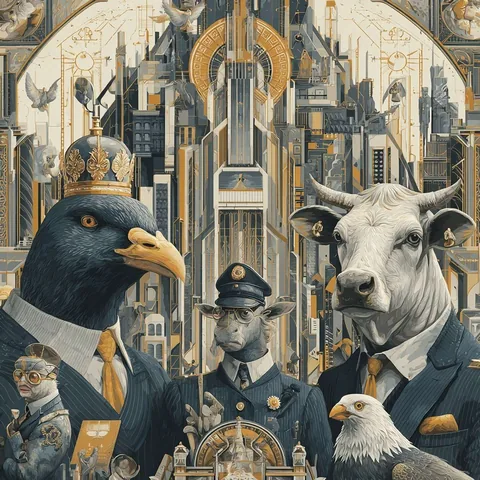
An Animal Apocalypse
This episode of Positively Pedestrian dives deep into an absurd yet brilliant fictitious phenomenon of a vegan world where animals rise to power, military stories,and dehumanization in the modern world. Alongside these elements, the episode traverses through real-life examples that provide context and reliability. Our host’s sharp cultural critiques compel listeners to reflect on pressing societal issues while simultaneously entertaining them with absurd scenarios. With a perfect blend of humor and philosophy, this episode invites audiences to reflect and question the world we live in.
Now in the show


Episode Art 8 pieces





Full Transcript
He could recall. Bad, I don't care. Oh, I sometimes, you know, got to be sensitive. Sometimes people think certain things are personal. Oh, no, it doesn't matter to me. Are they? Anything would be in that category for me. Most I had look at study or something. So, I'll go ahead and pause the recording.
So so so. Okay. I have no new seating. It's kind of kind of scary, right? We'll add a link in the description, you know, to the list, to your blog about it or. Yeah, yeah.
That's funny. So, you know, there's a there's a really crazy object. Get a cat. I know, I thought about that. I was thinking about, you know, Cassandra for one of her feral cats. Yeah. Problem solved. Maybe they want. It's like, well, there's at least three different kinds of animals. Maybe I get three kinds of cats. So, when I was.
When I was in the airborne, barracks, these, bunch of guys were going crazy. They had access, gotten access to the roof, and the roof was about, I think it was four, floors. OSHA and this building. So they got access the roof. So, you know, four floors. Pretty high, Yeah. And, you know, high enough to, like, if you fall down, you're trouble.
Yeah. I mean, second floor fall mostly will be okay. Kind of half ass jump out of it. Anything higher than that? So, yeah. So this one, one dude had gotten the one young kid, you know, basically kids these. But, you know, one young guy got Ahold of a rat that was that was, stuck to a glue trap.
Right? And, so he had had the great idea to, make him turn into a paratrooper. Oh. And so with a with a shopping bag and some string. Yeah, right. And some made a parachute. Made a parachute, take a marker and painted jump boots on him. Oh. Shivered. Black feet. Right. Yeah. And and, these squealing whole times, like, you know, torturing the skin of this, this, like, living creature.
Oh, my God, that's horrible. They somehow had access to the rooftops, so they kept bringing it up to the roof and and letting it jump get is earning his wings right and getting a jump. Oh. Getting it. Your wings. Oh my God. So more like survive multiple four four story falls. Oh it's survived many, many falls. And they kept doing it over and over.
Right. Like he's going to earn his wings, you know. Well so this is the most hilarious thing they've got to do. Yeah. Like this rat would like his. So prefer a cat. Get it then. These these guys, right? Yeah. So, I don't know, probably somewhere around 15, 20 times. Holy shit of jumping this thing. Oh my God.
The word is on the street is getting out that they're doing this. Something crazy, right? So there's plenty of people spectating this now and laughing and carrying on and making all these jokes, right? Right. Like, you know, you name it. I mean, sure, right. Calling him a foreign jumper, you know, because they do these crossover things to where, like, someone from Romania would come some.
So some group from Romania would come and get their American jump wings. Yeah. And then the and then some of our guys, we go over to Romania and get Romanian jump. We are Czech. And now it's like really prestigious. And so you know they're talking about it and being from Mexico and you know all kinds of stupid shit.
You know carrying on, laughing their ass. Laugh. The entertainment value from a fucking rat. Right, right, right. I mean, it boosted morale like a motherfucker, right? So the person that was on charge, like, basically on guard duty, even if barracks just didn't even do anything, just let it go on. Oh, yeah. You know. So anyway, finally, after all the commotion, yeah.
I mean, they could be doing a lot worse than that. Oh, for sure, you know. Yeah. Yeah. Right. I mean, I was on guard duty. Be like, fuck it. They're having fun. They're not killing anything. All right, except for a rat, which we were going to kill anyway. Also, finally, the the word got to the first sergeant. The first sergeant came out to see what the commotion.
White House. And he wasn't really to care. To care too much about the rat. Yeah. Or mouse. What it was like was he cared about the fact they had access to the roof because they weren't supposed to be up on the roof. Oh, shit. Okay. Right. So, like, normally that thing is, is locked up in by one, so.
Yeah, but somebody picked a lock or got a key or somehow got it open. Yeah. And, so that part of it was what got these people in trouble. So for punishment, to punish the all the offenders that were like, kind of like got caught red handed doing this up on the roof and sucking with the mouse or whatever.
He made these guys get in there full dress regalia. Oh, shit. Right. And do a full, full service for the fallen paratrooper, a.k.a. the mouse.
It's funny. It's out that it's funny. It's fuck. So the. So the dead mouse got the actual highest honors ever. I mean, the full man. Like, they had to get their all their perfect dress outfits, and he he inspected them all to make sure they were perfect. You know, it's like if we're going to honor our fellow soldier, everything's going to be perfect.
Oh, that's funny as hell. And so this was hour, an hour and a half episode of turning this mouse into a, paratrooper. Yeah. You know, sending him to jump school and all these guys. So, was, was was finished with, like, a 3.5 hour funeral ceremony. So funny man. So. So there goes everyone's evening, like, you know.
Yep, yep. Done. You have to give. You have to give, everyone creativity points in the. So, like, I mean, the first sergeant, he was wildly creative. All right. Yeah. Everybody the guy who painted the jump boots on the bread. Hilarious. Yeah, I got I got a Sharpie and an idea. I mean, you know. Yeah, it was screwed up.
Yeah, it was not Peta friendly, but come on, that funny shit. Yeah. I mean, you have you have a bunch of people who are like, you know, isolated from their family for the most part, you know, who knows? Ready to go to war to drop the hat. Young, right? Yeah. Like trained to train, to kill. And, you know, the rats are really doomed.
Suck the same blue trap right? I don't know, I, I feel terrible for the rat, but at the same time, I the the comedic value of the story is. That's amazing. So, yeah, that's one thing I didn't want to do with our podcast is turn it into like, a war story thing. But that one was like, you know, probably probably a pretty good one.
Should I tell later to like, anybody could relate to that. Okay. So, one thing I did want to talk about this morning was, I've been seeing a couple articles about, a chick fil A franchisee in Florida. I think his name is like Jeff Lindsay. Okay. And he, came up with an idea.
At first, it was a four day workweek. Then he changed it to three. And, the idea is, you know, when we are working those disposable jobs we were talking about this weekend for, there was always random shifts, and it was a lot to keep track of. It was a lot to deal with. What if you had other obligations or other jobs because you were underemployed or underpaid?
Yeah. Right. Right. So, you know, I had 2 or 3 jobs at a time, and it was tough. Well, what he does now is he said it makes it a lot easier of everybody knows the days they'll be working for the entirety of their employment with me. Wow. He said he divided workers into two pods since they're only open six days a week for three and three.
Yeah, and they're closed on the seventh day. He, bless, chick fil A, right. You're being done Sunday. You know that. You know how holy that day is amongst chickens, that it's like a it's like the day that they get reprieve. It's like there's no holocaust on a Sunday. Hey. Yeah, yeah. It's right. It's like they're great chicken killer overlord.
Right. Blows on Sunday. Right. All right. It's surprise day. Like well but if I can only make it till Sunday in the South, chicken chickens definitely get cooked up after church. I'm just saying. Yeah, yeah. There is church's chicken. That's how I. Oh, yeah. Yeah. And, that is definitely open on the Sunday. Yeah. That's true. Yeah. And they're a big chain.
But regardless, he'll use explaining his philosophy in this article I read from Z net of all places. Check. But, normally check magazine. Now they seem like you're just doing everything. Yeah. Basically, he was saying that. All right, we spend all this time at chick fil, like, thinking about our customer, delivering to our customer, giving, making our customer's lives as easy as possible with pickup options with, you know, fast service, all of these options.
And he goes, yeah, we legit fully the employee experience is a lot better than maybe another fast food restaurants. But he goes, the random shifts were bad for my business. The ranches were bad for their lives. And knowing what they're going to work and why they're going to work, it. And predictably, yeah, predictably. And he instituted writing detailed reports on your 13 hour shift, the gotcha, gotcha.
And also, he said it gives me a longer chunk of time to see what employees are capable of and what they're doing. Okay. So I can advance the good ones. Interesting. So I thought that was really a neat idea. Spend as much time on your employees and their after work and during work lives as you spend on your customers, but still make them fucking robots.
And I have to say my pleasure after their ride, still I'd roam. I had my pleasure to work at, Burger King. Yeah. So. Well, I if I ever go to chick fil A, I make it a mission to make that habit. So there's no valid opportunity for them to say my pleasure. Really? Yeah. It's like the ping pong conversation that, you know, you have back and forth.
Yeah, yeah, there's this thing for that. And not to my pleasure. Thank you. As my pleasure. Right. Yep, yep. So I say thank you for not saying my pleasure. And you're like my you reached you. Yeah. So you throw that out there as soon as possible. Oh, I ever say every. You know, I try some kind of creative way every time.
Yeah. To, block them from saying my pleasure. Yeah. Because it is not pleasurable to you. Here is that phrase, right? They don't want to hear about an unpleasant experience to be robotically called by a human. You know, that's under a mandate to say a particular phrase. No. I always hate that whenever I call a place and they had to spew a script at me.
Do. Yeah. It's weird. It's, you know, the script is necessary, I suppose, because everything is brought down to a metric of some kind. Yeah, yeah, but at the same time, it's, I guess, just naturally dehumanizing. So we have knee jerk reaction to it. It's dehumanizing. And on top of that, if I detect the monotone or hurried speech of a script, I automatically ignore it.
Right? You know, spammy the script, blah, blah, blah. Yeah. You know, it's funny that, dehumanization is necessary, right? For like so many, there's visitations necessary for mechanization and automation, for so many, for so many functions. Yeah. Right. For somebody that for for utility functions across the board. Right. So like, there's a shooter in Virginia campus, one of the Virginia, some, some college in Virginia.
We're getting attacked parking some. Yeah. Something. Charlottesville. Supposedly was just I just kind of briefly on NPR on the way over here. Oh, I didn't hear about the newest one now. Okay, okay, so another shooter, some shooter lit up just blasting off in a parking deck. For some reason. Nobody knows anything yet. The manhunt, I don't know if it's completed or not, yada yada.
And, the same, the same typical response is happening. Prayers go out to the family. We need to talk more about gun control. Let's avoid the hey, what's the word? The echo chamber already. And, so, you know, you get it. The same exact patterns that we've done for years. And as we to continue mass shooting every day or what, like three years or something.
Right. Yeah. There's, there's it's not going to change. It's, the political gridlock. It's not going to change for any immediate short term. Hey, Democrats did keep Ahold of this. So when they had control over the Senate and the House fully and presidency, nothing changed. Correct. There's maybe I think, well, they didn't exactly order some kind of hit.
A couple of people who, were stonewalling them. There were Democrats in name only. So Dinos instead of rhinos. Here we go. Yeah. So, you know, a system, a system that's, just a mask dictatorship or autocracy or an oligarchy, whichever one of those words you want to convey to the reality of whichever says only a few people are in charge, and they're clear about it, right, right, right, right.
Yeah. And it's like getting so, I guess normalized that they're starting to say the quiet parts out loud. All of the across the board. Right? Yeah. Like they're within within industry insiders that are the language that they speak is already, you know, one of complicit complicity. Like, for example, like, oh, hold on. You know, we were I said, we can get we're hiring such and such.
Yeah, because we have the right of way. But they have the they have the technological authority, you know. And we talked about that. Yep. A while back, Yeah. I mean like in some countries, seriously that it is incumbent upon the pedestrian to not get his. Sure. Right. Great. Great sounds. That sounds right. I mean, yeah, it's like the Wild West just, organic unit beware.
Right? It's like, hey, you know, this is a multi term machine state. It's like, yeah. So remember us on you went to work at UTC aerospace. They hired this hobbyist retail that please. There was an internal memo and literally it read you know such and such this wonderful lobbyist guy that's going to do all this great things and on behalf are going to go to Washington and write policy.
So in the internal memo, literature basically says our private company or our like, you know, corporation. Yep. Is sending a person to Washington to literally write palsy. I know, and that's the key. And it's I saw that lobby before they said, right, exactly, exactly. And you know, this guy is such and such as an insider. He held these positions and they even said this man's an insider.
He has the connections. He has this. Wow. And so that is not I saw that cartoon of the little piece of paper rolled up piece of paper saying he was a bill on the Capitol steps TV part of Capitol Hill. Yeah. Talking about how bills get generated and how they get through the system. Yeah, it's a little bit of a different story than what was in that memo, because it needs to go from dude's word document to, yeah, to a senator or a senator.
Well, Senator, I don't even think it has to go to a senator. I think it just gets proposed. And then, a quorum of a certain number of them, then just take it and make it a bill. Right? Right. I don't even think it needs the story. He's got headphones in, and, he I don't even think he.
Yeah. It doesn't. There. Whatever. Let me go ahead there. He's got headphones and go ahead and say what you're saying. No. It's like he's the headphones. I mean, you're probably pumping him up helping him get a job, you know. But it also it blocked him them from having an interaction with us. Yeah. This is where he could just have graciously moved out of his way.
And that's what we would have done. Courts and worse, people would have done it. Of course, like, you know, he will need to be an anti-social prick. And you know, oh, okay. I wasn't really going there. I was just going with the idea that, like, the technology in this particular case was, distracting, creative, created and so created a situation that was less human.
We're talking about dehumanization. And ultimately, that's it. It did. It. It Ramil. Which is why interaction with the environment it be hated the interaction with the environment. Yes. And let's now explain exactly why meta is a fucking fail. Because, yeah, it's dehumanizing and because it mediates your interaction with people. You should have a direct interaction. Exactly. It's just like, you know, you could interact with the people directly or in a chat room or, you know, in a more organic way.
Still with technology, I ask you, right, right, right, right. Something like that. But instead we've got these layers that were are there you were talking about that this script is necessary for metrics, right. Well, that's what those layers of mediation are necessary for. Two minute. Yeah. For metrics. Right. So the shooter the reason I was talking about dehumanization, how I tied it in the shooter, all that is for some, some, you know, episode in this person's life, they've reached the point where they cognitively have dehumanized the others.
Right? Right to where? To the fact where they should just be exterminated like they have. No, they have no utility, I don't think let them on the same plane as themselves. Yeah. Right. Right. Like like these people have to die for some, you know, abstract reason, right? You know, even if it's psychotic, no shooter just like, decides, hey, I'm going to start shooting, right?
Right. It's, you know, it's like the Vegas guy, you know? I mean, the guy pointed it to the hill, you know, was a multimillionaire, you know, and for some reason, he thought he was above and beyond everyone else that he was shooting, trying to shoot, you know, and, you know, wanting to just create a certain amount of chaos because they're so disenfranchized with society.
So they've gotten to a point where their life or their mental state is so curated that they don't get about that guy who just doesn't fit the profile of the rest, the one on a Vegas guy who's a multi-millionaire and a successful gambler. Yeah, well, I mean, did he die in the process? I don't even really know much about the story that nobody knew why he did it.
Because he died. He kill himself or someone killed her. So, like a shootout or. I think he killed himself. Okay, so it was like a last power thing. There was some weird type, right? He was going to go off, go out on top of the mountain, I guess. Yeah. I mean, die on a hill for some reason.
Yeah, I mean, I, I could see how somebody could, like, not do that, but, like, get to the point in their life where they feel hopeless. Yeah. And be so angry at that, that that's their fight for us to try to be a multimillionaire. See how that is? I'm pretty sure I wouldn't be able, but see, something has had caused that person to reach a point in their life where they've dehumanized themselves.
Yeah. You know, so the point they they found. No, obviously they their anger consumed their lives to the point that it's true to the point where they lost their humanity. Yeah. Yeah. And so the, you know, you know, I guess that's it. It's about this loss of humanity and all the things that chip away at it. Yeah.
I mean, social media, the dehumanization of social media is anti-social. Really, to certain kinds of work and, and working in a certain industries, you know. Yeah. And so that's why I was kind of pulling reference to the Chick-Fil-A guy who just like, cool idea. Three on, three off and get to know people and blah, blah, but then have this.
Yeah, it's easy to criticize, I guess, but I have this mechanical my pleasure. Because, you know, corporate says. Right. So it's like, I guess I guess, like you have to put things on a scale and say macro and micro, you know, the, the, my pleasure thing is nothing really is. So. Yeah. Okay. It's a moot point really in the big scale.
Yeah. And in the big scale. And, ultimately it's more funny than anything. It creates in their minds. It creates a corporate culture of respect and connection to and service respect. Yeah. I mean, I guess to some extent you can teach ethics, you can teach respect, and you can script a certain extent, an environment by which those things are fostered.
You're okay. By that. And again, I feel like that's in their mind is I think they're taking a very facil approach to it. They're not really understanding, you know, so like Coca Cola, you could easily target something like chick fil A as they're just serving shit to people. You know, there's no there's no actual positive utility of the organization.
Right. Makes a bunch of people a lot of money. Lots of people very obese and sick. Right. Exactly. So that, you know, if you just take a giant eraser and erase Chick-Fil-A from the planet, nothing happens, right? Well, if anything, you might end up with a chicken celebration. Yeah. Chicken celebration party is chick coop party. Chicken coop. But also, you might end up with the net flaws of.
Yeah, I guess inevitably the party, the chicken coop devolves into starvation and overpopulation of chickens and then the chickens, and having a, the functional equivalent of the chickens. United Nations gathering. So, you know, what do we do now that our human overlords no longer find us tasty? We're at a billion chickens and counting. Yeah. How colony?
The eggs are all hatching. You don't know what the fuck we're going to. We're going to do. We need ten planets in another six months to to house our population. Elon Musk, save us. Yeah, yeah, we're building chick X. Yeah. Working with, going quackers with with, whatever version of NASA. I'm trying to take this.
I'm funny. So they can, Yeah. Yeah. Like, I mean, there's always the perennial massa. I like that one, sir. Sure. So. So the chickens are like, you know, and decided to join in with the cows because, you know, we've also raised McDonald's America. They're getting to us, the cows, and then they're taking their slavery back with.
Yeah, massa, they're, they're, space agency. And right now, like, as we, as we speak, we're writing the new Animal Farm book, but this is the one that's like reality. When he was, you know, finally decided that, veganism is the way. And so basically, all the cages open, all the population of all these animals enter the world.
And here's what I think quickly devolve into the story that we're talking about. Right. Oh, yeah. Yeah, yeah. A real life animal farm with hierarchies and politics and so we start off with, like, the, matrix. Yeah. Again, this isn't a crosswalk writing. So the new Zion celebration of, like, this weird kind of quasi dirty, everyone's, sweaty and grimy, but but but sexually charged masses.
Deejay, celebration. That's what happens. Oh, do we have, like, a multiyear Woodstock for the animals? That's what I'm saying. Like, it just starts off the cages open and it's like, oh, my God, we're free party. Yeah, yeah. And then, so in a very short period of time, the reality sets in. Well, let's give them a get give them a couple years of straight up party and debauchery won't go well.
The problem is, is that their, their, their, reproductive cycle is so freaking fast is that you can't get them a couple years. I mean, a couple of years is it's already destroyed. So, like, sure, you know, they have to start thinking of this out of the gate, no pun intended. So what do we get? That was the gates are lifted.
How much fun do we give them? Three months. Can we get in? Through what? Dude, you got to understand. No way. All those eggs are hatching, buddy. All right, a month weren't sure a month or so of, unbridled, hard partying drug abuse as a butter budget. I like a bacchanal again. First of all, like, you know, a very celebration of that.
Just dive in and the after include, like the narrative of the, the the worldwide collective of vegans talking about how wonderful this is and everything is good and grand and splendiferous he the surge funding them, you know. Yeah. So so there's like this collateral or like carryover celebration amongst the vegans which has its own human kind of debaucherous effects.
And, so, you know, the people that have eaten the animals their entire lives are just looking at it like, you know, look at all that dinner, you know, going to waste. There's people starving in Africa, right? Saying like that old adage. Oh, yeah, look at all this. Waste not so, like, you know, instead of looking at them as animals, as life is valuable things, they're just nothing but a, you know, living commodity right after way more if they're not human, are actually trained, they're just walking dinner.
Right. And, so, so they're, they're upset because, you know, so, so there's no partying and debauchery amongst them. They're just pissed that you do that or they're going out there and hunting, free animals, I don't know. Well, you know, we gotta gotta put it in the like grain context of like, that's no no longer possible. All right, all right.
Because, yeah, they're now a protected class. Yeah. So I guess like I said, there's no more McDonald's, there's no Burger King, there's no Chick-Fil-A or anything like it. Yeah. So all that's gone and the skills have been lost in our society to do much. Other than that. Yes. Yes. Well, good. Yeah. And so like, everyone's dropping weight like crazy and like the world was actually there's less pandemic and all these, like, great things are happening.
But, you know, it's not culturally normal, so everyone hates it except for the vegans or like, yeah, we got what we want to. Yeah. And, you know, you might as well take away guns at the same time in this scenario. I mean, less the animals become armed. Yeah. Because they're already anthropomorphic, anthropomorphic sides of them.
And we're giving them autonomy, like the chicken, the United Nations and the like. The in the animal version of the United Nations. Right? Absolutely. Yeah. So anyway, large yard United Nations. Yeah. And is is literally a giant fucking barn, like like huge barn, like Capitol building sized barn. Right, right, right. And so, you know, for any and all, other place around that joint, right.
And, so then the reality sets in and the world is now, you know, thrice overpopulated with, animals within the first month. Yeah. Human beings reached 8 million. They converted to veganism shortly thereafter and released all the animals. Now we have the. Yes. And so there's animals everywhere, about as much as they can in all different forms of disease.
They almost like zombies because they can't get enough to eat. Their cannibalizing one another, you know, etc.. Right? It is literally like the dystopian hell on earth for, for these animals wavy on the manage. We've got all this, these populations of animals that have prion based diseases and oh, I mean, you know, and now there's like massive zoonotic, you know, cross fracture infections.
Yeah. We're getting all kind of disease from them. Yeah. They're getting disease from us. Yeah. When you have a chicken with feline Aids, you know, it's like what's going on. Yeah. Right. It's a so this goes on and on and, you know, very quickly the animals realize that, yeah. This, this, this, the, the existing symbiotic relationship they had filled with despair and and violence and death and slaughter and management of their entire lives.
Right. At least at a minimum, you could barely call it symbiotic. It was more like slavery. Slavery. Oh, sure. Yeah. Fair enough. And then they quickly realized, though, that without that infrastructure, there's been genetically modified to the point where they cannot exist fairly, you know, chickens that can't stand up because their breasts are so. Well, you got all right.
Which and which are now have atrophied. And because they're not getting the chemical supply and the biotics of have so you get, you know, everything's wrong, you get all these animals coming off of steroids, you get so the rage at right raging, like I said, they're cannibalizing one another and bovine growth hormone and everything else, you know. So what happens when they come off of that.
Yeah. So there's like this, this, this like someone one of these animals erect like the Georgia stone of like how we have to, you know, a massive reduction in our population and then. Oh, shit, there's all these political parties. There's, like the Trump of chickens. Oh, man, that's awesome. That comes out and people start rally behind. Right wing populist, her right wing.
I love it. Chicken to the left and right wing vortex. Yeah right. That's epic. And and you couldn't say populist because that's of the people. What would you say? Who knows. It doesn't matter what you say. Right. But so like the reality would quickly shift. And so, you know, this, this massive upswell population and horrible, you know, reality for these animals would set in, you know, and then, of course, would be a human overlay to all this.
Right? You know, because humans then would now be infested with these things, until they naturally started calling their own population. Right. So the predators would start to multiply like crazy to instead of the prey predators cycle. Right, right. And so in that it would throw off ecosystems. So my you think you think in, you know, in whatever animals could exist in the wild, like had enough genetic, natural, genetic wild remnants left in them to find a find a niche in which they could survive in the wild.
Right. What would be now? Oh my gosh. And all kinds of screwing up all kinds of human population balances, like you said, the you massively, you know, shifting the ecosystem out of balance. All right. And so we basically anti anthropomorphize these things at this point because then all of a sudden they're all classified as vermin or. Yeah.
So species yeah they're they're invasive species. Whatever's left of them, they're they're nuisances. Right. Right, right. We've got roving bands of animal control, deputized people, you know, calling the population these different gangs of rolling chickens, like with the chicken fingers. You know, where the where the wings with the junkie like that. Where the crispy chicken. Yeah. Oh, 11 turns far bicep.
Oh, yeah. Where the buffalo chicken. Oh, I love that. Oh, yeah. I'm gonna go out to Buffalo. Those are, those are the larger ones or. Yeah, that's the one that I like. But so you know, these, these, animals, they get together and say, like, what do we do? And, the countermeasures they'd have to put in place for survival would be dramatic.
You know, they might have to, basically, maybe make a secret alliance with a with a rogue band of underground, carnivores, human human meat eaters. Yeah. Right. So, like, they're still they're taking a certain percentage of them, like, so their criminal justice system, when someone does something wrong and they get down into the. Yeah, yeah, they, they go to jail, which is actually the, underground processing facility.
And so the families never see him again. There's all these conspiracy. Why appeared. Yeah, yeah, yeah. All right. And, you know, everyone knows they can still smell it. They still smell the the fried goodness. Right? Right. That's. It's in the air. Yeah. It's impossible. The mass, like, you go by a cookout at 2:00 in the morning.
He you know, you know. Yeah. You know, there's flesh being. Yeah. Being, cooked and consumed. Absolutely. And so no matter what they do, these underground processing plants are noticeable to the rest of human beings. Right? But it's like a shadowy, kind of winking, understood thing right there. Like, I think about it because part of the shadow economy, just like the we talk about drugs, drug sales, illegal drugs and.
Well, that's what I'm saying. That's that's the shadow economy right there. Like Chick-Fil-A is like, yeah. Oh man. Keep it on the down low. You know, check this out. Yeah. And now the chickens don't even get a fucking Sunday off, you know, because the underground, you know, 2424 seven. So, yeah, I guess inevitably there might be this like, point at which the animals collectively decided it was better before.
So this inflection point out. Yes. We had no, we saw we got our beaks cut off so we didn't fight each other. Yes. We had to. Yeah. But now those pump chemicals. Yes. Now. No, those things are happening. So they're, you know, lacerating each other with the beaks and having terrible, you know, outcomes. The, the, the animal hospitals are completely filled to the max, right?
Yeah, yeah. Right. Plus they have their own and they have to give them the give. And for the animal, the hospital. Oh, yeah. They're they're nothing. Majority of them are basically collectively a welfare slash charity state. It's morally right. No. Every every one of them is on disability. Oh I do think they do have certain ways to generate income.
Chicken who you a great fertilizer. And they can also take and collect their poop and create power generation plants with, the methane is the true. But it's the the classic reductionist. Right. So like anytime you take energy and put it through a process, you have a reduction. So, the grain that it takes to produce the, the chicken shit, is less caloric than what's available in the grain to start with.
True. So the vegans, you know, that's one big vegan argument is that the you could, you know, have more food supply for humans, right. By eating the grain directly. Yeah. Right. Every time you process it, every time it goes through, an organism's right. You know, they have to use some of the energy from their metabolism for inefficiencies.
And then when they poop it out, it's less energy than they started with. So, so same argument there, right. What I'm just saying. But but. Yeah. Right. It's people that export power and poop for, for some time. For some time. But don't forget now there's a, there's a they're chiseling in on the the, the food stock for the humans.
That's true. And so that's not going to work. And, you know, yeah, it might work through the short term where we identify with them, where we have, you know, an openness to, like you said, provide charity and welfare. So in these, I don't think I've told you this before, but like, there's certain creatures that are, natural creatures that are what they call edge creatures, like edge like border or edge creatures.
Okay. And like deer, for example, don't do so well in, like, the deep forest. But they do fantastic on the edge of the forest, on the edge of human civilization where there's farms and there's. Okay, gardens and so they kind of grab things that human beings correct, mass and correct. And so deer will over populate really quickly.
And a really good edge situation, like you have a lot of farms and stuff right near the woods. Right. So they live in hide and use the woods as cover concealment and protection. But then they drive by real operations to steal from him that that was actually what they did. And so, when it's deer season in a lot of counties that are in these kind of edge communities, right where there's farms, you'll have, like a bounty, you know?
Well, that kind of. But you have this idea where, every hunter is allowed to have a certain number of gear for, for season, like, you know, you can get six deer. Yeah. Right. Right. Your hunting license allows you to get, like, up to X number of deer per right season. But there's this waiver exemption called a crop damage permit.
Oh, nice. And there is freaking you just oh my gosh, what happened to my crop? Oh do you can take as many. You can. Yeah. Right. So you can call them as much as you like. Wow. And these two apparatus working together keep the deer population in a, in a check where they can. The population of gear can remain healthy hunters, you know.
Oh. Like your freezers full. Yeah. I guess people with the need to get that type of boner, the the ability to get that kind of bonus. So. Oh, yeah. Because people really don't live off of benefit anymore. I wouldn't they know in the amount that you pay and the firearm and the spray and the regalia and a tree fucking tree, house tree for tree stand, it and the, the press at home that you're using to make your own bullets and, you know, match great ammo.
And my God, you put all that together and you could have bought, you know, life supply of beef, right? You could have bought multiple sides of beef or your butcher that you bring that, you know, deer to, to get butchered. Yeah. And then if you say, oh, it has to be venison because that is then, okay, you can buy that.
That doesn't say well, but yeah, but then again, listen higher in the nitrates and nitrates and a lot of other meats. Right. Yeah. This guy is already stopping. Uses. But you see the guilt by this race, whatever you were like, did you see what I did? That gesture. Did you see what you did? He put his hand over his mouth like, oh, shit.
Like I like I did wrong. I totally made him think like you did. And he did do wrong. Well, he did it wrong. It. He deserves that. Emotional. Yeah. He serves that micro dehumanization because he did that to us. Now it's the micro dehumanization, I don't think I think it's he's connecting with you realize he wronged you as a human.
Right. So okay, so I was a right that was humanizing, not the human. Yeah. So, by my gesture, dehumanizing him. Humanize the whole thing. That's. I think so, yeah. So that brings me to another topic. But I want to finish up this idea of this cropped image for a minute, and it's calling of these animals. Right. So within a certain, administrative kind of like, array of rules and regulations and like, you can kind of say, loopholes.
Right? The crop, Davis's prominence, a loophole the, government could then, for the local population, manage the population of the animals. And they can they can pull the different threads and tweak it over the years, for the health of the animal, different limits. Whatever. Right. Because if they don't do that, the crops will be eaten like crazy and these deer will all repopulate within a few seasons to the point where they're beyond the menace.
Right? Like you're running it, hitting them in their cars or, you know, and all of this is still very rough. It's not very precision, those controls, but yeah. So I reckon there would be other type of countermeasures amongst the animal, United Nations and working strictly with the humans. Right. That would inevitably get the population to a reasonable right.
Right. Sustainable. Some of these shadow counter measures where, you know, the animals aren't directly aware, but there's rumors of this. Yeah. So the, the whole entire chaos started when you opened all the cages. Yeah. Right. So like, well, it's the chaos started when you change the status quo and you change the balance. It was creating the, when you tried to make things more fair without controls in place to take care of the overflow.
Yeah. My thinking on one that was awesome. Okay, so say, that's for what we're talking about. He's playing his music out loud so we can hear him coming. And he used his voice, and he's our cognitive warehouse. Yeah, right. So even though he was using several pieces of technology, those didn't interfere with our counter. Yes. And so a smoother.
Right. Yeah. And which is why MIT is failing right there. Right there, by the way. Right from the interaction he said this interaction is essential for when I'm getting ready to do which is right, this bike high speed down this trail to get some other right. So I would pay a lot of money, okay. I would pay like the amount that would cost for an Oculus and a good computer to drive it.
I would pay for the technological equivalent of that. If you gave me a dope ass, augmented reality. So now I'm in reality functional, functional tool that I could use rather than something like graphics or, 1990 big headed avatars for dead collides that are disembodied, right? Yeah, yeah, it looks like it. Seriously, it looks like the Nintendo mes.
Yeah. What other shit? But it has to because of the state, not because of the billions of people that they want to have on it. Right. That's that. That's like utter crap. Right? And you know who wants to meet with that thing? You know, I certainly know. So what I do want to though do is like be able to kind of, Tony Stark pull up a screen on my wall.
And that's the person I'm meeting with. Well, yeah. Now I'll pay big fucking dollars to have that, to feel cool as fuck when I use my hand gesture to swipe another screen up on my wall and, you know, like a couple of years ago, until my computer was about ten years ago, that they had something, with K desktop environment, KDE on Linux where you could playing thanks to devices, you know, and they made it work for a little while and, they lost their developers.
So see, I signed up for that shit, right? Because then when my wife comes in the room and says, I got you some new coffee, I can just graciously turn her and say, wow, thank you so much. Appreciate that. Yeah. And I'm not have to take off this big headset, interrupt my weird, you know, we we looking meeting, you know, weird, bizarre thing with you.
Like you said, you're using something like, magically to, or connect, notice your gesture, random movements and determine what devices are in the area. Maybe you're using a combination of that and synthetic aperture radar to determine what devices are in your room. Exactly, exactly. And, you know, or like, just something like this, we can walk around and public data becomes available, and like, these little balloon clouds come up, like from my projector, right?
Like more or less like Google Glass. But but slick, but actually, like, you know, not not hideous and terrible. Yeah. So like, clearly if someone has on these weird, creepy, sex offender glasses. Right, right. And is staring at you, sir, what do we call a military perfect troll? Us. Yeah. That's right. And and their eyes aren't focused completely on you because they're focused on the augmented projection that's happening in the lens, right?
Yep. And now you've created a derivative. It's not an augmented reality. It's a, another version. And that, well, we talked about this, months ago, but there's a company who just started going into human trials with a contact lens. Sure. It sure does. This the same thing we're saying to Google Glass. And that, to me, is not not very intrusive and yet still insanely functional.
And we're one of those. Yeah. So it has to become it has to be a human. Unless you have a cultural shift. Right? Unless there's a big cultural shift, which they tried to do and they couldn't. Right. Unless that were to occur, you'd have to make it completely seamless with natural human interaction. Yeah. So like if things are popping up in our current environment right before our eyes, because now these augmented reality contact lenses.
Right, right. But we're still having our same interaction. Yeah, that's just cool. In fact, it'll probably give us then more, but it's going to inform us on the fly. It's going to enrich our interaction. It's going to it's going to be similar to what the Chick-Fil-A guy was trying to do in spirit. Yeah, that he's like, I want enrich their lives, give them more time for work life balance.
Right. So what we could do in that environment is that the augmented reality in that case could help us be more human connected as well. And it could be help us be more connected to real, true facts and figures. And that myself know the owners right there. Oh, so like that could be helpful. You know, like that dog could be RFID and you know.
Yeah. And we'd know that, hey, this dog is chipped and it's that lens right there. And and then the signature of the human nearby would help us identify where the other people are. And not only that, it would make our podcast badass because we'd have real time facts and corrections order on whatever correction they had whenever I was talking.
Oh, and then we wouldn't have to spend hours in post-production fact checking ourselves and making corrections. Yeah. Oh yeah, we so do that, guys. We definitely reedit in the correct things in the podcast. So yeah. Yes. Visit our podcast there. Is that happening. Oh is there. Yeah. Are you really editing things like that. No. But adding corrections okay.
Yeah that's different. So if I spell it out from fact and my fact it was off by 10%, but that'd be no. Yeah, that makes sense. But yeah I mean I really do enjoy this bird of prey effect we have in the studio now two. Oh. I get so with the augmented reality. You know, we could, like, be pulling up values of the houses as we go by.
It's just out of curiosity. I mean, we would have access to not just floods of data like we do now. We wouldn't be inundated with it. We would be able to pick and choose and filter, and we'd never come out again because the sex offender data would be overlaid. Yeah, because it's like you got the street and there's like 12 sex offenders and you're like, what the fuck is going on?
I didn't know this is my neighborhood. Where all the schools in this area, a three or out of A12 thousand, there's a mass exodus from popular areas just because of this. Krieger. Yeah. So that would be that's actually a good point of like humanities, if that most people were, made much more aware of the full reality, or at least aspects of it that people typically care about, that could be very damaging.
Oh, look at that. That's a big ask it. Yeah it is. I could use you bloody well. Well one job. Yeah. You could be gainfully employed. How about will mouse for food. Yeah. That kind of looks like you'd take a mouse out pretty good, dude. I think he'd take anything out. This in my room? More bloody. Yeah. So again, there's like, you know, cats, for example.
Or in our animal analogy, well, absolutely devastating to bird and, and certain populations of wild animals like devastated. Right. So there's no doubt they're an invasive species. True. But they purr nice and they fun to pet. So. Right. And it's really hard eat. Speaking about you're talking about reproductive cycles. It's hard to control cats. And how much they produce.
They do a good job the they're this good natural ability to when they're feral find ways to survive. Right. Oh yeah. I mean and even then they're not feral. They still retain a lot of those feral elements. They are their own animals. Yeah. Right. Right, right. Yeah. They're pretty dynamic in that way. You know, I could imagine like a Yorkie, you know, surviving very well.
No, no. Well, I know that a regular house cat out. Hey, it's fine. Yeah. It finds its way, right? Yeah. So, you know, back to this humanizing thing is I was thinking recently about humanism, you know, and the religion thereof. And there's there's a degree of dehumanization, unfortunately, built in the idea of trying to to, bring religiosity to the human equation, like to, to bring religiosity into into humanism.
Okay, is, in a way, dehumanizing. Okay. So I mean, that's all I, I'm sure another layer of mediation. Yeah. How do you like kind of make a whole podcast for that? Because that's like a huge thing to unpack. But in general, I was just thinking about that lately. And, I mean, my critique of humanism as of late has been since it's mostly been devoid of the technological impact.
It's missing its mark big time. Well, and I think that's what we've. All right. I said this about Christianity as a kid, but I think it applies to humanism equally, that you have to rephrase it in the context of the culture with what you're in. Yeah, you have to say, okay, humanism is about what affects human being. Whoa.
Did. Whoa, Joe, did you? Humanism is about the human condition. What is affecting human being, what is helping, detracting from what can we do? Create success. Those sort of things. Right, right. Well, then you absolutely have to include certain illogical effect. No, I guess I elsewhere, if we can go a different way, avoid that. We can't.
Right. So you absolutely have to include technology or you're being blind to a facet of the human condition. Yeah. So the, problem with humanism and now the problem with most religions in general learning is that they, are not allowed to actually, evolve rapidly enough to address the elephant in the room. And so what they do is they dance around periphery issues that are get a lot of attention and allowed to evolve.
I mean, maybe it's right that human beings are too slow to change and evolve. Yeah. So for example, specifically with humanism, they've really, latched onto the LGBTQ, stuff when it is part of the human condition. Right? Well, yes, it is, but it isn't the elephant in the room about human civilization. True. So what is what is the elephant in the room?
Is applied technology and environmentalism. So, like the chickens where the gay has been open human population, you know, which is now about a billion, is a serious thing. And so it needs to be dealt with seriously. Yeah. And that's not just give TVs to Indian farmers. Now or for sterilization to some types of eugenics program. Those aren't. Yeah, those are the answers.
Those are hamfisted ill thought out and, you know, short lived. Right? The answers are legitimately bringing the world to a state of civilization where the cultural naturally follows to where people wouldn't have so many shorter. So, like, if you're in this, like, depraved, high infant mortality environment where it's richly impoverished and your best chances at ever having a retirement is to have as many children as possible.
That's one hell of a phrase to think about. Turn around in your mind. Richly impoverished. Yeah. And and so when you have that environment you have a natural cultural incentive to have produce. Right. Yeah. You're going to, you're going to want as many kids as possible because for many a reason you need them. Yeah. And so they have like this, this knows you had that, had that brewing.
So right now you have like the kind of basal, meaning of life happening all the time, which is procreate. So, like the meaning of life from a biological standpoint. Okay. From a from a baseline organic, entities perspective is just to procreate. That is the that is the meaning of life. Yeah. From a biological standpoint. Right.
So there's that natural since, you know, we're part of the natural environment that that impulses they're biological. Yeah. Right. But then you have human beings which have civilization and these higher abstract ideas, you know, we've layered all of these things on top of our natural impulses. Right? And so then you can create an unnatural impulse to not have the desire to have to just procreate and create a new cognitive purpose for yourself, like find your own destiny.
What's my point? Purpose in life? You can define that for yourself. And so humans have this nice bifurcated, collection of what we consider our purpose. We don't just have the basic biological need procreate as our purpose or meaning of our lives. Right? We have we have this abstract cognitive, meaning of like as well that we so self produced and we talked about before the and we've talked about before that ultimately the idea here is we need to create a culture that allows you to transcend those basic needs, allows you to have those things.
Right, so that you are more in that, giving into that cognitive idea of what can I do with my time? I have leisure time. I have this in that. Right. So, so people collectively start producing the replacement rate of next generation or less and not obviously having then exponential or e, base growth. Right, right. So, yeah.
So when you put all that together, the chickens and the cows and the things, when the gates come on flying open would be at the baseline of having you start to create all that stuff. Well, yeah, they would need the hierarchy of needs. They'd be probably in the negative. Yeah. And so this new society would have to achieve all of that.
Not only that but coexistence with the highly developed society. Right. So then back to the humanness idea is that the, micro focus on certain issues, which are indeed are valid social issues and should have some air time to hyper focus on them is self-defeating. Because then you're not addressing the real master of in room issues that you need to be focusing on, right?
Like, who cares about LGBTQ if we have geothermal Mika at work, right? Because one can against the other out. It's like nobody cares about the the what the neighbor identifies as when everyone's hair and teeth are falling out due to radiation poisoning. Yeah, right. No, no. Nobody cares. So I mean, ultimately, maybe that's the thing. Rebasing, trying to rebase your own corner of the movement on real issues that, you know, not intellectual flapping about that it feels good.
Right? But really, what what can you really do for not only those societies in India that are producing huge numbers of kids, but what can you really do for the poor in any country? What are some universal solutions that may have an impact? That's right. So I want to create a new intellectual movement, that's very closely aligned with some of the principles of humanism, but have it the hierarchy as far as the issues and the are efforts.
Hey, guys. Hey, buddy. Oh. Look at that tail. Go. And John, come alive now. It's like, why I love that that duality that dogs exhibit, right? It's like this pretty strong, menacing bark, right? You know, combined the wicked tail wag. He's like, if you came over here, I'm so fly with you, I'll look you to death. You know I'm here.
I said, I'll lick your death to death because I'm bad at all. The hardcore hardcore. Yeah. Water bores you. I will waterboard you. You'll confess to every crime whether you did it or not. Before I'm done with you. Come pray with me, please. Yeah. Come on, come on. Right up to the bits. Let's go up. All over. Oh.
Allow you to be fully humanized. Come over here. You want actualization? I got it right over here. Open that gate. I'll show you survival. And I mean, really, we groomed him to be like that. That is survival for them. You're here, right? Yeah, right. There's still a certain. I'm not a wild in every animal. Oh, hell yeah. Including including humans, you know?
I mean, you put him in a situation like happened in 2008 where you had roving bands of domestic animals because their owners had abandoned them. Yeah. Yeah, that could be scary. Yeah. I saw this in that crappy neighborhood. I was going to Gastonia. There was a tiny little bando. There was a Pomeranian, a beagle and something else, and you couldn't tell what it was.
There's like certain animals in the roving pack of dogs that are like, just the toadies. Yeah. Like that. Like like a Christmas story. Scott fires his little toady. It's like, yeah, you know the cocker spaniel in the group of wandering dogs? Apparel dogs. It's like, is retard? Yeah, yeah. Get off me! Yeah, it's like running. It's ears are flapping.
It's. And but it feels the power of its brethren. Right. Of his brothers. And so like it's carry itself a little bit taller than only one. Right. Does it isn't quite as goofy. Yeah, but. And like, really it's starting to believe itself that it's somewhat of a badass. Yeah. But yeah, it was like these three little dogs and it was funny, but they were mean.
Dude, it doesn't, it doesn't. Yeah. It doesn't talk about it's really saucy at the end of the day and the issues. It just wants to play sometimes. Oh right. They're too busy killing. Yeah. You know play is being put aside for. So anyways I'll finish by saying that, I think that there's a missing element for people like, not necessarily new religion, but a new philosophy that they've started tying into their lives is what's legitimate.
It's like helps them get through each day positively with, with, with higher spirit and higher energy that doesn't put them on their knees. Every game keeps them on their feet, walking tall, not down on their knees, vowing to, which is always a man in proximity to some kind of God or ideology. Right? Right. So, oh, that's on.
Leave it on right there. That's a good one.