

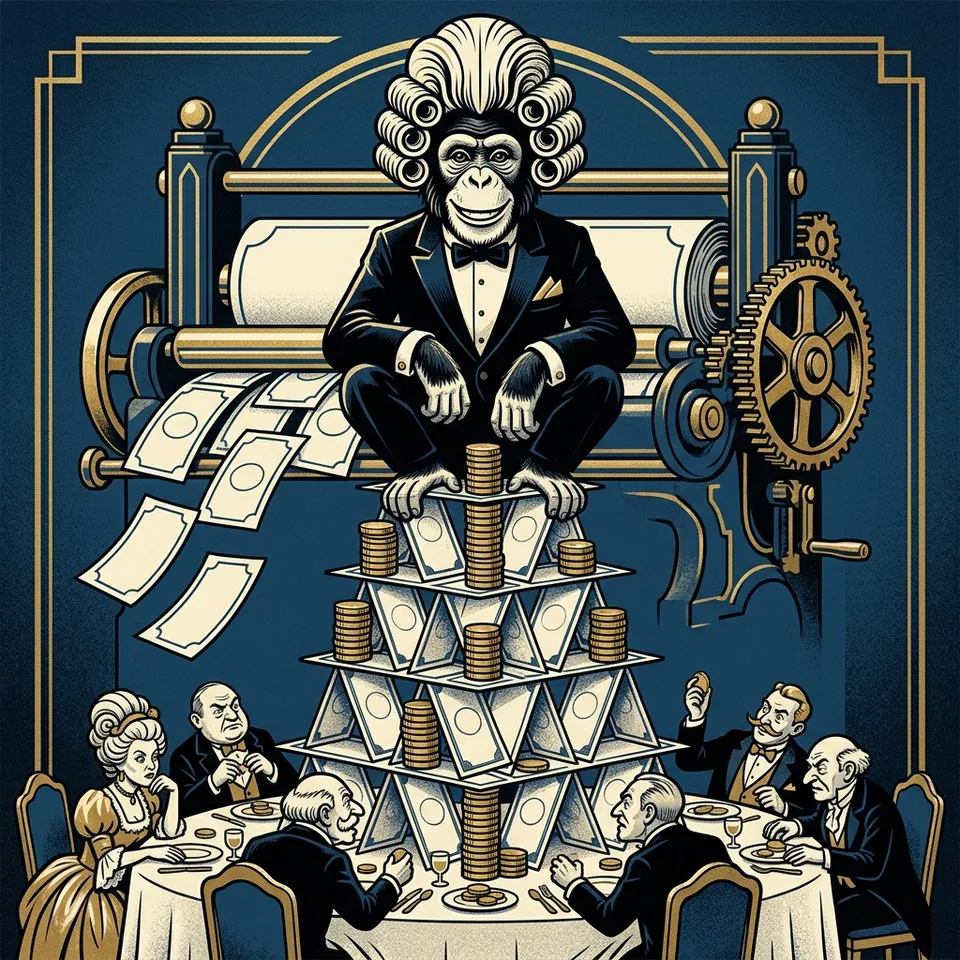
Extra content pops up along the way.
Trailheads
Good places to start walking.Chapters
November 12, 2022
FTX Monkey Business & Eat the Rich
Double-tap the sides to skip 15 seconds
Trailheads
Places to startArtwork explorations
The other takes the image generator gave us, and the prompts behind each piece.
Chapters
Settings
FTX Monkey Business & Eat the Rich
With Kris Tyte & Sean Snodgrass
In this episode of Positively Pedestrian, we discuss the indictment and extradition of FTX founder Sam Bankman-Fried charged with fraud, money laundering, the downstream effects of one of the largest financial frauds of all time and the financial house of cards the global economy is built upon. Then we entertain the thought experiment of the wealthy and powerful in America turning on each other and what this type of family feud would look like in today's bizarro world of wealth and power distribution. Next we move into influence pedaling and clever bribery schemes in politics allowing the enrichment of politicians. Fiat currencies and debt as wealth global schemes, followed by more examples and remedies to deal with a wide range of monkey businesses.
Share
Detour
Episode description
In this episode of Positively Pedestrian, we discuss the indictment and extradition of FTX founder Sam Bankman-Fried charged with fraud, money laundering, the downstream effects of one of the largest financial frauds of all time and the financial house of cards the global economy is built upon. Then we entertain the thought experiment of the wealthy and powerful in America turning on each other and what this type of family feud would look like in today's bizarro world of wealth and power distribution. Next we move into influence pedaling and clever bribery schemes in politics allowing the enrichment of politicians. Fiat currencies and debt as wealth global schemes, followed by more examples and remedies to deal with a wide range of monkey businesses.
Chapters
Show notes
Episode Art 2 pieces
Full Transcript
Cool. Yeah. So you got me these gloves there. The problem is, is that you can feel air coming through them, you know? But it's like they're warmer than no gloves. Right. But it's like the air coming through. It almost makes it slightly colder. Yeah. Yeah. We need, like, this, like gloves on top of love. Yeah. I need the Dumb and Dumber where he's wearing two pairs of gloves.
Yeah. You get so mad, he starts choking him and he goes. Your hands are so cold.
He's choking him to death. And the only thing he cares about is how cold his hands are looking great. But my favorite scene from hands are freezing. From right around there is a priest. Like, talking about how he's got to go to the bathroom. He's like, just go, man. Yeah. Just go. You guys just pulling over for one second would be too.
Yeah. Then he gets off and he's frozen to him. Yeah.
So damn funny. They hit a they hit a certain a certain thread with that. Yeah they did, they did. And I feel like it's something that could just never be done again. Exactly. And but of course, like the movie, they can't leave it alone. And they've tried it. Part two and three. Right. Yep. Yep.
Oh, weird. Austria. Even the pretty good day. I didn't watch, did you know? No, I didn't see either of the other ones. And the bathroom. Seeing. Only rivaled by.
By something about Mary. Yeah.
Austria. Yeah. Good day. Shrimp on the body. Oh, let's not fucking it. And I feel like, you know. Hey, the average American probably fits that spot pretty well, but he didn't didn't understand why that was funny. Yeah. Right. Right. That's so funny. Yeah. Isn't that where that Crocodile Dundee guys from Austria. Yeah. Austria? Yes.
Jesus saw something funny other day about Russian and Prussian. Oh, I don't know. I don't remember, but anyway, we're talking about, SBF and FTX.
Talking about how they extra day they got from the Bahamas. I gotta mention. Okay. Until, like a few months back, I went over to Chris's house and we go to this or we had, you know, Chinese. The for the fortunes were sponsored and written by FTX.
Yeah. So this this this jackass has managed to weasel his way into, like, tons of cover Forbes. And, you know, it's just in front of Congress about how to run a good business and all this fucking nonsense. Right. When someone's making money from nothing, hand over fist, all the freaking warning signs should be, you know, flashing. But instead, all these crypto pros and all these institutions and people who should have said this doesn't pass the smell test were duped.
Yeah. It's weird. It's almost like the might makes right or like, you know, people are making the money. And so when they're making the money, everyone assumes that they're doing it right. Like that they're doing something. They're so smart and they're doing something right. And if you listen to him, on the face of it, he was saying, which he sent admitted in his ju in his interview with box.
His impromptu self-initiated interview over Twitter DMs. Yeah, that he was. But he was feeling all the right things. He was talking about working with regulators since the company's inception. He was talking about doing things above board. He was talking about what was the I forget the terminology they used, but it was basically this form of baking altruism into your business.
Yeah. Right. Like you said, saying all the right things, but then doing something completely different. Right. Having some weirdo nerd sex cult with his freakish looking girlfriend. Well, you know, I don't care about that. Have all the sex you want, but, you know, I do care about defrauding people out of fucking billions of dollars. I'm like, God. Billions.
Like the scam scandal is bigger than Enron, from what they've been saying. Well, it's okay. Back of the neck and calculations put it at 10 to 12 billion. And so that's just just probably the face value. That's not to mention the downstream, you know, effects right. Like people that are heavily invested in it. Yeah. The financial carnage and then how things are leveraged in capital markets.
So like you know, things things are never just one off their their paper on top of paper. There's a multiplier, you know. Yeah. So like that was the mortgage backed securities thing. What they do is they take a whole bunch of mortgages, packaged them together and put a grade on the package. Right. And then sell that package as a commodity.
So when the housing market, you know, kind of bottomed out, not just the the mortgages were bad, but all the notes that were bundled on top of that that were securities traded as securities. Right. Fell out as well. So the same thing is going to happen here with this Ft is that, you know, downstream services and bundled commodities are going to be fucked up too.
Yeah. And so everyone that was every institution. And that's the thing we're worried about the institutional investors because the institutional investors have a have the market sway and impact to take us out. All the institutional investors that invested in derivatives of what Ft was offering or packages, like you said, those kind of things. It's like that's that's the thing all these financial products that were built on top of it, it's this house of cards that is following.
Exactly. And, you know, guys writing himself $1 billion loan and what the how how is that even possible? Right. Like I'm CEO of a business. Yeah, I'm CEO of a business. And I can't just go right myself. A loan out of the business? No. Like, you know, there's. And this is just a tiny business, let alone a big business that's, you know, by default, you know, to be designed to have all these baked in controls.
This is just a small business. I mean, we can't the owner nor I can't go in and just withdraw from the account. No, we need two signatures on it at least. Yeah. So, yeah, we can we can work together. But. And so this we're just defrauding ourselves at that point. In the essence, though, that's what this implies. This implies that all of the people at the top were colluding.
That's crazy. So he's not the only one. A whole slew of people are going to go to jail. Yeah. And this dude doesn't. See, this is the thing to like. You know, you go in, you go in, and knock over a convenience store for 50 bucks or 200 bucks or whatever, you know, and you're you're fuck, you're in jail for 20 years plus.
Right. Like ten, maybe ten, 20 years. Well, what what do you do to other fucker who just defrauded the world of 10 to 12 billion? I mean, why isn't that not life in prison? Never be. You know, and then I mean, service, some type of. I mean, I guess you could you could make it to where you can.
Yeah, I guess you can get to the point where people with real resources could find some way to then, you know, if they feel like they're getting in trouble, never face anything because it just, you know, just just disappear, you know, just disappear out into some country. You know, there's no extradition. Yeah. And, you know, on some secret account, they score the way it has 10 million in it and never be outside the long arm of the lock on the idea.
But anyway. I mean, I think that people that, like, knowingly commit this fraud and at this kind of magnitudes and so many people's lives. I mean, there's plenty of people that were like almost all their eggs in one basket on crypto, you know? And FDX was a big it was a big exchange, was a big exchange. So, you know, there's people whose lives are definitely just like Bernie Madoff, you know.
Well, yeah, there's plenty of people whose lives are destroyed. His rage is even farther than Madoff, you know? And what's so great is he did this in so much shorter amount of time than Madoff did. Yeah. You know, it's like he's really a genius at fraud. I have to commend him. And the system is just so you know, that's that's that's the thing I keep saying over and over is that the system, society as a whole is actually kept it held together by the good nature of people and people acting, doing the right thing.
Right. If if people were just, like, subject to the controls of the law. Right. In other words, like you do it ever. You want so long, you know, if you get away with it, you get away with it. And if if people acted just like I'm going to get away with whatever I can, there would just be society would be completely different.
It wouldn't be cohesive, it wouldn't be. It wouldn't work. So it wouldn't work. I mean, we've got some would say we have a thin veneer of groupthink and, you know, general kindness and altruism holding it all together. We do. Others would say, no, the evidence runs deeper. Yeah, I do think it runs deeper. But also I think that the the evidence is overwhelming, that that's true.
And I agree, human beings, good nature is what holds everything together. You know, then we have people like did see the machinations of the system and see how they can use the goodwill that either they've built or other people have built to their advantage 100%. And we have had a rash of those people getting caught lately. Everybody from Trump to SBF.
Well, so this is what this is. What is the threat of the actual toppling of the system? Right. Because the system 100%, no doubt about it, is catered to the wealthy. You know, we've said this many times is that capital makes money more efficiently. Generally it's we're the wealthy in our society are the ultra wealthy are thought of as you're it's incumbent upon you to be a benefactor.
It's incumbent upon you to bestow your largesse upon society. You're supposed to trickle down what you have. Yes, you're supposed to give it out to some degree. Right? But there's no there's no there's no law compelling. In fact, the opposite. The laws are, are are tailored to help them magnify their wealth. Right, right. Because like I said, capital makes money more efficiently in our system than than labor.
Right? So, so capital in and of itself makes money more effectively than you know you've got, but you've got all these people by about the, the JP morgan's of the world, the Dale Carnegie's the, you know, all these magnet magnates of industry back in the day gave back and shaped our society. Right. They're still the ultra wealthy. You're still shaping our society.
But for the worst, wealthy are taking those things from us. Yeah. So not only are the laws, you know, oriented to favor the super ultra wealthy, but the but the laws are also like, written in a way where there's so many ways that someone who can put up a legal defense can get away with things for so long.
But like Trump's technique of, like, stalling, you know, slow walking everything to the point where it just. And it goes away. Right, right. Or maybe it doesn't go away, but it's a hell of a lot less than it was ten years ago. Yeah. Or like, you know, playing the media, you know, having the media give them free publicity and all kind of.
Yeah. Using the court of public opinion effectively and using the goodwill that he's managed to somehow amass. Right. So get his ass out of things. Yeah. And then you have tactics like, it was JP Morgan or one of the Rockefellers, one of those guys who, GM early on would buy real companies and dismantle them, forcing people to rely more on automobiles.
Okay. Right. So like GM way back in the day for whatever. I think GM was the biggest Culper of this would buy thousands and thousands of independent rail companies that were actually let them down and just, yeah, literally pay people to go and pull the rails up, like lift the tracks out of the ground and just buy the company to dismantle it.
Right. Because that translated into incredible sales. And then the public is on the hook to build more roads. Yeah, right. So like the public infrastructure of roadways. So they would drive public investment and public sentiment toward delivery trucks, semis. Right. Which then directly translated later down the road to their profit. Okay. You know, and so, you know, rails way more efficient way, way more fuel efficient, way more economical.
Right. You know, means of transportation of large. I was wondering why kind of weighing because the automobile industry camped it down and then they weighing further than that. They'd actually go into local government and try to manipulate zoning laws for less rail access, I mean, etcetera, etcetera. Right. So and on one, on one side of the coin, you can say, oh, well, the company is just doing what companies are supposed to do capitalize, try to make money anyway.
No no no no no no no. Any way they can. Right. I don't, but that mindset is like we were talking about. That mindset is shortsighted. Yeah. Mindset is you know feast today. Who gives a fuck about tomorrow? Oh, it's massively short sighted. But welcome to capitalism, right? Well, yeah. Capitalism doesn't have a long memory, so there's nothing illegal whatsoever about buying up a rail line just to dismantle it.
Right, right. So it should be something. Well, so the government, like I said, is still reliant upon people doing the right thing. That's what I'm trying to say, because there's so many in between avenues to do the wrong thing that the system and regulations can't possibly cover all the wrong. Exactly. Can't list them all out. Exactly. So the reason that society works is because of the good nature of people that are working, that are parts of these boards, that are parts of these companies that are parts of the decision making authorities.
Right. That go out and do the right thing in the world. It seems like, at least in my personal experience, that what gets promoted and glorified is the more sociopathic tendencies of those leaders. Right. So. So wait until a non empathetic echelon of new artificial intelligence leaders come on board. What the hell they're going to do? Oh my God.
They're not only getting a game humans, they're going to game the system all the way through and through. Right. And it's just going to end up smoking pile of rubble. Yeah. With, computers at the helm. Yeah. With AI taking all the wealth. Taking all the resources. Yeah. Like I said, silicon and gold will be the. Yeah. Right.
The new the new homage that we pay to these mat overlords will be bending me at the Mecca of at the, at the throne of, you know, some incredibly awesome intelligence oracle or we're offering gold and silicon tribute. Really good at diplomacy knowledge base that makes. Yeah. I just can't wait to see this, like, giant weird computer with all this strange configuration.
Almost looks like this. The, the the quantum computer, they see, like, that kind of garbage can, you know, multi-tiered, I mean, with Adam stuff, right? No, but but I can imagine this computer having, like, the Trump hair on top of it. Okay, so this computer, so this computer idea, this overarching computer that finds the answer right of the answer.
Yes. Yeah. The answer. 32. Four. 42. 42. But yeah, Douglas Adams was kind of writing about that. This and this computer that ended up designing another computer that eventually provided the answer. Yeah. Right, right. Right, right. And but his was all.
For for parody, for making a think. Yeah. For for comedy. I, I don't know, but it was so crazy every time he took his story and put it in another medium, he rewrote it. Nice. Nice man. And it was called the trilogy. Right. But ended up being like nine of them.
Three, three trilogies and then. Yeah. And it's like trilogy multiplier. Oh, so fucking weird. But that's that's hilarious. It's also, like the people that are talking about Star Wars, like Harry Potter is just morning. They Harry Potter is just Star Wars written badly, like, rewritten and with shittier weapons. Right. I mean, with less cool weapons, it's it's goes back to that classic, you know, hero's journey from Joseph Campbell, right?
It goes back to the, you know, that there's whenever you take those kind of stories, you can break them up into known elements and a known arc. Yeah. You know, it's just that's why they're all similar. Yeah. And the ChatGPT thing is like, you know, able to write whole novels based on these kind of exact ideas. Yeah. So, so it just it just goes out and pulls existing content, right?
Right. And then gets the general sense of the theme and then just writes your story, you know. Here you go. And yeah, sure. Here's a new book for Hela to consume. And if a human being came in there and maybe you saw some plot points and, you know, kind of made it a little more cohesive and you wouldn't have to do a whole hell of a lot of editing work.
Yeah. Right, right. You know, to make a blockbuster, I bet. Yeah. Right. Totally. Yeah. So this this idea that I want to talk about today was that the eat the rich phenomenon, like this idea of the rich turning on each other. Right. In a series of chained events. So, like, oh, yeah, you're going to take me down. Well, blah blah, blah.
Right. And that chain reacts through justice, you know, because it has to once, once one domino falls kind of thing. Right. And so the amount of, the amount of fraud that that must exist out there, the amount of fraud and abuse in all of its derivatives, right, is criminally prosecuted. In many cases, in many and most cases.
Right. So if the if the wealthy started to legitimately turn the legal system onto itself, right. Boy, you have a whole different turn of events because this is why, like, I believe that Trump isn't been fully indicted yet. Like I think inevitably he will be right. Because it's just too much of a steaming pile of turd to not not recognize.
I really feel like what the state of New York is doing is they're trying to make sure they get it right. Yeah, well, you remember the thing that I put out, like how to really stop Trump, you know, like Billy Valentine, the way that the way, the way that you hurt rich people is hurting him and poor people.
Right? Right. And that's completely right. By by taking away the the money is that you strip them from their from their power position. And to be real. You know, they layers upon layers of protection that guys created the, you know, the various,
Constructs that he's built have to be torn apart piece by piece and carefully so as to maximize the punishment. Right. But then in the meantime, you can't have somebody living out the rest of their life without ever facing any punishment. So the idea is to, like they indicted the Trump Organization recently. They the organization. Yeah. In all kinds of counts.
And but it's the organization. Right. The corpus of the organization. Yeah. So there maybe maybe it's like the idea. That's that's the outside. And we're working from the outside in. Yeah. Yeah. But there's so many fat layers to go through that you'll never get to the core here. And, you know, maybe maybe that's the deal. Maybe they know we won't get him before he dies, but we sure as hell will cause some pain for what's left of his family.
Yeah. So fact that he's a former president is offering massive protections. The fact that he's re-upped for presidency 2024 is offering him massive protections. Right, right. His wealth itself is offering massive protections. He's got he's galvanized legal machinations that he's put into place. Yeah. Are offering a massive protections that we can't even fathom or unpack on this podcast.
Yeah, right. And he has layers of Teflon. Teflon Don. He's got layers of Teflon because clearly he has all dirt on everybody. And that's why he was so desperate not to leave the presidency. That's why he was so desperate for a second term, because it was automatically going to shield him from all this nonsense. Right. And the fact that he lost made it, made it way worse.
And so, you know, you know, the history, insurrection, all the bullshit. Well, yeah, it was the last gasp of a wannabe dictator, right? He was literally cornered because he knew all this stuff was inevitably going to come good. But so we have this, like, multiple kind of issues here. Right. One issue is that we don't want to turn into a banana republic.
We're the new administration that gets in charge, goes and puts in prison all the people from the previous administration. We don't want to have that kind of system here. That's one thing we're worried about. So there are sensitivities there. But also, if you're fucking piece of shit, let's send you to jail. Well, that's never happened. So let's fucking do it today.
Right. But then you create this trend and you really see that trend happening. Like, so the fact that the Republicans are taking over the House, they're already talking about all these committees to go after Democrats. They are. Yeah. Right. And so this could be the beginning. Inventing Trump could be the beginning of this whole retribution. Directing government resources at going after just basically the snake eating its own tail and a detrimental way.
Yeah. You know, the morning. Yeah. That can only go on so far. Right. Until snakes to to, injured to continue. Right. Especially when it eats its own anus. Yeah. Right. So we are in essence, you're saying it could be the beginning of the downfall of ourselves just because, it's driven by capitalism and revenge and. Right. And so the stupidity.
So. So if you look at the shot, it is so beautiful. So if you look at the profile of the typical senator or house, house, member. Right. Senator or House member. So basically this imagery of like elected government officials are in Congress, right? Because Congress's biggest as far as numbers. Right. Supreme court isn't that large. And obviously president and vice president.
Yeah. Unless you take less, you take into consideration all the staff and appointments and all that. But yeah, legislature is the most visible and powerful. Yes. And if you just do a back of the napkin calculus on what happens, you know, somebody gets gets a seat as a senator and now they have a salary of 100 and 5060 K, something like that.
Right. The average is around 147,000 somewhere in that range. Right. Which isn't major source of the imagination. Right. And then you look at their net worth after their term and it's millions. And how the fuck are they getting millions of dollars out of 150,000? Yeah. And the answer is that they're having speaking engagements. They get, you know, all this, all this on the corporate dime, just it's all.
It's all dark shadow money, right? That's coming in through super PACs and, you know, indirect benefits. Right. And so.
You know, there there's the snake eating his tail. There's if if these people start going after this kind of corruption, you know, and say, look, you knew you can't just go and have a speaking engagement for $50,000 for one hour of speaking. Right. Right. That's obviously a front for fraud. Yeah. You know. Oh, like you didn't provide 50,000 value there.
Sorry. Right. And it's probably not even 50,000. It's probably 250,000. Or a million bucks. Right. And so, you know, the point is to pick on the Democrats since I've been picking on a good job, lady. The Clintons, seriously, they were making like. Yeah. Right. It was something like the average they were making a year on speaking engagements was like 10 or 12 million bucks.
Right. And so. Yeah. Right. And so these things are so hard to like. You said, there's just you can't make legislation about anything. But every single person that that has a even sense would see that there's something wrong with that. Right. Yeah. And so you can imagine, like, all of a sudden our system changing to our legal system says there's a common sense criminality clause, okay.
If it smells criminal, it is criminal. Well, it's based on a judge a judges has to say. And then all of a sudden, the judges start getting really political that that's not happening. Well, that's already happened. Yeah. So we can't rely on the judiciary. Okay. Isn't it hard to say judiciary or judicial without sounding drunk now anyway? Yeah.
Go ahead. I was, I was, I was putting the notary signature block on a document the other day. Right. Yeah. And that signature block is called the At test station attestation. Holy crap. And you just said it. Really? Well, I was stumbling on that word. I couldn't say it. I was like, I felt like one of those kids trying to say specific.
Right. And Pacific. Yeah. Specific. And Pacific ruined me for years. Like the one I felt the worst about as a kid. Because I felt like I should have been able to say it. It's spaghetti. I couldn't say spaghetti. Yeah. It's all. Yeah. Or variations on it. I'd come up with like, ten different ways to say it that were not spaghetti.
Those are really common words. I think that kids mess up. Yeah. Specific and spaghetti specific. Pacific. So many different derivatives of fumbling that word. But attestation was killing me. That's a tough one. Attestation. Yeah. And so I could just say it's the notary block where they attest. Yeah. Yes. Exactly. Because that was I can handle my brain can handle that one.
Yeah, I can handle a test. But attestation, it's a tough one. I had to say it like 50 times. That's how I can somewhat say it now, but it's still not fluent. Right? Right. So it doesn't flow. Yeah, but totally hits me like jurisdiction or judicial or justice and all that. Like. Yeah, yeah. They just. You sound drunk when you say it.
Yeah, it was funny. There's maybe something interesting happening in the brain, you know, like, that might not be by accident because. Because our brain has such an ethical revulsion to the two tiered system that fumbles the words, it's like this word doesn't mean what you think it means. Like like you don't even want to say it like it's cognitive dissonance in two syllables.
Yeah, yeah. Justice. It's a double entendre of of of brain numbness towards the term. So, Yeah. So, so here, like this idea of, this system turning against those that benefit from the system could totally disrupt the whole apple cart, right? So, like, come on, let's be honest. We know that a lot of people that get into politics can see the big dollar signs.
Yeah. You know, because there's there's not only that. There's a revolving door. There's you know. Right. You get out, you go right back in as there's a fucking career path that is clear and is really just climbing the ladder of cash, for sure, because then you turn it around after, let's say that you get booted after two years, you still have your Rolodex of contacts, you still have all your LinkedIn contacts, right?
And then you will jump right into as a business consultant, at the very least. Absolutely. Some law firm hires you to now be an influencer. Yep. Yeah. Like the original equivalent of a social media influencer. But it wouldn't. Politics. Right? Right. You're going around you, Grace and palms. You're leveraging those contact and even you and say even. You see, Charlotte had a guy that was hired to do that.
His name was Olden Broadway. I'm sure he's dead by now. But he was the executive in residence, right? Yeah. And that's what he did. He took his contacts that he had built since he had been. His working life extended from, like, the 50s to now. Wow. And so. And he started out as, like, a IBM technician, right?
Yeah. And so the guy knew everybody, remember, you know, Fred Brooks, the mythical man month. No I don't. Okay. All right. There's a seminal project management book called The Mythical Man Month, and it's talking about, whenever they developed IBM OS 360 and, you know, it puts out tenants that we go by like, hey, adding more people, adding more people to the problem isn't necessarily fix it sort of thing.
Oh, right. Right, right. Yeah. But it talks about those things. Well, engineering problems aren't like standard construction projects, for example. Exactly. And so it outlines how you know how to approach these things and succeed. Well, yeah. So if you had two dirt piles and your objective was to move them and you have tons of shovels, right. You can just put a certain number of maximum people on it, like only so many people can access the pilot of time on the size of the pile.
Right. Right. And so there's like. But in general, the more people you add, the faster you move the pile. Yes. But an engineering project isn't so, so clean cut. Yeah. Because there's communications overhead. There's layers of knowledge, work and design, design choice differences. Yes. Like. And each of these layers. Velocity differences. Yeah. Right. Totally. Front. Front where. Middleware.
Back where? Yeah. Back in front. End type thing. However you want to divide it. And so, Well he in the anyway that Fred Brooks was at NC state, you know, whenever I was at Unk and Eldon Broadway is still talking to Fred Brooks, he's still talking to all these computer luminaries that he happened to meet when he was, you know, down at the bottom of the ladder.
Yeah. And they all grew up together. Yeah, yeah, yeah. And so, you know, you and CC was like being a research university. It's all about contacts and who you can bring in to get money and who you can align yourselves with to look good. Right. So, so there's like legitimate concern over like, the Burisma thing and Hunter Biden in Ukraine getting millions, if not billions for being on a board of some foreign company.
Right. Yeah. It's like, obviously there's some political influence there. But back in the United States, and I guess what I'm saying is, even on the crappy levels, the same structure is present. It's like that, that, that it's like the corporate fractal. It is. And it's like, at what point is it illicit? You know, like, and that's what I mean, where you could end up with this kind of adjudication system where the judge makes the ultimate decision, saying, no, you intentionally peddled your influence like you knew that you weren't bringing any real value besides your political connection right to the table.
And once it reaches this dollar threshold, it was clear that this was fraud. There we go. Right. And so you're peddling influence not, you know, but but right now that's not a crime. Right. And we'd have to we have to groom our judicial system to recognize that this undue influence that though it's not directly tied to an illegal undue influence, leads to that legal gray area, leads to right, which enables the gray area.
The gray area enables it. Right? Yeah. And so this is like exactly what happened with the Ft. Is this gray area of what's allowed to happen within corporate walls. Yeah. Right. The lack of oversight when. So especially when someone's successful. When someone's successful, they're giving more, even more leeway. Right. Yeah. And they're under less scrutiny because. Oh, they must know what they're doing because, you know, they're doing so well, blah blah, blah.
Again, they had this dude up in front of they had this FTX bro. You know crypto bro. Like hey said that it's funny I'll use that. They had this crypto bro up in front of Congress talking about how to tamp down fraud and abuse in that. That's that's that's hilarious. That's the problem with what we glorify in America, right?
Yeah. We glorify the might, makes right. The money makes right. Yeah. The success whitewash is all your crimes. Right. And so that's what I'm saying. If that system were to turn on itself, you would see this. You'd see the oh, my God, the bleeding would be so profound. Or maybe we can come out of it and do an apartheid sort of thing and say, you know what?
This was wrong. Here's why. Do a postmortem. Yeah. And, you know, there's again, there's so many examples of this. You know, junior senator comes in. They have no net worth to their name of any kind of appreciable value. Right. And then they go in and they come out a couple of years later. Multi-millionaires. That's clearly you don't even have to.
You know, so like Bernie Sanders for example, is millionaires now. Yeah, absolutely. This comes from book sales, right. You know, in the majority he wrote a book and he's using his his fame and popularity and populism to cash in on a book. Yeah. He is. And, you know, and I don't know that that seems more like not so bad.
Yeah, that doesn't seem than a, you know, there's $200,000 speaking engagement for two hours at a Rotary Club. Right. Right. In Chicago. Exactly. That no one went to. Sorry. Yeah. Right. You know, you had, like, fucking ten people at. Yeah. They just went and, you know, spoke for 30 minutes and they didn't sit down. Eight. You know. Yeah.
And here's your $200,000 check. Yeah. Or however many. Yeah. However, what's the upper limit? Right. Right. I mean, what is it? Fraud. And that's the thing. All right, so, banks, the way they've done this sort of thing right there, they try to hone in on fraud with suspicious activity reports, but they never turn the fraud detector in on themselves.
Right. Well. Right. Right. But they try to hone in on people using their system. Yeah. Yeah, yeah. Fraudulently. Right. Right. You know, we can use our system fraudulently all day long. Yeah. Because it's it's written into law that we're allowed to do this, right? Basically counterfeit. But, you know. But you. Yeah, sure. We can leverage your money a hundred times.
It's fine. Yeah. But if you spend 100 hours making a $100 bill, that's counterfeit. You're going to jail for life. So on this fraud with suspicious activity reports and the threshold commonly for a SAR is ten grand. But what they do, whenever you approach that ten grand, people may make suspicious. A human may make a decision to still say this is suspicious.
Right. You know, especially if you're trying to go. So I think we need the same sort of thing judicially looking, you know, they've got all these things that are profiling all this data and popping things up in front of human beings is potentially suspicious or suspicious activity. Why don't we have the same sort of monitors and controls over.
I mean, we have all the damn social data and they monitor us already. Why not feed into a system that says, hey, so this is a pattern? Yeah. So here's a here's a particular example. I think that's just so clear cut. Right. It's like every nation in the world, not every nation, but most nations in the world carry debt with other nations.
Right. Well, sure. So that's the functional equivalent of like you and I like me loaning you dollar. You, me a dollar island. Only $10. You own me $10. I loan you $100. This ledger that both of us can see and like. Hey, you know, you hold $600 in my debt, and I hold, you know, 450 of yours. Right.
And so instead of just saying those two debts cancel. We carry that debt as as wealth in our in our books. Right. Because I could call you on your debt. Yeah, but I could. You want. But but is wealth, right? So, like, if I can go into debt for $1 million, I have $1 million of actualized capital at my disposal, right?
So I can carry $1 million asset on my sheets because I have the debt potential of that amount. So, like, basically, I can turn that into cash if I needed to in theory. Yeah. So no, if I had $1 million in credit. Yeah. In credit access, like right now, I could use that as an investment instrument. Okay. That's an asset as an asset class.
Right. So debt as well kind of idea. Right. Right. Or the perpetual for debt is wealth. So in all the Trump says openly I love debt. Yeah. And he loves he loves the uneducated too. Right. And so yeah he likes all these instruments of, of of the allowing to easily step on, you know, the people. Yeah. But but anyway so so like debt is wealth kind of idea.
And so like China is in debt for trillions and the US is in debt for trillions. And all these major countries in the European Union is in debt for trillions and blah, blah. Well, who the fuck does the world owe it to Mars, right? You know, from now, from, you know, whatever the name the other day was hilarious.
Libor. Clipboard. Yeah. Clipboard is the debt holder of the world. Like. Like it's all shell game. Funny monkey business. Yeah, right. And so they clear fraud, waste and abuse is these fiat systems around the whole world, right? And so it comes China and Russia now looking to geopolitically create a new currency with teeth. So that's backed by commodity.
Interestingly wink wink backed by commodity. Okay. So I don't understand all of this. It's backed by crypto. But let me tell you what little you know it's backed by FDX. So there's a digital dollar pilot ongoing in the US right now, brought about by a series of executive orders from Trump and Biden. What? Digital dollar? Yeah, it's a digital dollar pilot.
This must go on for 12 weeks. I think it's about over now. And, Wells Fargo and lots of other banks are involved in it. Oh, boy. Now, this digital dollar pilot.
Seems to feed in to something that's going live in March called, I think it's ISO 222 and this, this international standard. Basically.
Establishes annoyance, so to speak. Some of these cryptos as being medians of mediums for foreign currency exchange. I see and keeps them in theory, is keeping the banks from having to shove physical assets to each other to settle debts. Right. So so the crypto scam is so lucrative and makes so much money. The banks and the government wanting on it too is what I'm hearing.
Yeah, that's just fucked. But in okay, when you look at it from a technical perspective, what they're trying to do, at least it seems like, is simplify the chain of custody of physical assets, simplify the layers of middlemen. And right built on top of the back of a foundation of fiat anyway. Right. Bullshit. But that's bullshit layer. So the the fiat currency layer is already corrupt and and rife with, you know, just fucked up.
But this idea here is to supposedly tamp down for OD, tamp down waste, tamp down abuse, because you have a distributed ledger that keeps track of transactions. You have, you know, you you should be able to follow the money. Yeah. So the Swiss system can't do it. So the Swiss system. Yeah, Swiss system can't do it. Right. Right.
So this new system will be able to do it. That's apparently what they're doing is for the most part digital, as I'm saying. And Swift. What do you mean for the most part? I mean, you think banks are sending, you know, cargo containers of cash each other. I gather the law requires them to do that to some degree.
Oh, come on, it's most of the shit is just numbers in the computer, and everybody knows that. Right? But the amount of the amount of money in computers and the amount of money. 100% sure that this is this is what's going on. But there's these basil three regulations. Okay. Yeah. That seem to point to back a bank needing to back its currency reserves with physical gold.
Okay. When is this supposed to happen? Because that's not that's not even close to being the reality, right? I mean, there's no there's no, commodity backing any of it. That's a whole that's the whole definition of. Yeah. And that's it. It's it's it's funny money, but, the value is proportional to the amount of value people believe it has.
And so.
It has no material value. This digital dollar stuff, it's opposed to get us out of what they call triffids. Dilemma. The captain. This guy. This is, I believe in the 30s was basically saying our fiat currency, our funny money, our monetary policy deeply affects all these countries that depend on our economy. Right. If we and there are other countries that are even openly keyed to the dollar value.
So if we print more money and saturate the market to bring things down, it hurts them too, if we, you know. Right. Well, you know, it taxes them too. Taxes and that's it. Right. My money printing is just an invisible tax for sure. It is so. And and how can you resist it? How can you resist it? So, like, you're a politician, right?
And you, your whole thing, you get into office and your majority of your time is fundraising and securing your next election cycle. Right? That's like the the major part of their activity is fundraising and making sure they get elected next time. So you have your finger on the button that activates the printing press, right? How could you possibly resist that?
Because you can throw all this money in the economy, right? You could throw all this money into the economy. And it looks great because you get an initial stimulus from this massive influx of everyone that happy running. Yeah, I know if they want to start running, like remember that we talked about that way back on one of our podcast like we did.
I think it was Joan Rivers or somebody saying that like the reason that she doesn't run because no runners are really happy. True. Like if I, if I looked around and all the joggers were all smiling and, like, loving their lives, then I might consider it right. But they look like they're in pain and well, yeah, I was invisible.
That was happiness. Or that was the. Yeah, this rictus plastered upon her face. It was just, you know, it's like just just absolute pain. And that might have been her death mask, right? She's about to drop dead. And that's how she looks in death. She has. This don't mean euphoria like that you get when you're on your way out.
Like a sense of impending doom hit a mile ago. Yeah, right. Like, she. She tore a muscle. All this potassium was being released in her blood. Her heart's about to stop. The top of mine is like flying serotonin slams. Yep. Yeah. And then boom. Death mask, grimace mortis. I love it, face. And we're envying it like. Oh, wow.
She looks heavy. Yeah, I think she was listening to comedy on her podcast. Oh, that had to be like I had to be. She was listening to positive Pedestrian. No. Yeah, yeah, she was listening to Positive Pedestrian while making her way around this picturesque park. Yeah. She was she was a, you know, listening to the green giant's dick part and laughing was a skunk story.
I think that is one of the funny one of the one of the other funny, funny, funny, funny things we've said or. No, she's making, she's listening to a secondary podcast that somebody made off of clips from our podcast. Yeah. Where they're commenting on on Doctor Pepe. Yeah, yeah. So like, it's a collection of the funny stories and these little tiny jokes and anecdotes that we said funny things that we said and coalesced them down to 30 minutes.
And she's listening to that. That's what she's listening to, I'm sure. Yeah. Because I mean, guys, we know where that kind of viral. He has that kind of societal impact. People are creating derivatives daily.
Like that should be another one of our, our random titles. Viral. We've gone viral like an SD.
You know, viral has like, taken on a possible positive meaning in today's society, right? You know, but let's get down to business about what viral really originally meant. Yeah, yeah, sometimes the disease and dysfunction is baked into this. Yeah, yeah, yeah. Maybe that's like a nice double entendre to the word itself anyway. And that's the thing. I mean, that's the whole implication of a meme is the ability of it.
Right? Yeah. Yeah. It spreads it's community. You can communicate it. You can. And, that's, that's it. You know, we are we want to be as communicable as syphilis. That's that's the one I want to do. And we're not afraid to say that we could. Very well, our way of thinking very well could be a disease. It could.
And that's where I'm going. Because. And maybe not so good idea to spread syphilis turns your brain as a Swiss cheese. Listening to us would probably do the same. Oh, I think no, I think a really good like, Münster. Oh, yeah. Dude, I love him. Once there melts or it's so good, like a stinky Gouda or something.
No, I like the milk ability of Munster. I'm going to go with that. I agree with you. Oh man. So freshly grated Munster. So our podcast is like syphilis because it'll turn your brain into cheese. But in our case a nice melting Munster. Yes, yes. Finding you. You'll consume this with your pinky out. Yeah. Your brain will be able to be made into the finest of girl.
Jesus, I think think like us. You'll be a pretentious prick. Douchebag. Who? Who really, at the end of the day, has never seen any measurable success in their life. But who is tech oriented and forever chasing the tales, the the the exhaust of those who have been successful? Yeah. And let's add one more moniker to it. Genuinely do care about people.
There we go. Would you actually just further hobbles us, which it might actually be the source of the detriment. Yeah. There we go. Like, yeah, you can't find success in life. Analyze how much you care about other people. Do you care too much? Okay, what I'm saying, you're just like it's bleeding heart that just can't help themselves from, you know, can't help yourself every time you get a dollar spending on somebody.
Here we go, though. I mean, you gotta say, the PR success of Mother Teresa, that was pretty unequaled. Yeah. I think if I measured my success about the amount of money that slowed to me to others in my lifetime, I'd be considered wildly successful. Well, there we go. I mean, maybe that's the right metric for success. Like how many people you've employed at how many dollar value over the years?
I mean, millions and millions for me. So there we go.
Currently not employing anybody but myself. That's okay. That's that's actually subject to change. With the business. I told you, we have an investor now, so. Yeah, man. No. No contract has been inked, but, you know, handshakes been done. Cool. You know, we'll see. I'll keep the podcast at the edge of their seat. Listening, sir. Oh, yes. The, on the cusp of wild financial success of our for profit business.
Yeah. As we decry the damage that capitalism brings.
Yeah. And, of course, you know, wink, wink. I'll do everything right. Yeah, yeah, yeah. Oh. Good time. I'm altruistic, you know, nerdy crypto, bro. Don't worry. You can trust me. I'm not a I'm not a fox guarding the henhouse. No, no. Yeah, well, could you have a girlfriend like this and be, you know, really some kind of mad, you know, like this and wear long socks?
And could you look like me? Yeah. And be an agent for fraud. How is that possible? I really do feel like that helped him. I really do, because he looks like he looks like some kind of nerdy moron who wouldn't have a social clue. Yeah, yeah. Just like, you know, the mask of the business suit, right, is the same thing.
Like, so that's the. That's the crypto bromance. I love it. Yeah, the crypto bro mask is the sweatpants and t shirt. You know, it's fucked up hair. Yeah. Why is fucked up hair thing? I don't know, dude. Trump, Boris Yeltsin or whatever the guy's name. No. What was the guy from? It was a. Yeah, it was Boris. Boris something.
Yeah. From English dude. Yeah, yeah. Johnson. That's it. His fucked up here, right? Crypto bro. Guy is fucked up here. Yeah. Rand Paul, whatever the fuck that is. What? Can I hate that guy? Well, I don't have a dog in that fight, but his hair looks deep. He does? Yeah. So what's up with fucked up here? And, you know, it does seem like it's this a title shield, so to speak.
It's like a weird thing, right? It's like what? So you take them less seriously and don't see them coming. I think you might be right.
I mean, there might be something to that, you know, like certain social cues that are signaling no real threat here. Yeah, yeah. Fucked up here might be one of those things now, since so many people have been using it lately, maybe it'll have less of an impact. Yeah, they've abused it. Yeah, it's been used too much, but this, I love the I love this, like, suit and tie as just, like, uniform for, this just double edged reality, right?
Is like, it's the smiley glad hand with a hidden agenda thanks to tool. Right. Tools lyric here. Yeah, yeah, yeah. And their enemy song. Right. So fuck smiley glad hands with hidden agendas. You know. And when I see like a suit and tie, that's one of the things I think of right there. I think I'm a smiley, glad hand with a hidden agenda.
Right. Like dressed just for success, quote unquote. I, I see it also as the classic prestigious. Right. It looks sharp. Yeah. There's a reason why that look is. Oh.
You're just trying to get run over. We got we almost got run over in the process of trying to not get run over. That's kind of funny. So, there's also a prestige about it, which I believe is there. It's got that V shape and the tie comes down. Right. It's makes someone look more stern, more profiled, more chiseled, more fit.
True. Right. And you know, all right. So it has a it has a stylistic looking term about it and able to engage in that photosystem at any moment. Definitely. There you go. Helps you helps you in the boardroom, helps you anywhere as the cultural significance that it carries those attributes. Right? Yep. And so, it carries the cultural moniker of business and professionalism.
Right, right. There you go. And then lastly, someone had to take time to get that outfit arranged that way. Yeah. So there was there's a there's a noticeable effort put into it as well. So you can find all those factors together. And you know, you get this like mixed bag of expectations and, you know, signaling that that type of uniform puts forward like uniforms put forward an idea.
Right. Any type of uniform puts forward an idea. So like all of a sudden, if I dress you in battle fatigues and put you in a Kevlar helmet and combat boots, you're probably going to carry yourself a little differently than if I put you in sweatpants and t shirt. You're gonna assume the cultural trappings of your mode of dress.
There you go. And so the uniform invokes the spirit of the wearer to some extent. Right? Right. So, like, if all of a sudden I put you in a monkey suit and you're you're you're the mascot all of a sudden for the Cleveland bananas, right? Or the Cleveland orangutans or whatever. The fucking sports team. And I put you in a monkey suit and, you know, have these banana balloons that you can shoot into the crowd.
You'll probably be acting a little bit differently than you are dressed up in winter garb, having a pod do it in podcast. Right? So not only acting differently, your whole entire like character gets invoked by the spirit of the uniform, right? So I'm making a case for why certain uniforms are can be beneficial or detrimental, right? So like the person in the trailer park that keeps themselves in sweatpants and t shirt all the time.
Basically, we're in pajamas all the time. It's never going to be taken as seriously as somebody who. Right. And they're probably not going to take them selves as seriously. That's that's exactly what I was getting at. The spirit that gets invoked within. Now, let me get to the final nail in this coffin when it comes to the suit.
Right. Is that I love telling the story because when, when when I saw it, it stuck in my mind, like, burned into my brain. Right. Is that in the barracks at the military? At the. The barracks at the military base. Right. The barracks. The barracks were majority of the the young male enlisted soldiers live young male, single. Yeah.
It's over. It's always designates this one little area is like the central, you know, desk, if you will, for the, for the building. And so you'll have the soldiers will randomly take turns or on a schedule, take turns. Posting is posing as guard duty, you know, so they, they keep track of who's coming in and out and keep, keep watch over the barracks.
Right. And so on the wall. For some reason, I don't know why they do this, but they show your entire chain of command on the wall. So start with your you know, your do that since basic, you know. Yeah. So you'll have a lieutenant but like you're Captain Major, you know, first sergeant, sergeant major, etc.. And then it goes all the way up to the president.
So it shows your basic authority chain of command all the way up. Right. And so the people that are like captains and first sergeant, stuff like that, you'll see them in like use like battle dress uniform. You'll see them in their military fatigues. Right. Right. But then as it goes up, you see the you see the sergeant major or higher.
And it implies that these people are not active in the future of war. They manage it. Right. And so, like you have the low level manager who's like dressed more like like more or less like you. Yep. Right. It looks nice. It'll be pressed, but you know. Right, right. That in their official photo. But then as you progress up, right, it goes to like formal dress uniform, military dress uniform.
You'll have that for like the sergeant major and higher. But then it changes to business suits. Yes. Then finally you're with the president who's just interested in the business suit. And so what does that tell you about military that has every symbolic, all the symbolism that you need to understand. The military industrial complex is right there before your eyes.
The thing is, it's transferable to not just the military industrial complex. Absolutely. To every every system we make ends up having higher and every in detail each have trappings for sure of them. And that's why there's that old adage, dress for the job you want, right? And so this. Yeah, totally. But but this, this actual symbolic like chain, like literally it's linear.
You can see, you know, it's in a linear fashion down the wall. Right. So for left we, we read left or right. So it's position left or right. So like you got this guy who's like basically in the trenches with you you know. Yeah. And then all the way up to like these untouchables that you can't touch that are, that are in business suits telling you that the true nature of what this organization is about.
Right? Right. It's about business. And if anybody in this world stops understanding that that that military activities is business. If anybody doesn't have that connection in their mind. You're welcome. And never change that connection because it's 100%. The pure, real truth of the situation is that military industrial is dangerous. Yeah it does. It looks like it looks like awkward to traverse.
Right. Yeah. So we're looking at this a really strangely designed staircase with a bunch of Christmas or eclectic Christmas ornaments and decorations and things on it. Shares in the middle of it. Yeah. Just looks like drunk death. Anyway, that's it for today.