Extra content pops up along the way.
Trailheads
Good places to start walking.Chapters
May 23, 2024
Symbiosis - Humanity, Technology & the Web of Life
Double-tap the sides to skip 15 seconds
Trailheads
Places to startArtwork explorations
The other takes the image generator gave us, and the prompts behind each piece.
Chapters
Settings
Symbiosis - Humanity, Technology & the Web of Life
With Kris Tyte & Sean Snodgrass
This episode delves into the intricate relationships between humans, nature, and technology. The hosts explore the concept of symbiosis, highlighting how our connections to the natural world and technological advancements shape our existence. Drawing inspiration from Carl Sagan's 'Pale Blue Dot,' they discuss the responsibilities that come with our growing influence on Earth and the importance of intentional progress.
Share
Detour
Episode description
This episode delves into the intricate relationships between humans, nature, and technology. The hosts explore the concept of symbiosis, highlighting how our connections to the natural world and technological advancements shape our existence. Drawing inspiration from Carl Sagan's 'Pale Blue Dot,' they discuss the responsibilities that come with our growing influence on Earth and the importance of intentional progress.
Chapters
Show notes


Episode Art 1 piece
Full Transcript
To get started. I have this little image up here. And this is an image that I've been talking about for a long time. And, one of my good friends, Sean, is here. And this isn't a plug, but we have a podcast together. And when we talk about technology in this podcast and we, it's called Positively pedestrian.
What we do is we walk in the mornings together for exercise so we don't die of heart attacks. And,
Usually say as serious as a heart attack. This is as funny as art attack. I like it. So anyway, we walk in the mornings, and so we were just talking all this crazy stuff because that's what we do. It's kind of friends. We are. And, I was just one day. I was like, you know what? I think some people out there in the world might want to hear some of this craziness.
And a couple years ago, a podcast was born. And so we've been doing it. And, this image that I have on the screen, I described that length in the podcast, and what I did was I actually used the audio from the podcast and got a transcript using this program called Adobe Premiere. I got a transcript that was AI generated.
So basically take your voice and you feed it in there and you say, give me the text and it converts your voice to text to speech or speech to text. Right. And I use that text as the prompts in a, in a image generating AI called Midjourney. I use it to create this image. So I use the clip of me describing this image in the podcast to make the image for the presentation.
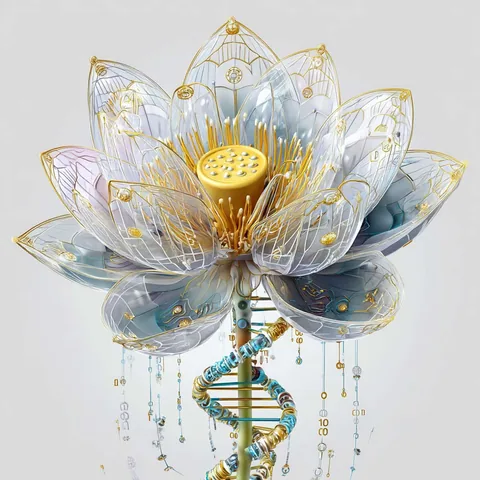
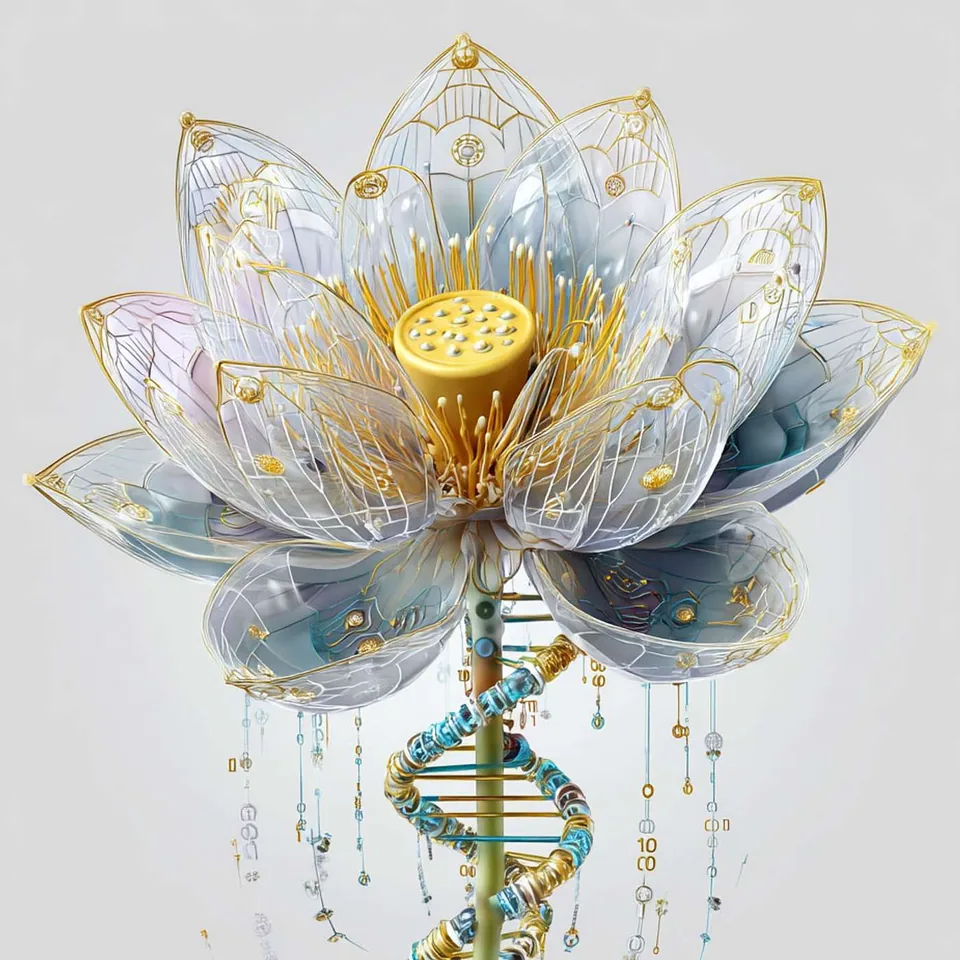
So not that this isn't about podcast is not about the image. I just thought that was in the Italian of where the seed came from. This was conceived years ago. This idea of this image and what you see here is a lotus. And what's so neat about a lotus plant is it grows out of the mud, murky water.
This like just you can have disgusting, you know, swamp with garbage, you know, and whatever. We'll film on the thing like the worst kind of pollution scene you could have ever imagined in mind. And this plant will come up through its hydrophilic. So come up hydrophobic, you know, the bud will come up and you will open up. And inside will be this beautiful, pristine flower.
Right. So out of this murky depth will emerge this plant. And this plant will will display its flower as beautiful flower. And it's perfect. So it can, like out of the garbage in the swamp, out of the primordial. Like, like junk. What will emerge? Just like beautiful, flower. And this is my metaphor for men, right? So, like, I believe that was merged on this planet into something truly.
And we seem to have, to some extent gotten some of the muck off of us, and we've managed to very much flourish. So that's the metaphor. Now below, you'll see it's hard to maybe hard to see in the screen, but, what you see is the double helix, around the stem. And this is made out of zeros and ones.
It's like I did it like binary trying to be clever. And the idea is that we have our ag t g and see, you know, our standard genome, our genetics, our DNA. But we also have with humans, we also have this kind of third thread running through us, which is technology. So the idea behind this is that it's supposed to be an image representing all these features.
So that's why that's the thing. It is what it is. So let me advance the slide and keep going here. I will take questions at any time, especially if something straight reminding you have to get it out. I will, I will stop to pay questions. I have no problem doing that, but within a reason. Okay. Yes, sir.
Oh, you should have. Yeah. Perfect. Okay, so we're starting off here with this, first idea of this web of life. And now most people have heard of, like, the food, the food web, and there's all these words for it. You know, the food pyramid, the food tree, all this kind of thing. And predators prey. You've heard all these words in biology, but we're looking here today is, we're in this space called the sanctuary.
So this this building, this particular room in this community center is known as the sanctuary. And so I think that it's fitting, because we're here to contemplate something pretty sacred. Okay. And what I think is sacred is our connection to life, to each other and to the systems that sustain us, or in some cases, endanger us. Right. And these are sacred.
So we begin not with ourselves, but with something larger, something we're part of but not really in control of. And so nature is a collection of separate things. And nature, as we all know, is a vast network. It's not so simple and very fast network. So forests whisper and underground the underground. Beneath the roots of the forest lies in my network.
And then my network communicates in ways that we're just now uncovering. And technology is neat because not only is it not only relearning from nature, but as we learn more, can do more, and sense more with technology, we're learning that there's layers and depths to nature that we never knew existed, which is quite remarkable. Let me give you just a quick photo on the example of this, which I think is pretty fascinating, is that they've found recently discovered that plants actually taught, they actually communicate.
I might have heard that in the news. Or if you're into science channels, is that especially when a plant is in distress, it will make an ultrasonic clicking noise to alert the insects and the other flora around it that there's something going on that that's bad, and the birds will actually react to this. And they're learning now that more and more organisms react to basically like the cry of, of the planet that's maybe getting clipped or is, dehydrated in these water.
And this is who would have guessed, right? And another example of this is, cutting your grass. If you've ever cut your grass and you have that nice fresh cut grass mill, that's an actual chemical signal that the grass is letting off a distress hormone. So that smell that we enjoy so much is the anguish of the of the grass getting chopped.
So I just thought that was also interesting. So there's all these chemical and biological and even audio signals that these plants are giving off that, you know, we never would have guessed or none. And the stuff is more and more known to us. So ocean currents, they basically pulse below us in the oceans like a planetary bloodstream. We have these great currents that travel through the ocean, that bring warmth from the Caribbean up into, basically like northern Europe is actually warm because of Caribbean currents.
These big grand currents went all the way through the oceans, almost like conduits that travel all around. Who would have guessed? We now know how all these work around the whole earth. The ocean is living, and it's circulating where the bloodstream water all over the entire planet. Inside each of us, there's trillions of microorganisms. The sheer number of microorganisms that are in us and on us outnumber our own human cells.
So there's more bacterial cells within our bodies and there are actual human cells. That's amazing. Now for Mother's Day, I wanted to throw a really interesting point here that I learned about in the past. And while we were in the service today, I wrote it down because it's like it's Mother's Day. And I said something about Mother's Day is, there's this thing called fetal micro chimera ism.
That's a big word, fetal micro chimera. And what it is is when a woman, goes through pregnancy and carries it out, she actually, in many cases, the blood from the fetus and the DNA from the fetus actually gets into her bloodstream and into the tissues of her body and alters her DNA. Not only does it alter her DNA, the fragments of this fetal DNA get into her body.
And remember, the fetal DNA is a combination of the of both parents. And so now the mother actually has bits and pieces of the father in her. And furthermore, the epigenetic response, epigenetic is how your genes are expressed are also altered by this process. And so not only does a mother, you know, bring life, as we were talking about before the meeting here is actually what happens is that the baby becomes part of the mother.
That's pretty cool, right? And it affects the woman for mostly the rest of her life. Like, not that having a baby, you're not going to get the one for the rest of her life, but it's actually like a physical change in the DNA as a result of having a baby. I think that's kind of beautiful. It's, it's in some cases sounds scary to some people, but I think that's quite lovely.
Also, I talked about the bacteria and how we have these different floras throughout our body. We have our gut flora, we have the floor on our skin. We have different bacterial compositions around our whole body. And one interesting thing is that a woman right before she gives birth, her body will incubate a tremendous amount, billions and billions of a specific bacteria called lactobacilli.
And then as the baby passes through the birth canal, it gets slathered in this, in this bacterial soup as it as it's born. And almost immediately that bacteria gets in the sinuses, it gets in the nasal passage, it goes down and throat, esophagus and its entire intestines fill with this bacteria that just multiplies like crazy throughout the baby's body.
It happens to be the exact bacteria that's needed to digest milk. So the mother's milk, it becomes digestible in the baby because the mother incubated a very specific bacteria that she gave to the baby in the process of giving birth. That's wild and pretty damn cool, right? So, that's my Mother's Day. Mother's day adlib. So, thank you, thank you.
So, I'll catch you on that. So, this is a humanist meeting, so there will be some definitely some humanist things in my presentation. So as humanists, we affirm that humans are an integral part of nature. This comes from the Humanist Manifesto, by the way, the product of unguided evolutionary change. We do not see comfort and fantasies.
We embrace the reality of this world just as it is finite, interconnected, fragile, and wonders. So right. In the Humanist Manifesto, it talks about this interconnectedness that humans have with nature, and it's a real and important thing. And this is what this whole presentation is about, why these interconnectedness matter to us into the world. And yet we are not disheartened.
We welcome the challenges of the future, drawn to the yet to be. And what this reminded me of was not only the topic of the presentation, but this also reminded me of Carl Sagan's Pale Blue Dot, where he encouraged NASA to use the use the fuel to actually turn Voyager one back. You know, you're just propelling through, you know, our solar system and incredible speeds.
And, you know, it's precious. It's fuel on board is limited. So it's precious. And he was advocating just turning it around. Turn the camera back and look at take a picture of the Earth from hundreds of thousands, if not millions I don't know. At this point, miles away and reluctantly, they they abided and they did it. And they turned Voyager one back and they pointed it at the Earth from super, ridiculously far away.
And it's just this little pixel looking thing, and this is little light blue thing just floating in an abyss. And the gravity of that image is monumental, because when you take it in like that Carl Sagan call from him was that look again at that dot. Excuse me. That's here. That's home. That's us. So from that vantage point, we are just this, this speck in this incredible cosmos, which is, humbling to say the least.
But it also shows us that, like, I think that this profound we could probably have a whole discussion like this just on this kind of topic, but, I'm tying that into to show that we're in a system in Earth still for us right now, in the current level of technology we have and our level of sophistication, it's a closed system.
To us. This is where we live. This is where we're born. This is where we live in. This is where we die. And so, as far as the eye can see, that's the way it's going to be for us. And we are a still a single planet species that, despite some bold claims that we. But the idea is that here we are and we're in this closed system, and this system matters because it's as you see throughout this presentation, it is not only compelling, it's compulsory.
And it mandates it's it mandates who we are and what we are and what we become. And I'll break that down. We live on this mo of dust suspended on a sunbeam. And somehow on that speck, we've developed tools powerful enough to reshape the entire planet, to alter our climate, and to accelerate species through technology, from genetic engineering.
And now with AI tools. Okay, in many ways, humanity has become a geologic or geologic force. The actual human activity now shapes the surface of the Earth more than than nature does year after year. So human activity now sculpts the face of the earth, the lithosphere, more each year than nature itself does. Through chemical weathering, physical weathering is going to suffer erosion.
All this stuff is less change to the Earth than humans do each year. That's that's how advanced we become with our technology to sculpt the Earth. In many ways, we're we're a geologic force. Like I said, we this can feel overwhelming. But today I want to hopefully have you look at it a little differently. If we're capable of altering the planet, we're also capable of healing it.
And that's an important line. I want you guys to think about that for capable of bringing it to the point where there's climate change, where there's a big garbage patch in the ocean, all kinds of stuff. If we can do that, we can also feel it. So it's not hopeless. That's another big part of this conversation today. That stuff is not hopeless.
Right? And if we are in a symbiotic, if we are symbiotic creatures by nature, then cooperation, not conquest is our actual evolutionary strength. So rather than this model of that man has dominion over the earth, and it's us to push it into submission and have it do our bidding and will and you know, it's up to us to decide what we do with it.
I think if we look at it differently, we'd be better off, but look at it as stewards and that we could use it to a mutual benefit is the way I think that hopefully I can mostly prove that or convince you today. So this talk is about symbiosis now? Sure. You know, not only with the natural world, but with each other and with the technologies that now shape our destiny.
It's a call to reclaim intentionality. Important. This is a call to reclaim intentionality, to act with reverence, and to recognize that progress is not inevitable. It's a choice. So let's continue.
Okay, the architecture of systems. To understand symbiosis, we must understand the architecture we are shaped by. We do not live in a vacuum. Each of us is embedded in systems, complex environments that organize our experience from birth. These include institutions like education, law and commerce, but also invisible defaults like cultural norms, economic assumptions, and algorithmic things. Scrolling on your phone.
Here is a foundational truth. Our environment is the greatest predictor of our outcomes in a community that's clean. Let me give you an example of this. Right. So in the community that's clean, safe, interconnected, filled with opportunities for learning and cooperation. Human beings tend to thrive in those environments. They live longer. They report greater happiness. They experience fewer health crises and contribute more and more meaningful ways to others, not because of some type of moral superiority or some type of special philosophy, but because the environment itself nurtures being well and doing well.
By contrast, community shaped by poverty and pollution, systemic neglect, fear, and fragmentation tend to tend to yield far worse outcomes. Crime, despair. Systemic. Misanthropic.
No problem. So here to the root cause is not bad people making bad choices, but mainly bad conditions. So more often than not, there's this broken. There's this broken glass and broken window. Theory in crime and law enforcement is that if the area that you that you're patrolling has filled with broken windows and depraved depravity, you're more likely in a high crime.
It's well known in law enforcement. Lots of nations are starting to look at that repudiation and actual reforming people, rehabilitation of people that have committed crimes. There's many countries now starting to turn to putting that person in a new environment. By changing their environment is where you actually get the rehabilitation. In the United States, we have a prison industrial complex.
Unfortunately, that's mostly profit driven. It's not really based on rehabilitation based on money, unfortunately. I think that's the reality. And that leads to massive recidivism. People coming back over and over. They get out of jail, they come right back. That's that's not you got to change the person because they never change the environment. You have to change the environment that the person is in if you want to change their outcomes.
Is the idea, right? So as humanists, we resist the oversimplified idea that individual choice alone determines our destiny. It's not choice matters, but it's not the only thing. That's not what determines our destiny, it's environment. And I'm going to try to convince you it's mostly on environment. We understand that free will will operate within constraints.
Those constraints are shaped by the systems and environments around us, which means, crucially, they cannot be reshaped. So the idea here is that the person can be reshaped in only if and only if their environment is reshaped. Mostly it's not nothing. Nothing's like, you know, set in stone. There's exception to every rule. But as a general rule, the environment has a tendency to predict the outcome.
Interesting, because we're really kind of raising born and raised and grew up in a world where we're kind of taught that choice is what matters the most. But really, you can only make that choice sometimes. Imagine if you know the whole hierarchy of needs. It's hard to contemplate philosophy when you're starving. That's a simple example. Okay, today, one of the most influential environments shaping human outcomes is digital.
Social media platforms are not neutral spaces. They're engineered ecosystems designed to harvest one of the most valuable commodities in the world. Our attention in what has been called the attention economy. Your focus, your clicks, your swipes, your dwell time, dwell time is converted into profit. The more time you spend, the more data you give, the more ads you see, the more of of of your valuable resources lost in someone else gains.
This shapes more than our opinions. It reshapes our identities. It rewires behaviors that erodes focus and empathy. What we attend to becomes what we believe, and what we believe becomes how we act. When we treat the mind as something sacred, we must treat the information environment as something sacred too, because the information environment is going to shape our brain.
So if we care about outcomes, we must care about the quality of our environments, including the ones we scroll through. And if we want better people, we must start by building better places, both physically and digitally, where human potential can flourish. Because people do not rise above their environment, they are lifted or buried by it.
Next.
So what exactly is a human? So we'll turn inward and ask this question what exactly is a human being? Biologically, we're classified as a great ape, part of the hominid family. Our closest genetic relatives include chimpanzees and bonobos. And in many ways, we share the basic physiology, behaviors and social complexity as these creatures. Anyone that remembers the late Bill Van Fleet heard a lot about chimpanzees.
So recall that for for some of those people that know what I'm talking about. But the difference, while subtle in some respects, are overwhelming. In consequence, human beings possess a remarkable for speech. No other species communicates with such range, nuance, and abstraction as humans. Language allows us not just to signal or warn each other, but to imagine, to remember, to construct civilizations from sound and symbol through language, to do something extraordinary with our inner world and through shared stories, we begin to shape reality itself.
We also creatures of memory and persistence, not just through DNA, VR, progeny like we discussed earlier, but through stories, culture, writing, and now our data footprint and now our data. And the data bits that we leave behind is also part of our story now. We're not only influenced by our genes, we actively interact with them. The emerging science of epigenetics reveals that our environment can switch genes on and off, affecting our health, our cognition, and even inherited traits trauma, nutrition, social stress all leave chemical footprints on our biology.
They can actually tell by taking your internal microbiome within 50 miles of where you live. Because of the unique flora that comes from living in a certain area. We pass these on one more homage to mothers. Actually there's this. We feel like we're closed systems because it's me and it's you and it's everybody, right? We feel like it's it's it's I.
And it's you and it's, you know, this person, that person. But it's not really that way. It's continuum. We share the air. We share the we share the biome. Right? We share the. We share the food. We share all these things together. And in the case of mother and child and father and child, they actually share antibodies. So if a mother sleeps skin to skin contact with her baby, the antibodies from the mom will pass through the skin to through the skin of the baby and help the baby along.
And so they encouraged fathers to sleep with skin contact. Also hold the baby, make skin skin contact because the antibodies from the father actually will then pass into the baby. Of course, the mother and father have the perfect type of antibodies for the current environment that the baby's finding itself in. How beautiful, how elegant. Sorry, another adlib there.
But among all the traits, the most defining one, the most differentiating is our symbiosis with technology, right? No other species build layered tools that recursively enhance our own capabilities. Yeah, birds will build nests. Sure. But, you know, humans build neural interfaces, global networks, and now artificial minds, the whole artificial worlds we're building now, right? We use tools to build tools.
We assembles to manipulate our reality, real or perceived. We do not just adapt to the world. We adapt to the world. We adapt the world to us, often faster than we understand. The consequences of. This relationship with technology is not superficial. It's deterministic. It defines us more than our strength, speed, or even raw intelligence. It's why we can alter the climate.
It's why we can transplant hearts and encode consciousness in digital systems. It's why we live in cities, build rockets and simulate worlds. We're not the strongest species, nor the fastest, but we're the most synthetic in the literal sense of that word in my mic. Die.
Technology. Time out. Is that better?
We're not the strongest species, I said, nor the fastest. Right. There's a thing going on the internet right now, man, for one gorilla versus 100 men or something like that. So we are the most synthetic in the literal sense of that word, meaning we combine, we integrate, and we build upon nature itself. We are a symposium symbiosis of biology, language, memory and machine.
And that distinction comes with off, with humility and responsibility.
That's everything.
I hear you. The nature of symbiosis.
So far, so good. Everybody with me. All right. Perfect. Now we look inward, looking at outward at the web, that we're part of natural web that we're part of, through the lens of symbiosis. Symbiosis is often misunderstood as mere cooperation, but in biology, it refers to any long term interaction between species, whether mutualistic, parasitic, or something in between.
The natural world is built on these relationships corals and algae, trees and fungi, birds and flowering plants each depend on each other, not in charity, but in mutual structure, but in structure. Their success or failure is not individual, it's entangled. Both of them succeed or fail, typically together. Symbiosis is certainly not limited to two species. We've now find it especially in microbiomes.
We're finding whole concerts of array of species coming together in ways that are almost beyond. Imagine eight species working together for one common mutual goal, or more or more. I think that the case is easy to make, that the entire living world is one hybrid species, if you will. It's one collection, one blue dot. One living organism. Right?
So we carry an entire ecosystem inside us that regulate our digestion, that regulate our mood and our immunity. Humans live in layers of symbiosis, from the microbial to the societal to the technological. Increasingly, we rely on algorithms, interfaces, and machines to remember, guide us and to connect us. These systems biological, social, technological. They do more than support us.
They determine us. They shape our beliefs, influence our desires, and anticipate our behaviors. In doing so, they become the primary predictors of our future. Whether someone will thrive or suffer, create, or struggle is often not a function of personal willpower is a reflection of the symbiotic systems they are enmeshed in. Which brings us to a deeper question what is free will?
In this context, in this context of symbiosis, what exactly would free will look like? We'd like to imagine ourselves as sovereign decision makers. But if our preferences are conditioned, our choices shaped by unseen systems and outcomes predicted with increasing precision, then we must consider the possibility that what we call free will is less of a cause and more of an effect.
This is not fatalism. It's an invitation to responsibility. Because if our systems are the primary vectors that guide our trajectory, we must point these systems in the direction in which we wish to move. We can't interrupt harmful. We can interrupt harmful patterns, and we can cultivate mutualistic environments. We can build symbiotic relationships that uplift individuals and communities alike.
To be human is to be symbiotic. To be ethical, we must be aware of this as we nourish and care for our environments as we do for ourselves. So an old phrase you are what you eat. I've heard that one before. There's all these wisdom in proverbial phrases that just always goes overlooked, right? You are what you eat.
There's a reason it's a symbiotic connection to be free. Paradoxically, freedom, paradoxically, is to become conscious of the forces that women are free.
Now that's fun.
Let us turn to the most powerful and perhaps most faithful of all of our symbiotic relationships, the one we have with technology. From sharpened stones to silicon, microchips, from hand access to holograms. Human beings have always evolved alongside the tools we make. But something has changed the pace. Technological development is no longer linear. It's exponential. In just a few generations, we've gone from slide rules to smartphones, from candlelight to quantum computing.
We now carry in our pockets more processing power than was used to land astronauts on the moon. Peter has become a flexible, agnostic amplifier, able to accelerate advancement in nearly every field, from genetics, genomics to client to climate science, from logistics to lightweight. When I practice this speech, I got it wrong into. But this transformation has left us with a profound challenge.
We're still analog minds living in a increasingly digital world. New pressures are being placed on us physically, mentally, emotionally, and spiritually. Our sleep cycles are disrupted by glowing screens. Our attention is fragmented by alerts and algorithms. Our sense of self is mirrored and sometimes distorted through curated digital identities. The body is not left behind either. We are seeing the rise of embedded medical devices, wearable monitors, and prophylactic or cosmetic surgery that are not simply therapeutic, but augmented.
Think of like bionic eye or something. Like, athletes are reattaching ligaments to get better pitching arms and all this kind of stuff. This is all coming. There's there's already approved by the FDA. Well over 100,000 of implantable medical devices. Now, many people in here probably have artificial hip or an artificial valve in their heart or something like that, a pacemaker.
These things, we're moving away from just this. I don't want to say pure. We're moving away from this idea of like human, of what a human is. It's really just this organic being. Or is it a combination of organic being plus all this environment, symbiotic plus technically environment, technical environments of use as well? It looks like it is.
The evidence is there. And this is only increasing. So we're we're seeing the rise of these in medical devices like I said. And then with this Crispr technology I'm sure you've heard of in the news at this point. Genes can now be edited directly in the near future. We may be able to modify not only inherited traits, but epigenetic expression in response to environment, by desire, or by design.
So cosmetic gene augmentation is on the horizon. I want my baby to have blue eyes. We're crossing a threshold. The boundary between natural and artificial, between human and machine is dissolving. We are just. We are now. We are. We are not just evolving. We are converging into something new. It's no longer simply homo sapiens enhanced by gadgets. This is the beginning of a new genus, one defined not by biological biology alone, but by an intentional symbiosis with technology.
This does not mean we're becoming less humid. It may mean we have the opportunity to become more more adaptive, more aware, and more interconnected if we choose wisely. But this transformation is not automatic. Question is not whether this will happen, but whether we will participate consciously with ethics and empathy as our guide. Technology will shape our future, but we decide whether it will liberate or enclose us, heal us or harm us, deepen our humanity, or replace it.
We actually make those. We will be making those decisions. I love the mic. The tools are not the danger. The lack of intention is we zoom out, we look at the arc of history. The common perception is one of instability, chaos and collapse. The headlines are often grim. Fear dominates our news cycle. I'm sure you guys are well aware that right now, and it can feel like everything is unraveling, but the data tells a different story.
The long term trajectory of humanity is not defined by disaster only. It's also defined by steady, measurable progress. In just the last 200 years, we've transformed the human experience. Extreme poverty has fallen from over 90% of the global population to under 10%. Child mortality has dropped dramatically. Life expectancy is more than doubled in many parts of the world.
Literacy, disease eradication and access to clean water have increased with with breathtaking speed globally. These are not accidents. These are not miracles. These are the result of something powerful. We have embedded our best human instincts into our systems. When we encode empathy into healthcare, fairness into laws, science into public policy, and access into education, we create systems that align with our better nature, and those systems become self-sustaining.
They begin to nourish the very qualities that make possible to begin with. This is symbiosis, the feedback loop between human potential and human design. When her values and our structure evolve together, the human condition improves. Not because of individual heroism, but because of the environments that we create together. And this is the humanist vision from from the Humanist Manifesto I read directly.
We believe that working to benefit society maximizes individual happiness. That progressive cultures free us from the brutalities of mere survival and instead allow us to flourish. We seek to reduce suffering, minimize equity, and foster a just distribution of the planet, resources and the fruits of human effort. Yes, we do need an equity moonshot.
I'm looking at you. Yes, indeed, 100%. You're right. We need an equity moonshot in this, in this place. Because that will create the systems that will then create us. I know many of us are grieving. We stand for human rights, civil liberties, diversity and democracy, not as slogans, but as blueprints for how to live well together. And we do this not only for ourselves, but for the future, for the planet, for the shared world our grandchildren will inherit.
Now more than ever, this vision matters. Like I said, many of us are grieving many of those tired right now. Many of us are angry, disoriented by the cruelty, the corruption, the noise. Right. But let me offer this. Despair is not clarity. Despair is not realism. Despair is forgetting. Forgetting. Progress is still happening. Millions of people are still creating, healing, learning and improving the world every day.
Can't lose sight of that. And if we can remember that. If we can see clearly that progress comes not from wishing, but from working, not from cynicism, but from participation, then we'll know what to do. We keep going. We hold fast to what is good. We show up. We speak out and we build forward together. Let us return to the question what is our responsibility in the age of rapid technological expansion?
What is our responsibility at this stage in human development? The tools we are creating are not just powerful, they're transformational. They can extend life, unlock knowledge, connect continents. They could entrench inequality if we let them. They can erode privacy and concentrate power in ways we've never seen before. We're already witnessing a quiet shift in authority from human design makers to intelligent systems.
Algorithms determine what we see, what we buy, who we date, and even how we are policed. This is perhaps the greatest transfer of power in human history, and it's happening largely without public scrutiny. This is why I call myself a technology philanthropist. To me, that means someone who believes that technology should be developed and applied for the benefit of all humanity.
It's a mindset rooted in optimism and in the conviction that innovation, when guided by compassion and wisdom, can uplift lives and expand opportunities. Technology has consistently moved us forward, is lifted us up from darkness, cured disease, extended lifespans, and unlock new levels of human potential. And today, we're experiencing a knowledge explosion and exponential expansion of our collective intelligence as a species.
This is something we should celebrate, but at the same time, we must confront a core challenge. Technology is accelerating past our biological limitations. Ben was talking to you about AI becoming more intelligent than humans on paper, and that's not far away. Okay, I'll talk to these while we are. While we are creative, intuitive, and capable. We are also finite beings.
This is critical. This is critical. We don't have infinite faculties, and so that makes us vulnerable. And so our environments have to be ones. We have to have the environments where the defaults are standards that are built into our environments enhance us by default, not drive us down by default. We can't pay attention to everything. It's not possible.
Nobody can do it. Nobody has infinite faculties. No one has infinite resources. I'd love to think. I'd love to wish I had. I wish I did, but I know I don't. And so I need to rely on the good graces of others every day. I have to rely on that person that's flying over into my lane and taking me out.
Yeah, I know.
This is the overarching objective and philosophy of technology philanthropy. It's a call for a new kind of advocacy, one that puts people at the center of every equation, not profit or control. It's also a framework, a utilitarian measure of morality based not on abstract ideas, but on real world outcomes. Let me offer an example. A nuclear reactor used to power a city to bring electricity to hospitals, schools and homes.
This is morally valid. It enables civilization and powers people. That same technology repurposed for for a bomb becomes a threat to everyone we hold dear. It undermines peace and endangers our survival. The tool is the same. The difference is in intention and design. And who benefits?
Mike might say that again. Say that again?
Sure. A nuclear reactor. Okay, I'll just read the whole thing. This is the overarching objective and philosophy of technology from entropy. It's a call for a new kind of advocacy, one that puts people at the center of every equation, not profit or control. It's also a framework, a utilitarian measure of morality based not on abstract ideals, but on real world outcomes.
Let me offer an example. A nuclear reactor can be used to power a city to bring electricity to hospitals, schools, and homes. This is a morally valid use of technology, enables civilization, and it empowers people. That same technology repurposed into a bomb becomes a threat to everything we hold dear. It undermines peace and endangers our survival. The tool is the same.
The difference is intention and design. And who benefits technology. Philanthropy means asking those questions before the system is built. It means measuring progress, not by speed or novelty, but how much suffering it reduces, how much dignity it protects, and how much opportunity expands. The future will not arrive by accident. It will be shaped by one line, one code, one line of code at a time, one policy, one invention at a time.
It's our job, yours and mine, to make sure that future serves life, liberty and human dignity.
We've come a long way this hour. We began by understanding that we are not separate from nature. We are part of it symbiotically. We work in nature as a symphony. Cells in our body are part of a living world, shaped by its forces and shaping the world in return. And somehow system is visible and invisible. Guide the outcomes of our lives and how we in turn can design them with empathy, equity and foresight.
We explored the human being not as a fixed entity, but as a biological, emotional, linguistic, and technological symbiotic species. A species in motion. We're not a stagnant, static species. Our species is moving rapidly, especially because of technology. We recognize that our relationship with this technology is no longer superficial. It's intimate. It is transformational, and it's in our hands.
We saw through the evidence of history and through the lens of human humanism that progress is real. It is uneven. Yes. It's uneven. It's incomplete. Yes. It's fragile, as we've seen lately. Yes, it's fragile, but it is real. And the progress we've made is worth protecting. What lies ahead is not guaranteed, but neither is it out of reach.
Because the future is not a place we are headed to. It's a place that we are co-creating moment by moment, system by system, generation by generation. It's easy to feel overwhelmed by. Remember, you're not powerless. Yours and the attic. Your influence. You influence every system that you're a part of. And every action you take ripples outward. So I invite you, each of you, to live consciously and conscientious, to see clearly, to participate with courage, and to design with care, to speak for those who cannot.
To vote not just in elections, but in daily decisions. With your time, where you put your attention and your compassion. Put your to to put your shoulder behind the future the way you see, because the challenges are immense, but so is our capacity to meet them with reverence, with science, with wisdom, and with love. Let us rise not just to survive this century, but to make it beautiful.