

Extra content pops up along the way.
Trailheads
Good places to start walking.Chapters
September 12, 2022
Systemic Injustice, Affluence Edition
Double-tap the sides to skip 15 seconds
Trailheads
Places to startArtwork explorations
The other takes the image generator gave us, and the prompts behind each piece.
Chapters
Settings
Systemic Injustice, Affluence Edition
With Kris Tyte & Sean Snodgrass
In this engaging episode of Positively Pedestrian, Kris Tyte and Sean Snodgrass explore the complex relationship between wealth and the justice system. From examining how financial resources affect individuals' legal issues and getting out of warrants, to the world of cybersecurity and what it means to add value to a company. This episode is raw, funny, and insightful on critical topics, shedding light on real-world issues, influencing everyone to reflect on the implications of wealth and justice.
Share
Detour
Episode description
In this engaging episode of Positively Pedestrian, Kris Tyte and Sean Snodgrass explore the complex relationship between wealth and the justice system. From examining how financial resources affect individuals' legal issues and getting out of warrants, to the world of cybersecurity and what it means to add value to a company. This episode is raw, funny, and insightful on critical topics, shedding light on real-world issues, influencing everyone to reflect on the implications of wealth and justice.
Chapters
Show notes

Episode Art 9 pieces
Full Transcript
Finally leaving Trump world. Finally he's going to lose some power and credence. Amazing. I mean, you know, I just don't understand his enduring hold and credibility. Yeah. It's like I'm not exactly thinking it's going to, like, fully restore faith in the system, but, you know, it can't hurt. Oh, I guess you're recording. Yeah. Okay. So ultimately, we're mentioning that Chris mentioned that several independent sources had said that.
What's up? Oh, I don't have a cigarette, man. I don't smoke. I apologize, man. Yeah, man. Good luck.
With it, guys. Looking for a cigarette? Yeah. Alrighty then. They. They run the house. I was gonna run there, so it's like it's good to pick up. Re up on distribution. Revenge of the house. But as about twice a week.
And there's a guy who we ride the bike who's a book out outside nursery does not live there. Usually leaves by about 8 p.m. and he, he's really fucking nice. He's helped me out once. You're saying that's a potential drug, then, like right down the street from your house? Yeah. Oh, great. But it's not. It's no sell out of it.
Oh, okay. I think it's one of the places where they hold it. Gotcha. And then people come there to get it. To sell it. Either that or they have meetings. Let's say they're a distributor. Not a not a retail. Oh, yes. You have a retail outlet. It's a warehouse. And fucking the guy who's standing there, who sits there with the bike.
He helped me out once. I came home, like, I don't know, about 5 p.m.. I didn't have my keys. And so I was knocking on the door trying to get the sand. And he keeps saying, the guy keeps screaming. I thought he was walking down the road. He's like, yeah, oh, hey, hey, man. Hey, it's screaming at me and it realize it until the black dude.
Other black guy I already passed that I see Salman or distance. He's like, hey, he went. And then I finally give him some recognition. He goes, he went down the street. He'll be back in just a minute. He was trying to tell me Sam went to go get a burger and we'll be back in a second. I didn't have to wait.
Do all.
Alrighty, then. Because he knows everything's going on down that street.
Wow.
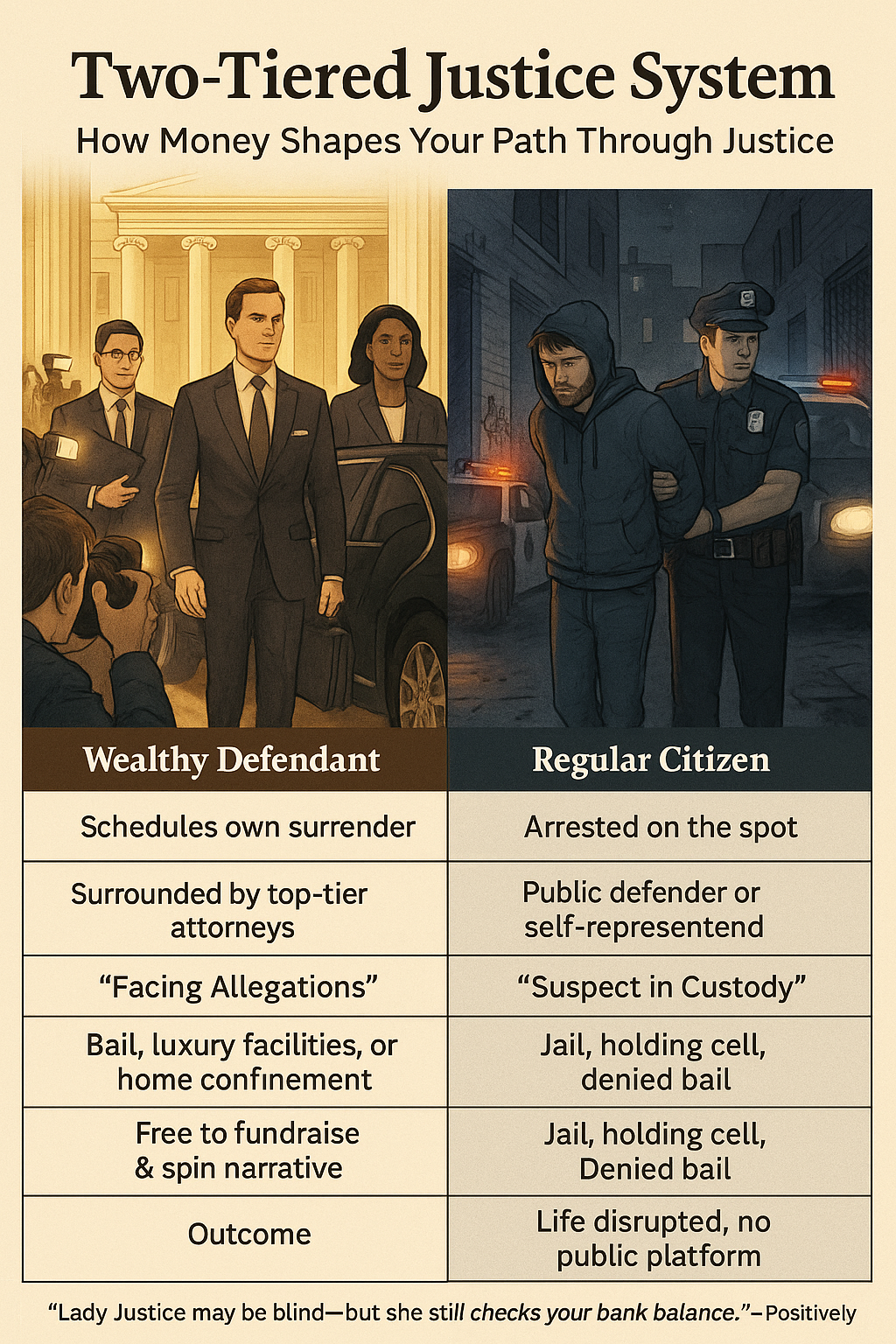
Yeah. So this this is a real, like, seemingly 2 or 3 tiered justice system, you know, in the United States and in the world, for example, you know, based on how much money you have. Well, they say Lady Justice is blind, but maybe she takes a peek at a bank account. Yeah. So, you know, it's like when, when wealthy people get accused of some kind of major crime or whatever, you know, they, they have this, like, entourage of attorneys around them.
And when it comes to them being indicted, they actually, like, turn themselves in, quote unquote. Right. It's like if you were to get a warrant for your arrest, you know, it just come take you. Yes. You know what I mean? You wouldn't be turning yourself in. But when you're wealthy, you come up with the terms of turning yourself.
Right? Right. Yeah. Like on Thursday, he'll turn himself. Thursday at 8:00. Under these circumstances, will. He'll turn himself in. Right. Right. What the fuck is that? Yeah, but it was you and I would just be like, cop, come to your house and just grab your body. Snatch. Well, I told you about the one that was out for my arrest that they ended up dropping because they had the wrong middle name and they had the wrong address and couldn't tie any charges to me.
Right. Sure. All right. Yeah. It's like heaven, Sean. I wouldn't. Well, I went and turned myself in. My ex-wife, who was my wife's inside because I was like, look, I've been out of the country. I have a passport. All these things, if they haven't got me for it yet, they're not going to get me. Oh, let's just not turn myself in.
And she was like, no, no, she rode me and she rode my meat for months on it and got me to turn myself in. What kind of wife is that? The fuck? And so I get there. It's never do that to me. She'd be like, run, right? I get there and, you know, I explained to the guy what happened and he was real apologetic.
He's like, are you sure it's you? I was like, no, I don't think I did anything. And he's like, he's like, man, I hate to do this, but I gotta put you in cuffs and the fuck? Yeah. So he puts me in the US and takes me to the back into the holding cell, and these motherfuckers in the back are doing some crazy shit.
They're fucking, like, cooking down bleach and smoking it. What the fuck? Yeah. They're, like rolling cigarettes in this bleach tar shit. What the fuck? And smoking it. And I'm just like, what the fuck? I don't have access to these things. Well, I don't know what the fuck. But they had a had a lighter and they had some bleach, and they were cooking it down into some kind of, like, brownish mixture and rolled down and smoke it.
Yeah. And I've just never heard of anything like that before in my life since I ask everyone about this. No one's ever heard of it either. Smoking bleach. And it just sounds like it'd be the worst thing ever to try. Why would you even attempt something is so, so obviously dumb. What is that, sodium hypochlorite or whatever is the chemical substance that that that couldn't possibly turn into anything, but by smoking it, I wouldn't think it would, except for maybe like some chlorine gas for your lungs.
Yeah, I can't imagine it's healthy. Convert to hydrochloric acid. Yeah. Okay, there we go. In your lungs. Yeah. So as soon as you off it in and moisture is exposed to it, it's going to be hydrochloric acid in your lungs. That's going to be awesome. But yeah I don't know what the fuck was going on. And I spent a few hours in there with those people.
Excuse Jesus. And then they had the night magistrate up. You know go ahead. And what is it. Issue a verdict on us or something? What the hell? But you have had some bizarre experiences. Yeah, half of them. I would definitely get back. Right.
But, you know, of the of the stories I've heard from people. All right. Man. So the full range of, you know, experiences I've heard people have with these different elements, you've definitely had some unique ones. I really don't understand how here, but it's great that I am.
It's almost like, you know, at that point when you're in that mode of like, how am I still here? It's almost like, I guess when you reach a certain age, you're just like, you know, fuck it, you know? Yeah. Like go for broke, because who cares? Like, what does it matter? Right. It's like I didn't. I am not even kidding.
Whatever I say, I didn't plan to live to 30, and now I'm 42. You're like the rock star that never was. Yeah.
No. That's great. The rock star never was. That's good. So we're going to hit with the trucks because we took the wrong route. But, That's okay. I want to mix it up. You know.
Mix it up a little bit. Well, we were trying to cop about. Is Trump possibly, possibly getting snatched up off of a golf course and new Jersey? Yeah, and possibly flown to DC to face some charges. Woo! Right. Yeah. We'll see if that's. If it's just a rumor. If it's legit. Sanity and credibility may be restored to the world.
Y'all.
I don't know. It's like I I'll be honest I'll be shocked if if they actually ever do indict Trump or anything, to be honest with you, I'll be shocked. Really? Yeah. Because. Why? Because he has his car friends? No. He's just gotten away with so much. His whole life. It's like, why now would he get in that, you know?
Well, maybe it'll finally come home to roost when he's 75. Maybe. What do you do? Stick em in the country club prison for the rest of his life? Dude, that's way better than him being out and being able to tweet and have have a social network. Oh, yeah. Sorry. True social. It would be true thing not tweeting. Yeah.
I'm sorry. He's truth it we he got like a quarter of $1 billion off of people for stop the steal. Oh, no, it didn't apply it to anything because there wasn't anything to apply it to. So, you know, his supporters will if he even does get arrested, he's going to get launched back out to the streets. You know, like they always do.
Because of course, you know, you and I would rot in jail, but he'll get bounced back to the street and he'll fundraise off of it. So he's got probably half a half $1 billion coming his way now. Well, you know, because they if if they did actually snatch him up. Well, I'm gonna look it this way and this might be screwed up, but this podcast is not exactly lessons screwed up.
Wow. Basically, he, a lot of his supporters may have been decimated by the Covid pandemic, which he ignored, or pandemic that he adored. That's an interesting angle. Perhaps his support is waning because a lot of the stands are dead. Yeah. Sure. Life. Herman Cain.
Turn to that guy. Yes, I do. Who also died of Covid. Yeah, he was at 9.99. Guy.
He was like into pizza. He was a pizza guy or something. Not Pizzagate, but, like pizza guy. Yeah, I know he had made a ton of money. Is that black man in business? I think if I if he was, like, selling pizza. I heard that. Which is pretty cool. That is cool. But then he got involved, and all this hollow balloon got himself killed.
Yeah. It's like there's a lot of people that have, you know, denied that the whole Covid was real and decided not to get back to the as a result and ended up dead. Yeah. On themselves. Over. They called it. Yeah. Yeah.
I'm living and so I love it. But yeah, I mean, you know, not to be cold and callous here, but kind of to me. He's not exactly been helpful or Western hostile to his constituents, to the people who swear filthy to him and pay paid for his existence. Yeah. There's literally, like, you know, many people that hold him up as literally as if he's some type of deity, as if I think the way they word it is that the Lord is working through him.
Well, the Lord is using him as a vessel. Wow. A guy who can't even quote a Bible verse. A guy who is so cold and callous as to in the midst of a riot, have his have his Capitol Police gas people so he can walk across the street for a photo op to hold up a Bible in front of a church.
Yeah. I mean, wouldn't it seem like there's some other entity working through him? I would say if there's if there's an evil counterpart to said God, then that's probably his agent. Yeah, I think that's how the story goes. There supposedly is one. Yeah. Why don't these people ever assume that perhaps it's the devil working through him as a using him as a vessel?
Oh, interesting concept Like, if you're willing to believe that there's some type of supernatural, and I got some supernatural entity using someone as a vessel. Right. You seem like maybe that would be the better pick. The more prevalent pick, because it's. He's clearly still spewing vitriol, hatred and, you know, general asinine comments. I mean, he's sitting here hating on people who have disabilities that aren't, namely that, that one reporter who's dead, hated on Josh.
How you doing, Josh blue or comedian two. Who? Yeah. There's some some kind of mocking of people with disabilities. But the, you know, preponderance of this man's life is, you know, one failed thing to have failed thing, you know? Griff the Griff to the Griff to the Griff, or whatever you call it. Right, right. I mean, the only reason he made he would have made more money if he had just infested his father's.
The all the money his father gave him. Yeah. In an index funds the 500 in the Dow. He would have made more money. So if that's true, basically, his life has been wasted. Yeah, well, he's a complete waste.
I wonder that that's an interesting case study. Like, how can you fail so much? Like, how can you fail so much and declare yourself a personal success? Well, it's just this. I guess it's just narcissistic sociopath. I guess that's what it is. Yeah. A bunch of labels you can come up with there, but, it there, there could be like a, almost a, almost like a trauma, like saying, hey, you know, I'm blocking out the idea that I was ever a failure because I can't handle it.
Yeah. It does seem like a very fragile person. Yeah. It's really it's really interesting. Could be a fascinating to see what what unfolds if, he does get indicted. Well, I mean, as far as the documents thing, someone on the inside had to report us. At us. That wouldn't. Don't increase someone's paranoia. I think it would exponentially have this idea that there's one or more moles around here.
Well, gets into all the mob shit, and he tries to this organization like it is a mob organization. He threatens he could Joel's he has his pictures. I mean, Michael Cohen, who's broken broken away as his long time picture said he would have him continually intimidate and pay people off. Well, that's another thing too, is like, why do we why do we want to listen to this guy now?
I don't want to listen to Cohen. Yeah. Why would anybody want to listen to him? I think the only reason we want to is he's, He was in his inner circle. Now he's spewing something that makes sense. Yeah. So he was this total liar, scumbag, you know? Oh, and he admits it, so. But why? Why not assume that he's still a total of liars?
Come back now. Well, he said, look, I got sent to jail because of being a total scumbag, and I got I my life is in was in shambles because I worked for a total scumbag. So I'd like to redeem myself by telling the truth. Yeah. And so we're now expected to line up and believe him. Fuck that. I don't believe a word he says.
Why would I believe anything he says? I like to believe anything he says that's anti-Trump because I'm anti-Trump. Well, it turns into my confirmation bias. It feeds into my personal narrative. Yeah, right. So I'm a huge fan of it, but I don't pace my life on what, like Cohen says. Yeah, I just I just cheer it up. Yeah.
Oh, yeah. That could just be another grift from his perspective. Good. He's out there making money. He's out there making money on his commentary. I mean, books and commentary and views on TikTok. Yeah, yeah. And that's okay with me. I'm all right with that. I figure, you know, Trump screwed him over. He deserves to make some money on his back.
So. But yeah, I don't I don't ascribe any veracity any level of to his claims I don't think. Right. There's any kind of truth to it, but I'm not happy about it. Yeah. Okay. Well yeah, I, I don't, I don't take any literal literally. I see the entire echelon of our government, you know, as, as really, you know, you've heard me say it a million times, the series of industrial complexes, you know, and these people are just click to Kratts, whether they are doing it directly or indirectly, they're still serving the same master, you know, and I don't appreciate that.
I don't think that's a solid form of government, in my opinion. It's not it's not it's it really is just a continual, I guess, to sum it up, in my opinion. Robbing Peter to pay Paul and kicking the can down the road? Sure. Yeah. It's a system on engineered to take the industrial output and funnel majority of that of the creative energy and wealth and to a certain group of individuals.
Yeah. You know, what the hell is that? But but it doesn't show up the foundations of the system. It doesn't make sure that the system will continue to operate. It doesn't give anything back to the system. It just continually robs it. Yeah. And so you have this, like the industrial output of a nation that's greater than any time ever in all of human history.
And the majority of the people can't benefit from that is just flagrantly, you know, so wrong. Yeah. I mean, not just it's not just morally wrong. It's it's it's tax wrong. It's like I don't even know it's wrong on every level you can imagine. It really is, you know, wherever, whatever everyone across the globe was pushing up the benefits of globalization when everyone was saying, you know, this global economy, these, global globally managed logistics systems, these globally managed, you know, companies will lift us all up from the muck.
We'll all be out of the mud. Right. And all the reason we weren't is because of these kleptocratic systems that run our world, not just our country. Yeah. In every country it's there's some version of the same thing. It's just to what flagrant extent. Yes. Right. And the countries that are doing the best that have the overall general population standard of living are the ones that do it the least.
Right. Like Norway takes all of their as nationalized, they're all output money and has made a retirement fund for everyone based on their own resources. And they the best they consider the natural resources or the resources of the of the nation, of the people, of the people. And they have brilliance. They're the sixth largest investor in the world.
So they're doing a lot of things right, apparently. And, you know, it's just it's just probably because they have the least amount of the kleptocracy or in their form of government. So the cryptocurrency becomes the bane of humanity across the board, right? It's it's inbuilt corruption and and the tools to hide it. Yeah. And so you know, you say okay, well maybe, perhaps this certain, segment of the population are the ones, the ones that are, you know, extremely wealthy and at the top are also the visionaries that are driving humanity forward.
And so by giving them the resources where, you know, kind of ensuring our, our future is led in the right direction as far as we're civilization goes. But but I don't think so at all. I think that these people put their pants on one leg at a time to, and are subject to all the same things that every other human is subject to the same flaws, the same, you know, personal issues.
We have to look at them on a personal level. We have to say, why is this person ultimately qualified to lead the rank and file? Why is this person. Yeah. You know what? What skills and knowledge they have, other than the fact that they've amassed a huge amount of resources on the backs of other people? Yeah. So let's take it.
Let's take this idea, like to heart here. Let's say, okay, let's say for argument's sake that we want to think like you. And I want to think that we're smart people. Let's just say, right, like, you know, to your horn, you to mine. Shawnee, I think you're really smart. You're like, Chris, I think you're really smart. I mean, yeah, that'd be easy for supposed to say.
And we do play it. Sure. Our significant others have, degrees and, you know, etc. and so forth. Sure, sure. Right. And so you would think that, like, collectively together, if we all came together and put our heads together, we could find a way to, you know, break into the 1%, if you will. Oh, yeah. Yeah. Right.
Well, why don't we like. Yeah. So. So no. Like, I'm, I'm asking that question legitimately. I don't know, I've asked the same question myself. Why am I not propelled myself to a higher echelon where I have less problems? Yeah. And I don't think it's it's more money, more problem. I think it's, No, no, I feel like it's more money, less problems.
Come pick that up. That's not bad. So that on eBay for 50 bucks. Yeah. So. But I'm asking this question in all seriousness, right. Like, I've had a lot of money flows through me in my life. Like I've made a lot of money and then passed it on to others. Right. In fact, I've made a really large amount of money comparatively to most.
But what I've done with most, with an overwhelming majority of money is that passed it on to employees, to other people, you know. Right. You you used it to keep your concerns on going to to, to keep the, the engines running. Yeah. If I, if I went to, went back and could do it all over again, I could, I could easily have turned any one of those ventures into a big cash windfall for myself.
Well, yeah, but you know, you know, I probably should have drew, but it might have involved, in the short term, giving some of those people and some of those other resources, some short shrift. It may have involved, you know, really undercutting some of the things that you did give money and resources to. Yeah. And it could be also this idea that we have a tendency to, migrate towards the things that are we're familiar with that are in our comfort zone.
Pretty much obituary. And so, being poor, I guess you can call it or not having a lot of money could just be then the safe place because you're familiar with it, you know. You know what it's like. You don't you don't know the additional burdens of handling massive amounts of money. And there are burdens. I'm not saying there aren't.
But what I'm saying is, I think those burdens would be more ultimately welcome to me than the burdens of not having it. But yeah, but so okay, so then why not pull that trigger? Because, well, because it's still an unknown. I think where I've come from on this is one partially because I never had money. I'm not exactly sure how to get it or that's part of my problem.
You may know the mechanisms for to acquire it more than I do, I imagine I.
Really my family always grew up with the main income stream of them was what can you earn with your hands? What can you earn with your workout? Yeah, you know, it wasn't start a business, start a start an organization. Start something that leverages the power of the collective. Yeah. It was what can you earn yourself? Because we, my family, thoroughly grew up as employees.
My family thoroughly grew up as cogs in the machine. We were not trained up to be independent. Okay, so you have a culture of being in that mode. And so that's really the only examples I've had. And the only thing I know. So that's the barrier you think to you having a large financial success. In that I don't see a, see the big picture of how to move through that path.
Okay. All right, all right. That I that I guess I'm trying to say I have a smaller mindset. I don't I don't see how to do it. Okay. Well, so, you know, there's this there's this really strange phenomenon that's happened in the last five, ten years. You know, this idea that you could be an online influencer, you know, actually make money through, just being a presence, you know, in the world, like on the just generating digital community, whatever creative output and putting it out there for people to consume.
Yeah, right. You know, there's, apparently a very lucrative position there. Like, there's this guy from what I, from what I know from my kids, and they. Mr. Beast. Yeah. It was just this young guy that is amassed tons of money by, I guess, making YouTube videos. Well, so he does a lot of different things. He's, he's a self-styled philanthropist in that he, he sets up situations where he gives money and resources to people.
And so it increases his popularity. Like he set up a fake banquets, like everyone who came in for a loan, he gave them the money. Okay. He set up, he set up a fake store once. The electronics store, everybody who came in got all the electronics. They weren't for free. He set up. He has. He has some joint.
He has some ventures, like, you know, those ghost kitchen things that they're doing? No. Okay, so, DoorDash has one. It's called. It's just wings. And basically at Marciano's, at Chili's, maybe other places. There's just the two I know, they have a kitchen that works out of theirs that takes orders for, in this case, it's curly fries, different wing flavors, bone in and bone and boneless.
And that's the only things they sell and drinks and these hand pies. So it's like a very small menu. But these restaurants stock this stuff they need for that and take the orders from DoorDash. So okay. So could like so he has a ghost kitchen called Mr. Beast Burger okay. That does to different chains and does that okay.
That's that's creative I guess. So is there a template that's been created by this person that anyone could just follow I don't know. So let's say that you were to do a detailed study of every, every move that he's ever made. And a lot of it's largely public. You probably could do a case study around him and then, like your goal was just to repeat it with your own flavor.
Yeah. Even success, you'd still be wildly successful, right? Right. So, like, why wouldn't someone like you do something like that? You're young enough. You have the energy for it. I don't know if he's a lot younger than we are. Well, still the model, you know, I don't think is is strictly tied to a specific age. True. But you got to have.
A youthful look I imagine does figure into it. Okay. So there's a charisma factor I would think. All right. All right I would think that rules me out. Oh come on. Got a ton of great. You got more girls.
I guess it's all about how that's defined, I guess. Yeah. I mean, usually I attract. Well, I, I get along with all the people very well. I get along with young people very well. And it's getting so that now I get along with people my own age pretty well. But it used to be I would only hit the low end and the high end of the spectrum.
That's the only people that get along well. That's interesting.
This is their anti jumper wall here. It must be. It's like this high railing.
That'd be a little hard to jump off that window. No. I guess it's the one second additional deterrent might stop you. I guess you take a little bit where you go. Yeah. There you go.
Well, so anyway, I think that maybe there's a there's a cultural barrier to these type of things. I think a lot of people like us and in our shoes have a tendency to not like there's a, there's a psychology happening kind of below the surface, which is definitely a fear of the unknown. Yeah. You know, is my, my parents and my parents before them, you know, earned a paycheck and made their ends meet that way, saved up for a retirement, had a four one K, ended up retiring and living on that plus Social Security that my family that's never been done.
Okay. Well that's like the safe the safe example if you will. Yeah. Yeah, yeah. Because my family that's never been done, no one's ever had a safe and secure retirement so far. Okay. Fair enough. Well, so, you know, perhaps the model that you have in your, in your mind that's just been bestowed on you through inheritance is the model of, you know, working your whole life.
Yep. You know, towards what end is the question, right? Yeah. Well, clearly, you know, there's there's, you know, there is opportunity. There is potential and possibility to break into that, you know, 1%. There is, you know, so if, if we're if we if we can create a model where we, like, legitimately decide, you know what, it is absolutely important for us to get into that so that we can exact what we want to do with our lives into reality.
So there we go. Right. And so then what is it going to take for us to collectively sit down and put our minds together and come up with this kind of sacrifice and effort, collective right, that take to drag us both and all of our attendant people we care about kicking and screaming into the 1%. Yeah. And, you know, I can think of one potential opportunity right now, and that's what I'm doing with Step It.
You know, that product definitely could be novelty enough to where, you know, we can get it in with lows or get it in with some big box store. Right. And you know, even if you made $5 per unit, you're you're still a million units. You can do the math. Yeah. You know, and so the question is and you take and symbol.
Right. Keep buying it. Yeah. And it's patented. It's got novelty. It's got everything that we need right. Yeah. You know there's a possibility for ancillary products supported. Yes. And so you know, why don't we go ahead and just pull that trigger once it's wrong. Yeah. You know what. What's the barrier holding it back? Well, right now I'm like in this chicken and egg scenario, right?
It's like, I know I have the money for production. Gotta have the production to have the money. Yeah, right. I'm in this chicken and egg phenomenon, and I'm a little hesitant to, like, finally pull the trigger with my friends because I don't want to let them down if case something goes wrong. So I'm trying to be too cautious.
So my my remedy to that, which is what I, where I'm going with this, like in the next couple of weeks is my remedy for that is to just offer a personal guarantee to my friends, okay? And say like, you know, here's this, like, sweetheart contract. This is excellent. This is a once in a lifetime opportunity. Plus I'm guaranteeing it personally.
See what I'm saying? Yeah. And, you know, I have assets to back it up, so. Right. Why not? Yeah. And, So that's what I'm gonna try. I'm gonna try that approach and take the fucking risk. Yeah, yeah. I mean, worst case scenario is, is, you know, 10% of what I ended up selling my house, 10% of the proceeds go back to paying back my friends.
Big deal. Right? Yeah, like, that's a small. That's a small risk to my to my overall picture. That's not too bad. You know? You know, I think the I think the product is like the right product at the right time. It's just a matter of getting this in it. Yeah. Getting that production going. We have something like 300 free orders with no advertising.
Nice. So part of the budget is going to be like, obviously big part of the budget will be going into advertising looking at 5 to $10,000 in, in a marketing campaign. Yeah. And then the rest of it going into full production of the product. So I have six different competent companies that can produce the product that I've been talking to and sending documents to.
And so okay, so for the last two months, six potential. Yeah, three are in the States, three are okay. And I guess are you waiting more towards I guess you're you're still doing a bake off right now figuring out which one. Yeah. I'm still. Yeah, I'm seeing which one will give me the best deal. Yeah. And, you know, it takes a lot of talks.
Yeah. And they want you to travel and all this kind of stuff. And I'm like, no, not so much. We could do it by zoom. Yeah, we don't meet a face to face, you know? It's just that's just more cash, right? And, you know, more words there on the environment. Right? You know, and. Oh, I was talking to you about that.
That's that's a huge issue is that you have these like big companies now that Covid is kind of wax to some extent or waned rather to something. Right. And you have all these companies now going back on all these junk junkets, all these flights, all this like rebel just chewing through resources like frizzy now, and you've got this new class of traveler to this.
The business class has been full for the last 3 or 4 I didn't build. This class has been full of the last 3 or 4 months. And it's this luxury traveler, this person who saved up all this money during the pandemic from not traveling and all that, who is just tracing around the damn world right now. Yeah, it's very interesting.
It's, it's amazing because they company will have such an emphasis on on saving money and pinching pennies here and there, you know, in various aspects of the company's interactions and dealings, but then blow an incredible amount of money on completely frivolous nonsense. Not bottom line, things really amazing, actually. And all these, like the company I work for, they they haven't opened up travel yet.
We used to have, you know, we have members of our team in spirit locations all over the world, and they used to fly them out pretty frequently. That hasn't happened for sinful for the pandemic. Yeah, because they had to tighten the belt because of regulatory fines and issues. Okay. And then you take the collective salaries of all the people that work for your company.
It's like, my God, that that.
Amazing amount of money it is. If you were to pile all that up, the actual like, total, total workforce salary commitment that that company must make must be just insanely and credible. Wow. Can't write. Writing that check every month. Must be something I can't even imagine.
I mean, it's.
Is beyond what my little mind fathoms. So you can imagine that the actual, uptake of money that these companies must be, must be able to, to, to to accomplish is absolutely insane, right? Like, somehow I don't know how, but somehow the bank is managing to pull in money from enough all these resources to pay you. You're so right, right, right.
And in part of it we've talked about is because of the way things are set up there, able to leverage, you know, a dollar a hundred times. Yeah. And so but even with that, you know, every time they pay you what this, you know, does that money just evaporate? Well, yeah. But does it come back to the bank?
I don't think so. I would imagine what I do is probably consider it a cost center from their point of view. Right? Yeah. I don't think I add to the bottom line, but. Well, you must. Right. They you must have some extent or else you wouldn't be employed. I, in theory, what I do in theory is I, secure assets and offer a platform to, basically we explore and innovate in the security space to protect us in the future.
So are these innovations that you guys coming up with, like adding to the asset class of the of the bank? Some of them get charged back internally. All right. So I'm like some dumbass middle management that doesn't know anything about it. Right. And I come in and I'm charged with deciding who to who to cleave off the payroll.
Right. And I'm tasked with that. And so I say, okay, Sean, tell me, why do you do you know, what have you done for this company today? Yeah. For jobs approach the Steve Jobs approach. Yeah. If I take your salary and benefits and edit all up. Right. And then that's a number. I slide the number across the desk and be like, tell me how you bring in this plus for the company.
So what I would say right now is I work on a very small team of five that, what we do is ransomware event simulations. We. Are working to identify and test virtual applications in each of our data centers. So, and make sure that the data can be validated by the application teams so that we can, in the event of a ransomware attack, push that data back to production.
And it's fully.
How many ransomware attacks that we had in the last six months or a year. And what we'll have to say is, instead of that, I would say security events that could have led to a ransomware attack. And I would tell folks, what are the odds of arraignment where it's striking and institution, and we have those in a PowerPoint somewhere.
I'd have to look it up. But, the powers that be had been touting this to the executives for a while, so I'd have to look up their executive slide deck for all your answers. Yeah, but, ultimately, that's the idea. They are predicated our project upon the likelihood of a ransomware attack. And we're trying to mitigate that by having controls in place, like a vault that, you know, we can test these things.
Okay. Well, so the company's standing up an awful large amount of resources, both in salary and, you know, wage and in the physical architecture, computer servers. Yeah. Infrastructure for for this protection. Yeah. You know, and in, you know, other other people in the same group as me are trying to offer other facets of protection along the same lines.
Gotcha. So, I mean, I guess that's the value add that you and your group are adding to the company. Yeah. Yes. That's the answer to the innovation, you know.
And so do you consider yourself personally a security innovator? No, I consider myself an overgrown system administrator.
I could I.
So but but your role in the team is you're essential to the overall goal of that. Yeah. I, I automate via the team right now. What I do is automate systems.
Okay. Fair enough.
So the ultimate goal of being able to create an infrastructure as a service pipeline so that we can charge back to other customers. So how safe do you think that the overall data system is for the company? I don't know, I wouldn't even be qualified to comment on this.
So you have no way of knowing or measuring your value at and or the value out of your team, right? You don't actually have any kind of knowledge or awareness of your level that we see, right? Right. That's correct. I would have to say, look, if, you know, here's a rough sketch of what I do and the value that I think it provides, but I don't have any hard numbers for you.
And, you know, I'd be able to give a soft answer to that question, but. So, yeah, so the level of protection that you're helping to offer the company is really speculative. Yes. Is there a chance that you're making it worse? Well, increasing the vulnerability. It's possible. And that's why every day I'm pushing for greater hardening. For greater,
Greater hardening of the infrastructure surrounding this project. I'm pushing for greater, redundancy surrounding it. I'm working on getting some redundancy surrounding getting in there and, and, the management of said vault and, you know, just really trying to understand things surrounding it, because, you know, hey, I imagine other companies have something similar where they're trying to mitigate the, the impact of a ransomware attack.
So let's say that you're a double agent and your objective is to see it, how much harm you cause the company. Well, just for argument's sake, how much harm do you think you could cost the company? Well, how little area of the world is pretty well enough? On my previous position where I touched a lot more applications.
Probably could have done more hard.
Like if I where I work now, it's a pretty much a.
Logically air gap situation.
So it'd be I think it'd be difficult with my skill set and knowledge to excel trade data from this.
From this, setup. What about your team? There's probably a couple of people. If he all work together. Was it probably Susan Dennis? But I think we'd all have to work together.
So assuming that wouldn't happen, the likelihood that your team is causing an actual possible net negative to the overall security company is low. Yeah. I mean, I'd say overall, well, probably increasing our security posture and probably overall, setting it up so that we do have some mitigations in place in case this terrible event, this pinnacle of bad that it.
Gotcha. So what's the worst case scenario for for the bank as far as security being British? Well, maybe from the a ransomware situation from the perspective of our team. Yeah I mean I'm in like overall to the company I would say a ransomware situation has to be up there. Okay. Because.
Our company runs on data like a lot of them do. And if we don't have access to our data and and also we aren't securing properly, the data and assets are gets worse than not only do we take a black eye on operations and be able to make money daily, we take a black eye on the public stage.
So, you know, we arm our ability to funnel additional customers and money in as well as generate the money because we don't have the data. What would be the net impact? It's the whole entire infrastructure for the bank where to get destroyed? I would say we would. I mean, you know, I've worked in another company that was an MSP where we rebuilt the infrastructure of a waste management company, do your ransomware attack.
And we managed to rebuild enough for them to continue making money within a couple of days, I imagine. Do your discoveries that you guys make in your creative efforts? Do they go to a larger collective like an FBI, some kind of clearinghouse? So for other banks and institutions to benefit from, we are a member of a number of trade organizations along those lines.
We have public organizations like FSI, Set and other financial related security organizations, and we share intelligence with them. We used to have a guy who's running our security organization that often touted direct contacts with the three letter agencies. Do you remember anything about that Apache Struts vulnerability back a few years ago? No. Okay. So.
The Java based framework that was in a lot of application. Gotcha. And, had a vulnerability, had a vulnerability. We had to test applications across the bank, but we got an early heads up and a contact.
That there was a problem. So we started before the ability was publicly issued. We started creating a test for it and tried to figure out what the exact service was do we had. So when you share the information with the clearinghouse or even the three of their agencies, better, better yet, the clearinghouse or the professional associations? Yeah, they are sharing the the data with does that and do do do you, groups that have access to that same level of information now have an insight on how to attack less robust infrastructure?
They would, if they were bad actors and somehow infiltrated these things, they would have a set of,
I mean, what often what you're going to share with someone is indicators of compromise with a share, potentially methodologies. You know, you're going to look at the miter attack framework. So you're going to say what are the what are the techniques and methods. What are the indicators that this actually happened to that you have a lot there. All right.
We're going to propagate centroids the street then. Gotcha. So it. No that's right. We're back in action. So so there is a certain level of security built into the, the, the gateway to, to gain access to the information of these collectives that you're contributing to. Yeah. Gotcha. But, you know, security is only as good as the weakest link type, you know, thing.
Sure.
Sounds to me like overall, it's, checking blocks. So if something does happen, the company can say, well, we put in all this infrastructure, protect it. No one could have predicted this particular threat. Now bail us out. Government. I mean, you know, I think when you're a bigger company to any degree, that's part of the calculation, you know, but I the pressure we're under, the number of hours we're working a week and all that.
I really think people are trying to make sure this initiative has teeth. Yeah. So you know, prevent it if you can. But then if you but then if inevitably you can't, you still have this fallback saying we we stood up the, the the best infrastructure we could to prevent it. It's not happen anyway right now. We're now we're entitled to the bailout.
It's cost. I mean, yeah, I'm sure that's all someone's calculus somewhere just makes sense.
So perhaps, perhaps one of the things we perhaps one of the things that you're actually providing indirectly is the cover story. In the event that something happens, and it really just depends on how severe that event is and how I put it happens. And if any of our security mitigations are able to take a bite up, I mean.
So how do you feel personally about being in a situation where you're not necessarily sure?
You're so scared?
But what now I like, yeah. So the idea, kind of bridging off that idea that, like, you don't have any kind of real certainty or or knowledge or measurable way to understand how effective you are, like your effort is in contributing to the overall mission. So that's been that's been my position since I have started working since I was 16.
I've never known what I was actually adding to the bottom line or what I was contributing, no matter what the job was. So. So you've always been in a situation where you've been unable to measure or have knowledge of your. Your favorite efficacy was I was a dishwasher and, you know, a person who stirred the sauce in a pan taller than me then was I have, to every single job I've had, I have wondered these things, but the most part I've had to just put them away and put my nose to the grindstone and do the job because I don't know.
Gotcha. Not a lot of personal metrics have been provided to me. Gotcha, gotcha. That's interesting. Right. Yeah. Well, it just means I am. What I mentioned as my previous family for generations have been but cogs in the machine, so am I. I'm surprised that I'm surprised that you then dealt in your own personal life, gravitate towards something very, very concrete that you can measure the results of for yourself?
Yeah. To to give yourself some, tangible, measurable, manageable goal to work towards. I mean, I have a bunch of side projects which are oddly, all the side projects I had in 2016, 2017, I'm actually using to build the stuff I'm doing at work now.
Okay, that's just feeding back into that. But yeah, you know, what I'm getting at is like something that's your own. Oh, you know, in, in your personal life where that you can put metrics to, to like chart some type of trajectory slash progress in your life. Yeah. You think that you crave that considering you don't have that through the work that you're doing?
Yeah. You think like so if you did something like, tangible, for example. Oh, like I was doing woodworking and I had goals to be able to attain certain skills in woodworking. Yeah. Or your, your, delivering packages. Yeah. You know, you could say that I delivered x number of packages, you know, on this day, that day, the next.
And so that's my measured effective efficacy. Right. So literally you're turning it screw you can you can measure how fast you turned that screw. Right. And to what measure of effectiveness. But in this kind of nebulous world of IT security. Yeah. You know, there's, there's again, really no clear cut way to know a bit better right now.
Yeah. The church on my house every Thursday has a, has a big giveaway, massive number of cars, at least 50. Wow. 200 at any given moment. Lined up around the block. So here we. Here we go again. You know, most productive, profitable society ever to exist, as far as we know of all through all civilization in this fucking breadline.
Right. Summer which she had during the pandemic, when the pandemic was raging and the kids weren't going to school, the schools were giving out, all the food they would have given out for lunch. Yeah. And so, you know, she she got would get a ball because it's like kids were at home. She had to beat them that offset it.
Yeah. That's interesting. Is like the the, the common person picking charity is really interesting phenomenon. Well, and it was like it was encouraged. It was like, so you have kids in school and you can prove their in school here. Yeah. Take it. Yeah. Yeah. And I understand like there's lots of situations where those. That's the only meal those kids might get all day right.
And I mean I'll tell you it really had this wall of bugs. She. Oh, that's just protein. Yeah, it really offset, the additional cost of having them at home because those kids eat like beast anyway. And then an additional meal you wouldn't think would be that big of a deal, but Jesus, it was. But why isn't anybody talking about kids eating like beasts?
Yeah, I mean, so why why, why aren't you or Summer telling the kids and not to eat like that? I mean, I, I did, but I mean, you know, if you have kids that, these kids have some muscle children, they need to feed muscle children, like, they have a lot of muscle. They have a lot of, you know, like their calorie requirement.
So higher than your average, you know, 12 year old, but doesn't have all kinds of muscle. Sure. They're they're just to maintain their eating a little bit more. Okay. But you know, that's contributing to like, probably a life, a lifelong, aptitude towards food and overeating. Yeah. And all the attendant things that come with it, I agree, but which is never really going to.
And just eat more in general. Sure. But, you know, they're they're teenagers who are, you know, in multiple sports. Yeah. So it's like it's hard for me to gauge really how much did they need it. So my peak ever my peak performance in sports for myself ever was when I was working out and playing sports constantly. Yeah. And simultaneously eating a very restricted diet.
What's that word? Trying to plow. You know, you weren't you were maybe burning 4 or 5000 calories a day, but you weren't necessarily feeding yourself that. Right? So I was I was focused on nourishing foods. Yeah. You know, foods that have whole foods and fiber with all the carbon if it would ever be taken a carbohydrate, taking them with fiber as well.
Type of. Right. Because I'd read some stuff and I was like, you know, working on trying to get peak fitness. Well, yeah. What can I actually accomplish in my body, you know, and the lesson to take away from me, and I think it's true for most athletes is, is proper nutrition is a massive component to overall success in a sport.
So if you're just shoveling fucking food in your mouth, just just taking in both calories and eating as, like you said, a beast. Yeah. You're actually doing your, your sports, prospecting a disservice, I'm sure. And Gavin has definitely improved his diet and he's working on it pretty good further. But you know, like now he actually eats breakfast every day and he tries to eat a breakfast is balanced.
Yeah. Fiber a fiber, intact carbohydrate two way to go. Yes. And you know it's something with that soluble fiber, you know, or insoluble fiber in me. Or poop bags. Nice. And then a trash can probably full of them.
Yeah. It's like social equivalent of an ashtray. Little secret. Yeah. Different type of butts. Yeah. So, another another thing right there is, this idea, if you can't measure it, you can't manage it. Sure. Right. So, like, if you're not measuring, if you're if you're working towards a really high performance top level in some sport, you must you have to start measuring your metrics.
Yeah. Right. And then being able to tie in the correlation of like I ate this. This was my performance. Yeah. You know this is my input output input. Yeah exactly. Input output. And you know you have to buy the input output results. You surmise you know also other things like all right. These exercises were more effective, these other things, you know, I mean yeah, a lot of different factors.
Right. But, I don't know how much they really instrument themselves. And I mean, I could.
Or how much the program or the instruments, the kids, you know, they have goals like they do weight training and conditioning. They have goals for the kids, personal goals. So personal records PR is, and so I don't know, all the different arenas they have personal records in. But, you know, it's things like squat and bench and.
Right, that's the kind of things. Yeah. I one talks about weight training. I went to I'm hockey camp several years in a row. And one of my went to was called Can Am, which was part of the part of the it was built around the the Olympics program from the out of the 80s when the US team beat the Russian team despite all the odds.
Right. For the gold medal. This famous, you know, moment in sports history for Olympics. Yeah, for the Americans, for America. Because we didn't allow professionals in the Olympics like we do now. Oh, right. And so now the professional athletes dominate the Olympics. Yeah. You know, every time there's a there's a professional and, comparable Olympic team, you know, like the dream team with the United States of basketball going there.
Crush everybody, you know. Right. Anyway, that was before that became a thing. They only had, college athletes. Okay. Playing in these Olympic Games, they they did not have professional athletes competing. Yeah. And that was like a matter of, noticeably rule, but like, I don't know, like prestige. Okay. And so the Russian team was filled with all these elite pros and, bruisers.
Right. And extremely skilled, extremely world class team up against a bunch of college students from the face. So the program that allowed those kids to be able to beat them was exported. And you guys were running it? Yes. You got it. Yep. Figured it out. You know, one thing we did as part of that performance in there is the day one we measured across all these different bowls.
Cool. How high of a mark can you put on a wall with a piece of chalk? Yeah. You know how to do that? It combines the graphic goes to how many push ups? How many sit ups? Yeah. You know what? Your endurance and these various calisthenics and aerobic things, you know, etc.. Right. And then 2 or 3 times throughout the program measuring it again.
Nice. You know, and the final result versus the initial result was substantially different. And you knew that you had gained. That's all. And a lot of the skills were directly transferable to the, to the sport, you know, so like for example, flexibility. At the time I was a goalie. So flexibility, speed, reflexes, all that kind of training and, and, metrics were essential for that role.
All right. Well, when I left the program, every one of them was, was it was height. Well, yeah. You know, and so of course then your, your performance in the score is going to actually follow, going to see the improvement. Right. Right. Because you develop the core skills. Right. There you go. So what I'm saying is in the top athlete situation you got to be paying attention to your to your, you know, x, y, z all the way across the board, you know, across the board.
And I mean, the same would go for you know what? What we're talking about, for me, personal metrics, I would need to identify core skills that would need to be developed, and I would need to put time to developing and measuring this at the same time. I need to get a baseline. Yeah. So in your domain of the IT security world, really all it could be would be like associations, organizations increasing your status and, and, and membership with those well on top of certifications in.
Yeah. And bare skills like it'd be, you know, I could set some goals like, hey, I want to there's a bunch of even if it's just something. It's so simple. As you know, the editor I use, I want to be more proficient in it so that I'm faster at solving a solving editing by hand editing issues. So I would have been more proficient in this tool, that tool for this reason.
There you go. You know. Yeah. So then like in your personal life, those things would be much more measurable than my status in an organization. Yeah. Well, you could you could still create a pooled, approach to that. Like, you know, I'm Matt, I'm the sheer quantity of the personal organizations in the field or this many members.
This many right now. Yeah, right. And then I want to increase that to this number over time to, to track the metric that way. Yeah. And then do to try to do a fair assessment of your engagement level with each one of those organizations as well, so that you're connected and engaged. Right. Not just a cart sharing member.
Right idea. You know, so I don't directly belong to anything right now. There. What's the organizations I deal with my company belongs with. Right. So you have the vicarious through the company? Yeah. So here's one for you. Why not? Have you ever considered, starting starting the proverbial fire that you could then put out and be a hero?
That's not my personality. But, yeah, I can see. I mean, I just asked if you ever thought of it. Yeah, I thought of it, but that's, I feel like that does more harm than good every time. Personal. That's my personal, dude. Well, I'm just saying, you could be the hero. You could, but you kind of turn into the anti-hero if you most likely get caught when someone does a root cause analysis.
Why did this happen? Oh, Sheldon did it on purpose. Well, you got to be smart enough not to get caught. Of course. Yeah, but I don't think that arson that then is the first responder that saves the kid. You know, in the in the in the top floor. Yeah. Goes about trying to get caught doing it, but eventually.
So it seems like people who do that kind of thing get addicted to it. Yeah, that's a good point. And it seems like people who do that kind of thing have a certain need for glory. So right now you're baseline level of measuring your effective see is that efficacy is that, you know, your company hasn't had a breach.
Yeah. So that's like and that's just a lot of the draw partially. And it's a confluence of things that are out of my control to. Do you even have any way to know that you've stopped X number of threats. I, I don't personally, but I've been involved in. So with my previous job where I handle the threat intelligence platform.
I could quantify through the teams that were my customers, how many campaign, how many say phishing campaigns they squashed? How many of this of that? How many indicators of compromise we collected, how many, how many organizations we were able to share relevant and finally information with about certain breaches, how many advanced persistent threat groups we cataloged and tracked, you know, things like that.
So there you do have some metrics then by which you can say, we've made this headway. Yeah. In diverting or otherwise stopping these, these known threats. Yeah that's exciting. It was pretty cool. So so how do you go about tooting your own horn on a daily basis for this, showcasing the threats that you first thought it or your group has thwarted?
Well, so for that, I basically gauged my effectiveness by how I was able to provide either automation or easier workflows for the people that were really the boots on the ground. But for this, I don't know. Gotcha. I mean, it's like I, I am in there and trying to I'm trying to make the isn't a really small team.
So I'm trying to let us work at scale. At this point. I think it's like, you know, we get a request, we get like one day to make ten VMs. Some of them might be it might be like three windows ones and seven Linux ones, you know, and then they have to be certain specifications display out, space and software load out.
And and then also we have to do certain resource to them, you know, basically just setting it up with some data and all that. Well, we only get a day if we're lucky and we finish some tests early maybe two days. To do this. So right now I'm just trying to make it faster us deploying them because at first it was taking us hours per VM to do it by hand.
So the whole conversation was just me learning more about your work. Yeah. And this will be one of our be roles. So don't worry about the traffic and the conversation for today. I was just never had the chance to have the conversation with you. Out of my own curiosity about what I do, about the entrance of what you do.
Yeah. And I'm glad I know now more. It's a it's a very ruminating.